
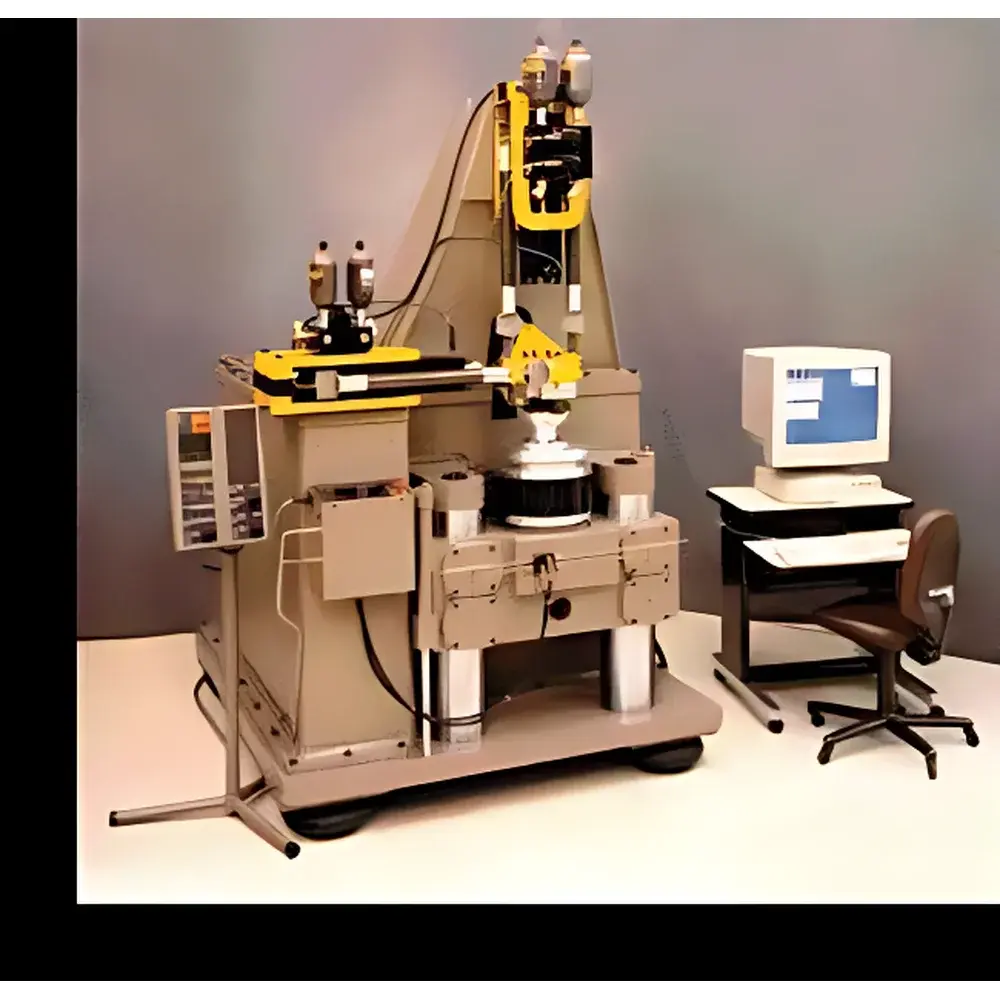
MTS 831.xx / 833 Elastomer Test System
| Origin | USA |
|---|---|
| Manufacturer Type | Authorized Distributor |
| Origin Category | Imported |
| Model | 831.10 / 831.20 / 831.50 / 833 |
| Pricing | Available Upon Request |
Overview
The MTS 831.xx and 833 Elastomer Test Systems are high-performance electrodynamic fatigue testing platforms engineered specifically for the dynamic mechanical characterization of rubber compounds, bushings, mounts, isolators, and other viscoelastic components used in automotive, aerospace, and industrial applications. These systems operate on the principle of controlled sinusoidal or arbitrary waveform excitation, applying precisely regulated axial, torsional, or combined multi-axial loads to specimens under programmable displacement, force, or acceleration control. Unlike general-purpose servo-hydraulic or low-frequency electromechanical testers, the 831 series integrates optimized mechanical architecture—including hollow vertical columns, low-mass rigid crossheads, and integrated load cell mounting—to minimize structural resonance and maximize phase fidelity across its operational bandwidth. The 833 system extends this capability with triaxial actuation and real-time road-load replication functionality, enabling laboratory-based simulation of field service conditions per ISO 4587, SAE J2233, and ASTM D4482 standards.
Key Features
- Three-tier frequency performance: 831.10 (DC–100 Hz), 831.20 (0.01–400 Hz), and 831.50 (0.01–1000 Hz) models—each calibrated to maintain ≤±0.5% amplitude linearity and ≤±1.5° phase lag within rated bandwidth
- Integrated load cell mounted recessed within the crosshead to reduce moment arm effects and improve force measurement stability
- Hollow-column design with tuned mass damping reduces parasitic resonances; structural natural frequency exceeds 1.2× maximum test frequency for all models
- Modular environmental chamber compatibility (−70°C to +250°C, humidity-controlled options available) supports ISO 188 and ASTM D1329 aging protocols
- Triaxial 833 configuration features three synchronized linear actuators with independent closed-loop control, supporting complex loading paths per ISO 10823 and SAE J2570
Sample Compatibility & Compliance
The MTS 831/833 systems accommodate standard elastomer test geometries including dumbbell tensile specimens (ASTM D412), compression set cylinders (ASTM D395), shear blocks (ASTM D5992), and full-component isolators (SAE J1506). Fixture adaptability includes custom-designed grips, shear plates, and spherical seating interfaces to ensure uniform stress distribution and eliminate edge effects. All configurations comply with GLP documentation requirements and support audit-ready test execution under FDA 21 CFR Part 11 when paired with MTS TestSuite™ software. Mechanical safety interlocks, emergency stop redundancy, and overload protection meet CE Machinery Directive 2006/42/EC and ANSI B11.19 standards.
Software & Data Management
Control and analysis are performed using MTS TestSuite™ software, a validated platform supporting method-driven test sequencing, real-time FFT spectral monitoring, and automated pass/fail evaluation against user-defined thresholds. The system logs raw analog sensor data at up to 100 kHz sampling rate with time-synchronized metadata (temperature, humidity, actuator position, force, acceleration). RPC Pro (Remote Parameter Control) enables import of road-load files from MTS RoadSim™ or third-party acquisition systems (e.g., Dewesoft, HBM Catman), converting time-history data into executable waveforms with harmonic distortion <0.3% THD. Audit trails, electronic signatures, and export to CSV, HDF5, or Universal File Format (UFF) ensure traceability for ISO/IEC 17025-accredited laboratories.
Applications
- Dynamic stiffness and loss factor (tan δ) mapping across temperature and frequency sweeps per ISO 4664-2
- Cyclic fatigue life assessment of engine mounts under variable amplitude loading (VAM)
- Creep-recovery and stress relaxation behavior under sustained dynamic preload
- Multi-axial durability validation of suspension bushings subjected to coupled lateral–vertical–torsional inputs
- Material model parameter identification for finite element analysis (FEA) of nonlinear hyperelastic and fractional derivative constitutive models
FAQ
What is the difference between the 831.20 and 831.50 models?
The 831.20 is rated for operation up to 400 Hz with optimized cost-performance balance for routine elastomer qualification, while the 831.50 extends the upper frequency limit to 1000 Hz and incorporates enhanced modal isolation for high-fidelity transient response testing.
Can the 833 system replicate real-world road profiles?
Yes—when integrated with MTS RPC Pro software and validated road-load data, the 833 executes synchronized three-axis motion profiles with sub-millisecond timing resolution and position repeatability of ±1.5 µm.
Is environmental testing supported?
All models accept bolt-on thermal chambers with independent PID control; optional humidity and corrosive atmosphere modules are available for accelerated aging studies compliant with ASTM D573 and ISO 1431.
Does the system support automated compliance reporting?
TestSuite™ includes configurable report templates aligned with ISO 17025 clause 7.8 and ASTM E2917, generating PDF/HTML outputs with embedded calibration certificates, uncertainty budgets, and raw dataset references.
What maintenance intervals are recommended?
Preventive maintenance is scheduled every 2,000 operational hours or annually—whichever occurs first—with documented inspection of bearing preload, actuator coil resistance, and sensor zero drift per MTS Service Bulletin SB-831-04.



