
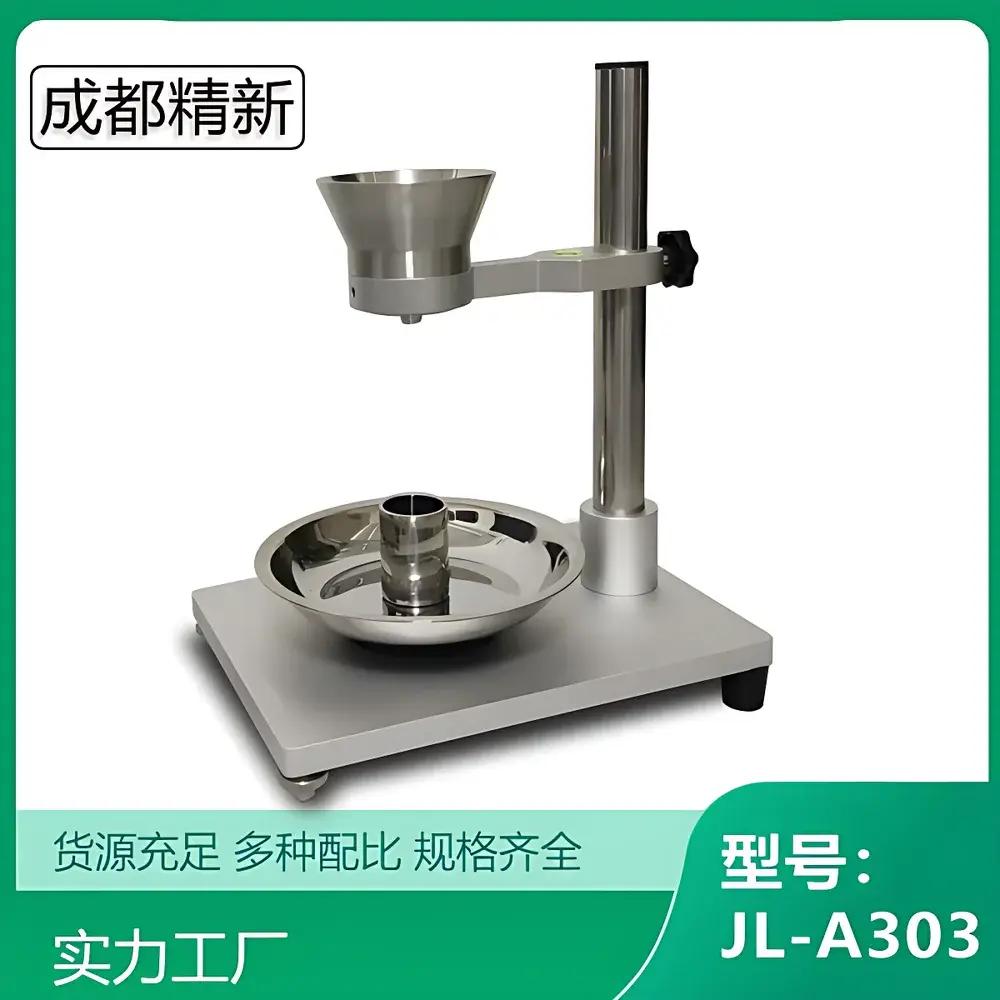
English Product Name
| Brand | Chengdu Jingxin (CDJX) |
|---|---|
| Origin | Sichuan, China |
| Manufacturer Type | Direct Manufacturer |
| Instrument Category | Bulk Density & Flow Tester |
| Instrument Type | Portable |
| Measurement Type | Solid Powder |
| Application | Metal powder flowability and apparent density testing |
| Standards Compliance | GB/T 1482–2010 (Hall Flow), GB/T 1479.1–2011 (Apparent Density) |
| Funnel Orifice Diameters | 2.5 mm and 5.0 mm |
| Funnel Cone Angle | 60° |
| Funnel-to-Cylinder Distance | 25 mm ± 2 mm (adjustable) |
| Cylinder Volume | 25 mL (stainless steel 304) |
| Scraper Blade | Stainless steel, 25 mm wide |
| Stopper Rod | Stainless steel 304 |
| Dimensions | Approx. 230 × 170 × 300 mm |
| Weight | 3.7 kg |
| Timer Resolution | 0.01 s |
Overview
The Chengdu Jingxin JL-A303 Hall Flowmeter and Apparent Density Tester is a precision-engineered benchtop instrument designed for standardized measurement of two critical physical properties of free-flowing metal powders: flow rate (in seconds per 50 g) and apparent (bulk) density (in g/mL). It operates on the principles defined in internationally referenced national standards—specifically GB/T 1482–2010 for Hall flow determination and GB/T 1479.1–2011 for apparent density evaluation using the funnel method. The device implements a gravity-driven, orifice-controlled discharge mechanism: powder flows under its own weight through a precisely dimensioned stainless steel funnel into either a timing vessel (for flow time) or a calibrated 25 mL cylinder (for bulk density). Its mechanical simplicity, material integrity, and dimensional repeatability ensure high inter-laboratory reproducibility—essential for QC workflows in powder metallurgy, additive manufacturing feedstock qualification, and battery cathode/anode material development.
Key Features
- Stainless steel 304 construction throughout—including funnel, stopper rod, scraper blade, and optional 25 mL measuring cylinder—ensuring corrosion resistance, non-reactivity with metallic powders, and long-term dimensional stability.
- Dual-orifice funnel with interchangeable 2.5 mm and 5.0 mm discharge apertures, enabling compliance with both standard test configurations specified in GB/T 1482–2010.
- Precision-machined 60° conical funnel geometry and mirror-finished internal surface to minimize wall adhesion and promote laminar, consistent powder discharge.
- Adjustable vertical alignment system allowing precise, repeatable positioning of the funnel outlet at 25 mm ± 2 mm above the top rim of the receiving cylinder—a critical parameter for both flow and density determinations.
- Integrated modular base frame with rigid support bracket and removable powder collection tray, facilitating rapid setup, cleaning, and cross-contamination prevention between samples.
- Designed for seamless integration with external laboratory equipment: requires only a 0.02 g resolution balance (up to 1 kg capacity) and a 0.01 s resolution digital timer—both commonly available in ISO/IEC 17025-accredited labs.
Sample Compatibility & Compliance
The JL-A303 is validated for use with free-flowing metallic powders—including iron, aluminum, titanium, nickel, and stainless steel alloys—that pass unimpeded through either the 2.5 mm or 5.0 mm orifice. It is not intended for cohesive, hygroscopic, or agglomerated powders without prior conditioning (e.g., drying, deaeration). All mechanical dimensions, tolerances, and procedural steps conform strictly to GB/T 1482–2010 and GB/T 1479.1–2011, which are harmonized with ASTM B213 (Standard Test Methods for Flow Rate of Metal Powders Using the Hall Flowmeter) and ISO 4490:2018 (Metallic powders — Determination of flow rate using the Hall flowmeter). While not certified to GLP or GMP by default, the instrument’s design supports full traceability when used within documented SOPs—including manual recording of raw time/mass values, operator identification, environmental conditions (temperature/humidity), and calibration logs for ancillary devices (balance, timer).
Software & Data Management
The JL-A303 is a fully manual, hardware-only instrument with no embedded electronics or proprietary software. This architecture eliminates firmware dependencies, cybersecurity risks, and obsolescence concerns common in digitally integrated testers. All measurements are recorded manually in laboratory notebooks or LIMS-compatible spreadsheets. Users may implement digital data capture via external tools—for example, integrating stopwatch timestamps and balance readings into Excel templates that auto-calculate flow rate (g/s) and apparent density (g/mL), apply statistical filtering (e.g., outlier removal per ISO 5725), and generate audit-ready PDF reports. For regulated environments requiring electronic records, the device is compatible with 21 CFR Part 11-compliant systems when paired with validated third-party data acquisition modules (e.g., USB-connected timers with timestamped CSV export and balance interfaces with RS-232 output).
Applications
This tester serves as a foundational tool across multiple industrial and research domains where powder handling performance dictates downstream process success. In powder metallurgy, it supports incoming raw material inspection and lot-to-lot consistency verification prior to die compaction. Within additive manufacturing, it provides preliminary screening of spherical metal powders for laser powder bed fusion (LPBF) and electron beam melting (EBM) processes—where poor flow leads to uneven recoating and porosity. Battery manufacturers rely on it for evaluating cathode (e.g., NMC, LFP) and anode (e.g., graphite, silicon composite) powders during slurry formulation, since apparent density correlates strongly with electrode coating uniformity and volumetric energy density. Academic and government labs use the JL-A303 for fundamental studies on particle size distribution effects, surface modification efficacy, and humidity-induced flow degradation—often as a reference method alongside more advanced techniques such as shear cell analysis or dynamic powder rheometry.
FAQ
What standards does the JL-A303 comply with?
It is engineered to meet the dimensional, procedural, and reporting requirements of GB/T 1482–2010 (metal powder flow rate) and GB/T 1479.1–2011 (apparent density), which align closely with ASTM B213 and ISO 4490.
Is calibration required for the instrument itself?
No intrinsic calibration is needed—the funnel orifice diameter, cone angle, and height offset are fixed mechanical features verified during manufacturing. However, the external balance and timer must be regularly calibrated per ISO/IEC 17025 or internal QA protocols.
Can it be used for non-metallic powders?
Yes, provided the material exhibits free-flow behavior and passes through the 2.5 mm or 5.0 mm orifice without bridging or channeling—commonly applicable to certain ceramic, pharmaceutical excipient, or food-grade powders.
What maintenance is recommended?
Wipe all stainless steel surfaces with ethanol or isopropanol after each use; inspect funnel orifice for burrs or debris using a 10× magnifier; store in low-humidity environment to prevent passive oxide buildup on internal funnel walls.
Does the kit include a balance or timer?
No—these are user-supplied components. A balance with ≥0.02 g readability and ≤1 kg capacity, plus a timer with ≥0.01 s resolution, are mandatory for compliant operation.



