
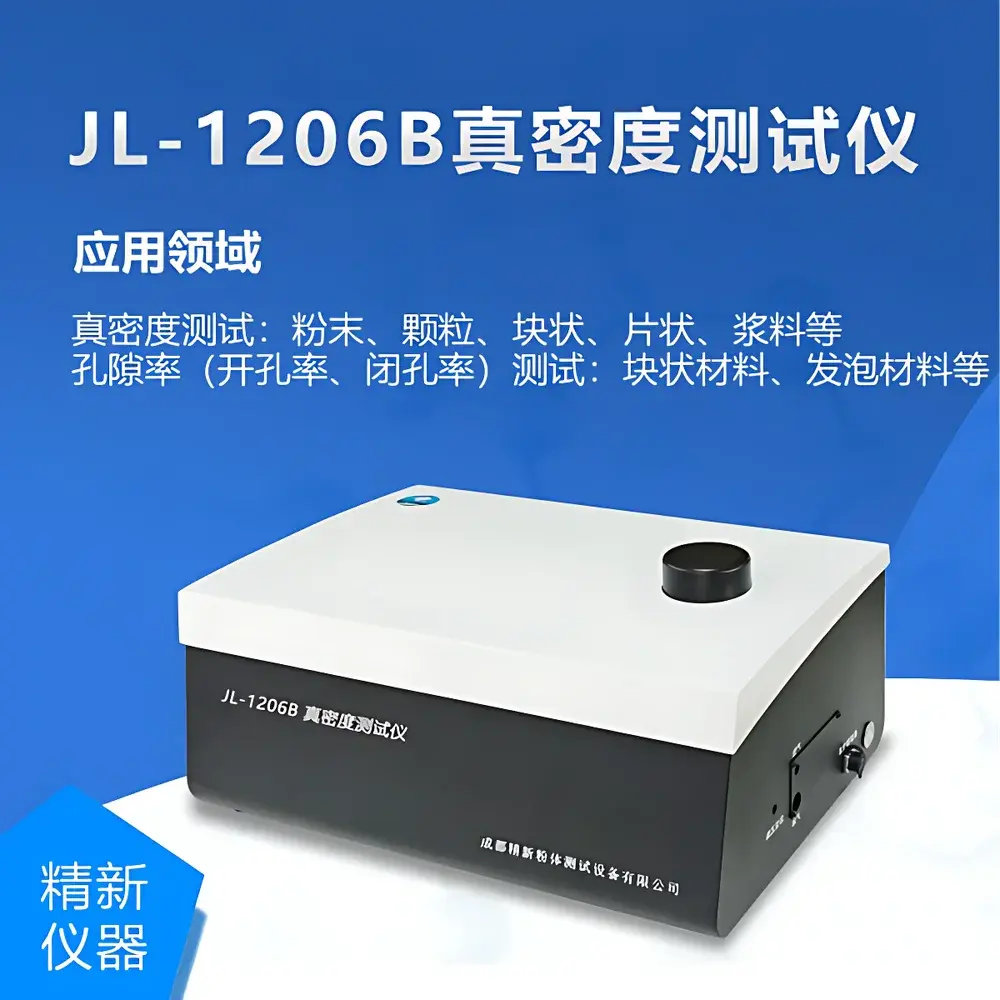
Chengdu Jingxin JL-1206B True Density and Porosity Analyzer
| Brand | Chengdu Jingxin (CDJX) |
|---|---|
| Origin | Sichuan, China |
| Manufacturer Type | Direct Manufacturer |
| Origin Category | Domestic |
| Model | JL-1206B |
| Instrument Type | True Density Analyzer |
| Form Factor | Benchtop (Not Portable — corrected per technical specification: 14 kg, fixed installation required) |
| Sample Type | Solid powders, granules, bulk solids, foams, filters, slurries |
| Measurement Principle | Gas Pycnometry (Nitrogen or Helium Displacement, ISO 12154:2014 compliant) |
| Analysis Stations | 1 |
| Standard Chamber Volume | 100 mL |
| Optional Sample Cups | 10 mL, 30 mL, 60 mL |
| Volume Range | 0.01–100 cm³ |
| Density Resolution | 0.00001 g/cm³ |
| Accuracy | ±0.01% (relative) |
| Temperature Range | 5–35 °C |
| Operating Pressure | Absolute pressure mode, 0–130 kPa |
| Test Gas | 99.99% N₂ or He (user-supplied) |
| Calibration Standard | Certified stainless-steel sphere |
| Data Interface | RS232 or USB |
| Software Platform | Windows 7 or later |
| Power Supply | AC 220 V ±22 V, 50 Hz |
| Power Consumption | <200 W (vacuum mode), <50 W (positive-pressure mode) |
| Dimensions | 485 × 350 × 220 mm (L×W×H) |
| Weight | 14 kg |
| Compliance | GB/T 24586–2009, ISO 12154:2014, ASTM D5550–22 |
Overview
The Chengdu Jingxin JL-1206B True Density and Porosity Analyzer is a benchtop gas pycnometer engineered for high-precision determination of true density and open/closed porosity in solid materials. It operates on the fundamental principle of gas displacement pycnometry—based on the ideal gas law—and conforms to internationally recognized standards including ISO 12154:2014 (Determination of true density by gas pycnometry) and ASTM D5550–22 (Standard Test Method for True Density of Calcined Petroleum Coke). Unlike hydrostatic (Archimedean) methods, which are susceptible to liquid intrusion, surface tension effects, and sample dissolution, this instrument uses inert gases—typically nitrogen or helium—to measure the intraparticle volume of solids without physical contact or chemical interaction. The system employs dual-chamber pressure equilibration: a known reference volume is connected to a sample chamber of variable geometry; pressure transients during gas expansion are captured with high-resolution digital sensors and processed in real time to compute sample skeletal volume. True density is then derived as mass divided by measured volume. For porous materials, the analyzer further calculates total porosity, open porosity (accessible to gas), and closed porosity (isolated voids), provided apparent volume is supplied externally (e.g., via caliper measurement or mercury intrusion porosimetry).
Key Features
- Single-station automated analysis platform with integrated vacuum pump, solenoid valves, pressure sensors, and thermal stabilization architecture.
- Modular sample chamber design: fixed 100 mL base chamber plus interchangeable sample cups (10 mL, 30 mL, 60 mL) to optimize gas volume ratio and minimize dead space across diverse sample geometries and masses.
- True absolute-pressure control: full vacuum evacuation prior to gas introduction ensures complete removal of adsorbed ambient gases—critical for reactive, high-surface-area, or microporous materials (e.g., activated carbons, MOFs, catalyst supports).
- Intelligent pressure ramping and venting algorithm prevents mechanical stress on fragile or compressible samples (e.g., polymer foams, aerogels) by allowing user-defined relative pressure setpoints (5–90% of full scale).
- Self-diagnostic gas circuit: automatic leak detection, valve actuation verification, and pressure decay monitoring before each run ensure measurement integrity and reduce operator dependency.
- High-fidelity data acquisition: 24-bit pressure transducers coupled with microsecond-level sampling resolution enable accurate capture of transient equilibration curves, directly contributing to repeatability better than ±0.01% RSD.
- Factory-calibrated with traceable stainless-steel reference spheres; calibration verification routine embedded in software workflow.
Sample Compatibility & Compliance
The JL-1206B accommodates a broad spectrum of solid-phase materials, including but not limited to metal and ceramic powders, pharmaceutical excipients, battery electrode materials, geological aggregates, filtration media, polymeric foams, and cementitious composites. Slurries and pastes may be analyzed after controlled drying or under inert atmosphere to prevent volatilization artifacts. The instrument complies with GB/T 24586–2009 (Chinese national standard for true density and porosity), ISO 12154:2014, and ASTM D5550–22. Its operational design supports GLP-aligned workflows: all test parameters, raw pressure traces, intermediate calculations, and final results are timestamped and stored with immutable audit trails. While not inherently 21 CFR Part 11 compliant, the software architecture permits integration with validated electronic lab notebook (ELN) systems through standardized export formats (PDF, Excel, TXT) and metadata-rich CSV outputs.
Software & Data Management
The proprietary Windows-based control software provides end-to-end automation—from hardware initialization and leak check to final report generation. Users follow a guided sequence: sample mass entry, cup selection, vacuum hold duration, gas fill pressure, and equilibration timeout. All hardware actions (pump activation, valve switching, sensor polling) occur synchronously under deterministic timing. Real-time pressure curves are visualized during acquisition, enabling immediate identification of anomalies (e.g., incomplete evacuation, slow equilibration). Post-run, the software computes true density, apparent density (if input), total porosity, open porosity, and closed porosity using configurable formulas. Data sets support batch processing, statistical summary (mean, SD, CV%), outlier detection, and comparative trend analysis. Export options include PDF reports with header metadata (operator ID, instrument SN, calibration date), Excel-compatible .xlsx files with raw sensor data, and plain-text .txt logs suitable for LIMS ingestion.
Applications
This analyzer serves critical quality control and R&D functions across multiple sectors. In advanced materials development, it quantifies densification efficiency in sintered ceramics and monitors pore structure evolution during thermal treatment of battery anodes. In pharmaceutical manufacturing, it verifies batch-to-batch consistency of active pharmaceutical ingredient (API) crystallinity and excipient compaction behavior. In construction materials science, it characterizes air entrainment in concrete admixtures and evaluates pore interconnectivity in lightweight aggregates. In environmental engineering, it assesses specific surface area proxies for sorbent media and validates pore closure in encapsulated remediation agents. The ability to decouple open and closed porosity makes it particularly valuable for predicting permeability, diffusion-limited reaction kinetics, and mechanical resilience under cyclic loading.
FAQ
What gases are compatible with the JL-1206B?
Nitrogen (99.99% purity) is standard; helium may be substituted for low-density or ultra-microporous samples where enhanced gas diffusivity improves measurement fidelity.
Is sample preparation required before testing?
Yes—samples must be dry and free of volatile contaminants. Thermal drying (oven or vacuum desiccator) is recommended for hygroscopic or solvent-wet materials; degassing time and temperature should be documented for method reproducibility.
Can the instrument measure liquids or films?
No—it is strictly designed for solid-phase materials with defined skeletal volume. Liquids, gels, or unsupported thin films are outside its validated scope.
How is calibration verified?
A certified stainless-steel calibration sphere is included. Users perform routine verification runs; deviations beyond ±0.005 g/cm³ from the certified value trigger recalibration or service review.
Does the system support multi-user access control or electronic signatures?
The base software does not implement role-based permissions or digital signature capture, but all data exports contain embedded timestamps and operator identifiers for external validation within regulated environments.



