
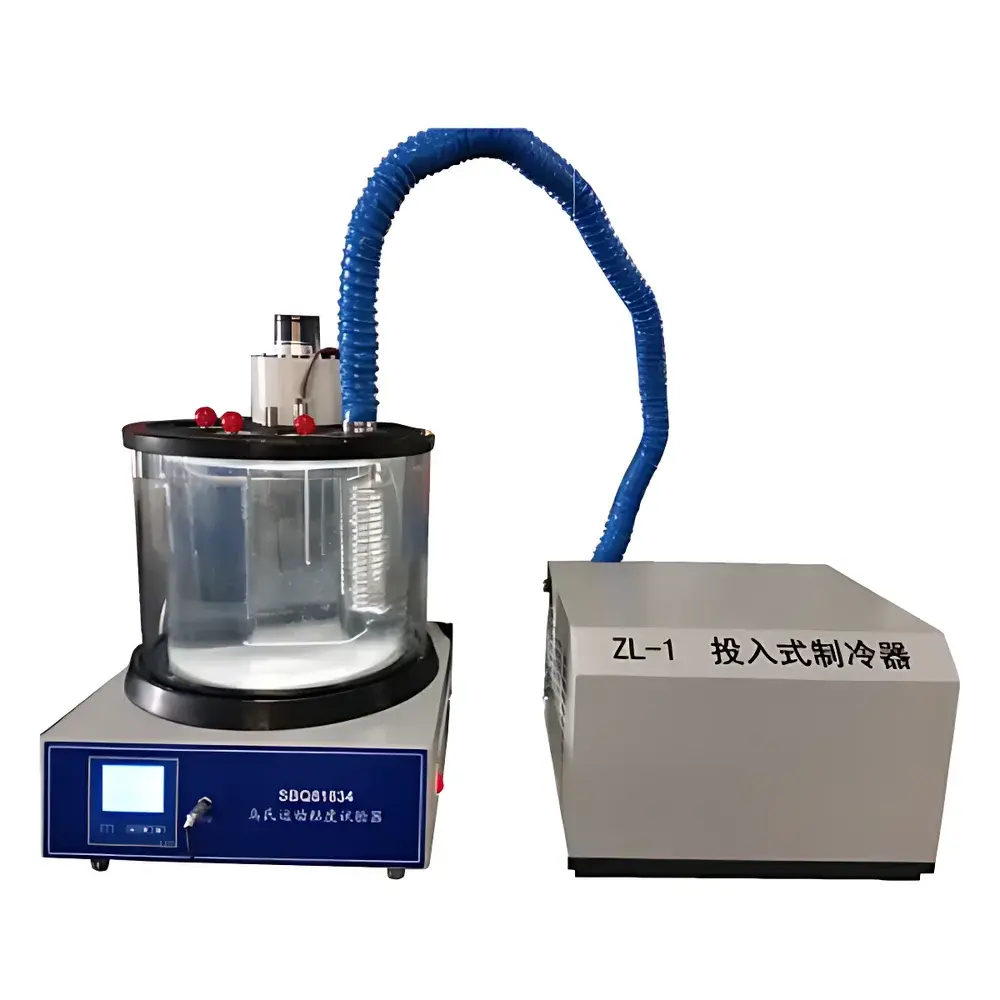
Qigao HSY-14190 PET Fiber-Grade Intrinsic Viscosity Tester (Ubbelohde Capillary Viscometer System)
| Brand | Qigao Instruments (SHQIGAO) |
|---|---|
| Origin | Shanghai, China |
| Manufacturer Type | OEM/ODM Producer |
| Country of Origin | China |
| Model | HSY-14190 |
| Price Range | USD 420 – 4,200 (FOB Shanghai) |
| Compliance | GB/T 14190–2017 |
| Measurement Principle | Ubbelohde capillary viscometry in dilute solution |
| Temperature Control Range | Ambient to 100 °C |
| Accuracy | ±0.1 °C |
| Bath Capacity | 20 L dual-cylinder constant-temperature bath (300 × 300 mm inner cylinder, 4-port configuration) |
| Capillary ID | 0.88 mm |
| Power Supply | AC 220 V ±10%, 50 Hz ±5% |
| Total Power Consumption | ≤1800 W |
| Dimensions (Main Unit) | 430 × 500 × 660 mm (L×W×H) |
| Refrigerator Unit (Optional) | 430 × 430 × 300 mm |
| Net Weight | 50 kg |
Overview
The Qigao HSY-14190 Intrinsic Viscosity Tester is a dedicated benchtop instrument engineered for the precise determination of intrinsic viscosity ([η]) of fiber-grade polyethylene terephthalate (PET) chips in accordance with GB/T 14190–2017, the People’s Republic of China national standard for testing methods of PET chips used in synthetic fiber production. The system implements the classical Ubbelohde capillary viscometry method under controlled dilute solution conditions—typically using phenol/1,1,2,2-tetrachloroethane (60/40 v/v) as solvent at 25 °C or 30 °C. Intrinsic viscosity serves as a critical molecular weight indicator directly correlated to polymer chain length and melt processability; deviations beyond specification thresholds can lead to spinnability issues, filament breakage, or inconsistent dye uptake in downstream texturing and weaving operations. Unlike generic kinematic viscosity testers, the HSY-14190 integrates a purpose-built dual-cylinder thermostatic bath, precision Pt100 temperature sensing, and synchronized timing logic calibrated for sequential efflux measurements of both solvent blank and sample solution—enabling calculation of reduced, inherent, and intrinsic viscosities per the Huggins and Kraemer linear extrapolation protocols.
Key Features
- Dual-cylinder 20 L constant-temperature bath with four parallel Ubbelohde capillary ports—optimized for batch testing of up to four samples or replicate runs per cycle;
- High-stability digital temperature control system with ±0.1 °C accuracy across 25–100 °C range, utilizing industrial-grade Pt100 RTD sensors and adaptive PID regulation;
- Integrated A/D conversion module with 0.01 s time resolution for efflux timing, supporting manual line-controlled start/stop via ergonomic external keypad;
- Backlit LCD interface with Chinese-language menu navigation—designed for operator familiarity in regional QC laboratories without requiring English fluency;
- Modular thermal architecture: independent 1000 W + 650 W heating stages and 6 W/1200 rpm magnetic stirrer ensure uniform thermal distribution and minimal convection-induced flow disturbance;
- Compliance-ready mechanical design: stainless steel inner bath, sealed electrical compartments, and non-corrosive fluid pathways compatible with halogenated solvents;
- Compact footprint (430 × 500 × 660 mm) suitable for ISO 17025-accredited lab benches with limited floor space.
Sample Compatibility & Compliance
The HSY-14190 is validated exclusively for fiber-grade PET chip analysis per GB/T 14190–2017, which specifies dissolution protocols, concentration ranges (typically 0.5–0.6 g/dL), capillary dimensions (0.88 mm nominal ID), and data reduction methodology. While not certified to ASTM D4603 or ISO 1628-5, its operational parameters align closely with those standards’ requirements for intrinsic viscosity determination of aromatic polyesters. The system supports solvent systems commonly employed in PET quality control—including phenol/tetrachloroethane mixtures—and accommodates standard Ubbelohde viscometers conforming to ISO 3105 geometry tolerances. For regulated environments, the instrument’s deterministic timing logic, fixed-temperature stability, and traceable calibration path (via NIST-traceable thermometer and stopwatch) support GLP documentation and internal audit readiness. Optional refrigerated bath add-ons extend low-temperature operation down to 15 °C for specialty applications requiring enhanced solution stability.
Software & Data Management
The HSY-14190 operates as a standalone hardware platform with embedded firmware—no PC dependency or proprietary software installation required. All calculations (reduced viscosity ηred, inherent viscosity ηinh, intrinsic viscosity [η] via Huggins plot slope extrapolation to zero concentration) are performed internally and displayed in real time on the LCD screen. Results are stored in non-volatile memory for up to 100 test records, each including date/time stamp, bath temperature, efflux times (t0, t), and final [η] value. Data export is supported via RS-232 serial interface (optional USB-to-serial adapter) for integration into LIMS or Excel-based reporting workflows. While the system does not feature FDA 21 CFR Part 11-compliant electronic signatures or audit trails, its deterministic measurement sequence and immutable parameter set (fixed capillary ID, fixed temperature setpoint, fixed concentration input) satisfy basic ALCOA+ data integrity principles for routine QC use in non-GMP manufacturing settings.
Applications
- Final quality release testing of PET polymer chips prior to melt spinning;
- In-process monitoring during solid-state polymerization (SSP) to track molecular weight build-up;
- Supplier qualification and incoming raw material verification against contractual [η] specifications (e.g., 0.62–0.68 dL/g);
- Root cause analysis of fiber defects linked to molecular weight distribution shifts;
- Method transfer validation between production labs and R&D centers operating under GB/T 14190–2017;
- Supporting ISO 9001:2015 clause 8.5.1 (control of production and service provision) through documented, repeatable viscosity assessment.
FAQ
Does the HSY-14190 comply with ASTM D4603 or ISO 1628-5?
No—the instrument is designed and verified specifically for GB/T 14190–2017. However, its temperature stability, capillary geometry, and timing resolution meet the minimum technical requirements outlined in those international standards.
Can it be used for other polymers such as PA6 or PC?
Not without method validation. While the physical platform supports capillary viscometry, solvent compatibility, dissolution kinetics, and extrapolation models differ significantly across polymer families. Use for non-PET materials requires full revalidation per ISO/IEC 17025 Clause 7.2.2.
Is a refrigeration unit included in the base configuration?
No—the optional refrigerator unit (430 × 430 × 300 mm) is sold separately and required only for sub-ambient testing scenarios.
What maintenance is required for long-term accuracy?
Annual verification of Pt100 sensor calibration against a reference thermometer and periodic cleaning of capillary tubes with appropriate solvent rinses are recommended. No user-serviceable moving parts exist beyond the magnetic stirrer coupling.
How is traceability ensured for regulatory audits?
Each unit ships with a factory calibration certificate referencing traceable temperature and timing standards. Users must maintain logs of bath temperature verifications and capillary ID verification using optical micrometers per GB/T 14190–2017 Annex B.





