
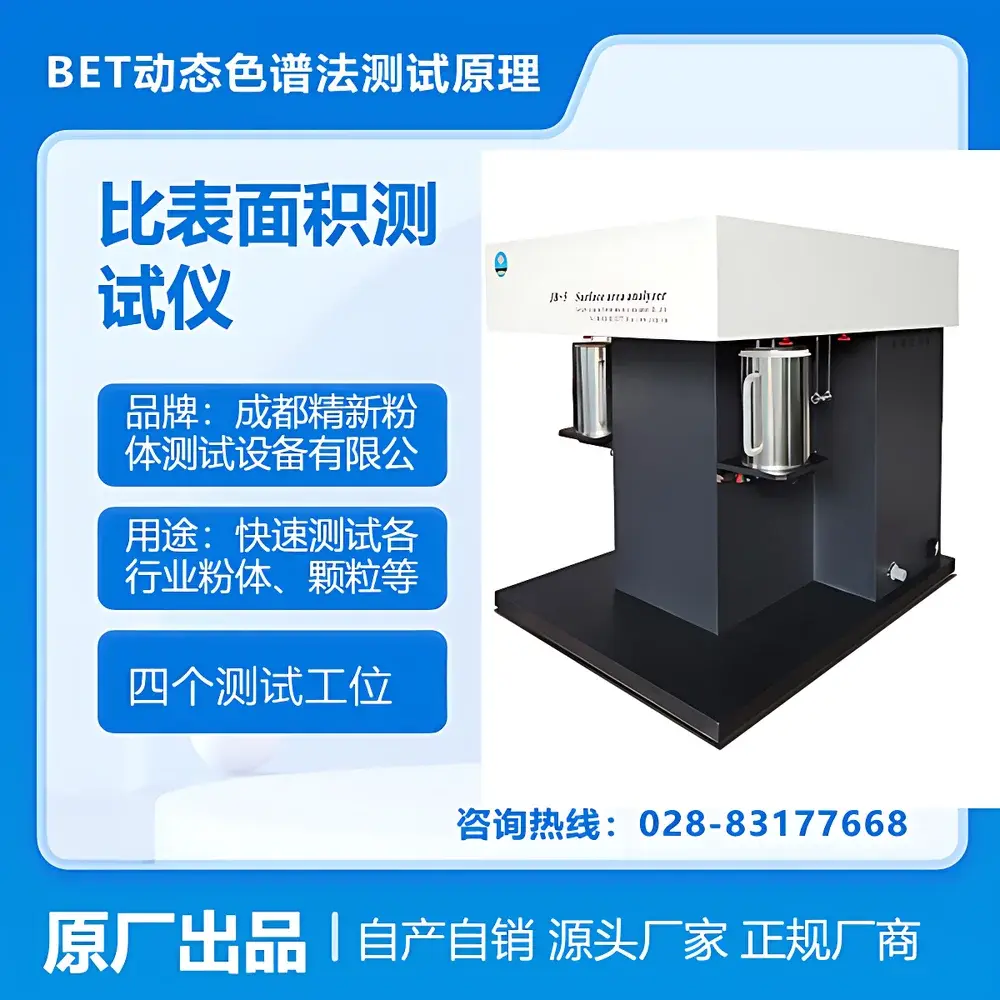
Chengdu Jingxin JB-50 Four-Station Dynamic Flow BET Surface Area Analyzer
| Brand | Chengdu Jingxin (CDJX) |
|---|---|
| Origin | Sichuan, China |
| Manufacturer Type | Direct Manufacturer |
| Regional Category | Domestic (China) |
| Model | JB-50 |
| Instrument Type | Specific Surface Area Analyzer |
| Measurement Principle | Dynamic Flow (Carrier Gas Chromatographic) Method |
| Measurement Range | 0.0005 m²/g to unlimited |
| Theoretical Basis | Gas Adsorption BET Theory with Gaseous Chromatography Detection |
| Repeatability | >99% |
| Standards Compliance | ISO 9277, GB/T 19587–2017 |
| Sample Throughput | 4 independent stations |
| Analysis Time per Sample | 5–7 minutes |
| Calibration | Certified Reference Materials (e.g., NIST-traceable SiO₂ or α-Al₂O₃) |
| Detector | Low-Temperature High-Sensitivity Thermal Conductivity Detector (TCD) |
| Carrier Gas | Ultra-High-Purity Helium (≥99.999%) |
| Adsorbate | Ultra-High-Purity Nitrogen (≥99.999%) |
| Sample Tube | U-shaped GG-glass (borosilicate), high-temp resistant |
| Cryogenic System | 500 mL Dewar flask with vacuum-insulated double-wall glass |
| Flow Control | Precision Mass Flow Regulators & Pressure-Stabilized Valves |
| Software | Windows XP/7/10 compatible |
Overview
The Chengdu Jingxin JB-50 Four-Station Dynamic Flow BET Surface Area Analyzer is an engineered solution for rapid, high-reproducibility specific surface area determination of solid particulates using the dynamic flow (carrier gas chromatographic) principle. Unlike static volumetric or gravimetric methods, the JB-50 implements a continuous-flow configuration where a precisely controlled mixture of helium (carrier) and nitrogen (adsorbate) passes over a heated, degassed sample in a U-shaped borosilicate glass tube. Adsorption-induced changes in thermal conductivity are detected by a low-drift, cryogenically stabilized thermal conductivity detector (TCD), enabling real-time quantification of nitrogen uptake at monolayer coverage. This approach aligns rigorously with ISO 9277 and GB/T 19587–2017, which specify the use of dynamic gas chromatography for BET surface area measurement under non-equilibrium, steady-state flow conditions. The instrument is optimized for laboratories requiring throughput without compromise to metrological integrity—particularly in battery materials, pharmaceutical excipients, catalyst development, and ceramic precursor QA/QC.
Key Features
- Four independent analytical stations enable sequential, unattended analysis of up to four samples without system shutdown or manual intervention.
- High-stability TCD with extended operational lifetime due to low-temperature operation and immunity to gas composition shifts—no recalibration required when switching between reference and test gases.
- Precision mass flow regulators and pressure-compensated valves ensure consistent carrier gas velocity and adsorbate partial pressure across all stations, directly supporting measurement repeatability >99% (per internal validation per GB/T 19587–2017 Annex B).
- 500 mL vacuum-jacketed Dewar flask with double-wall borosilicate inner vessel provides ≥6 hours of stable liquid nitrogen hold time under standard ambient conditions, minimizing refills during batch runs.
- U-shaped GG-glass sample tubes withstand thermal cycling from ambient to 300 °C, ensuring compatibility with rigorous in-situ degassing protocols prior to analysis.
- Modular hardware architecture supports field-upgradable firmware and sensor diagnostics, facilitating long-term compliance with evolving laboratory quality systems.
Sample Compatibility & Compliance
The JB-50 accommodates powders, granules, agglomerates, and porous monoliths with particle sizes ranging from submicron to several millimeters—provided they fit within the 6 mm internal diameter of the U-tube and remain physically stable under flow conditions. It has been validated for use with graphite anode materials, LiCoO₂ cathodes, Ni(OH)₂ precursors, Li₄Ti₅O₁₂ spinels, pharmaceutical lactose and microcrystalline cellulose, zeolitic adsorbents, silica gels, and hydraulic cements. All measurements adhere to ISO 9277:2010 (Gas adsorption — Determination of specific surface area — BET method) and its national adoption GB/T 19587–2017. Instrument software maintains full audit trails for calibration events, operator actions, and raw chromatographic data—supporting GLP and pre-approval inspection readiness per FDA 21 CFR Part 11 requirements when deployed with appropriate IT governance controls.
Software & Data Management
The JB-50 operates via a native Windows-based application that executes fully automated sequence control, real-time TCD signal acquisition, peak integration, BET linear regression (using the standard five-point P/P₀ range), and uncertainty propagation per ISO/IEC Guide 98-3. Raw chromatograms, processed isotherms, and summary reports are stored in a structured local database with timestamped metadata (operator ID, sample ID, degas parameters, gas lot numbers). Export formats include CSV (for third-party statistical analysis), PDF (with embedded digital signatures), and XML (compatible with LIMS integration via ODBC). All user actions—including method edits, calibration updates, and result overrides—are logged with immutable timestamps and operator credentials, satisfying traceability requirements for ISO/IEC 17025-accredited testing laboratories.
Applications
This analyzer serves critical surface characterization needs across multiple regulated and industrial sectors: electrode material qualification in lithium-ion battery R&D (e.g., monitoring BET drift during calcination or coating processes); specific surface area verification of active pharmaceutical ingredients (APIs) and excipients per USP ; QC release testing of FCC catalysts and supported metal oxides in petrochemical refining; surface area trending of nanostructured ceramics (e.g., Al₂O₃, ZrO₂) before sintering; and comparative analysis of activated carbon batches for VOC adsorption capacity estimation. Its speed and multi-station design make it especially suitable for production environments where >20 samples/day must be processed with documented metrological confidence.
FAQ
What standards does the JB-50 comply with for BET surface area measurement?
ISO 9277:2010 and GB/T 19587–2017 are natively implemented in both hardware configuration and software calculation routines.
Can the JB-50 measure microporous materials?
It is optimized for meso- and macroporous solids with surface areas ≥0.0005 m²/g; for micropore analysis (e.g., DFT modeling), static volumetric instruments with p/p₀ down to 10⁻⁷ are recommended.
Is helium consumption high during routine operation?
Average helium flow is 30–50 mL/min per station; with four stations running concurrently, total consumption remains ≤200 mL/min—compatible with standard 10-L helium cylinders for ~8–10 hours of continuous use.
Does the software support multi-user permissions and electronic signatures?
Yes—role-based access control (administrator, analyst, reviewer) and 21 CFR Part 11–compliant electronic signature workflows are available upon configuration with domain-authenticated Windows accounts.
How is instrument calibration verified?
Certified reference materials (e.g., NIST SRM 1985a or equivalent SiO₂ standard) are run at least once per 20-sample batch; calibration status is auto-flagged if deviation exceeds ±1% of certified value.



