
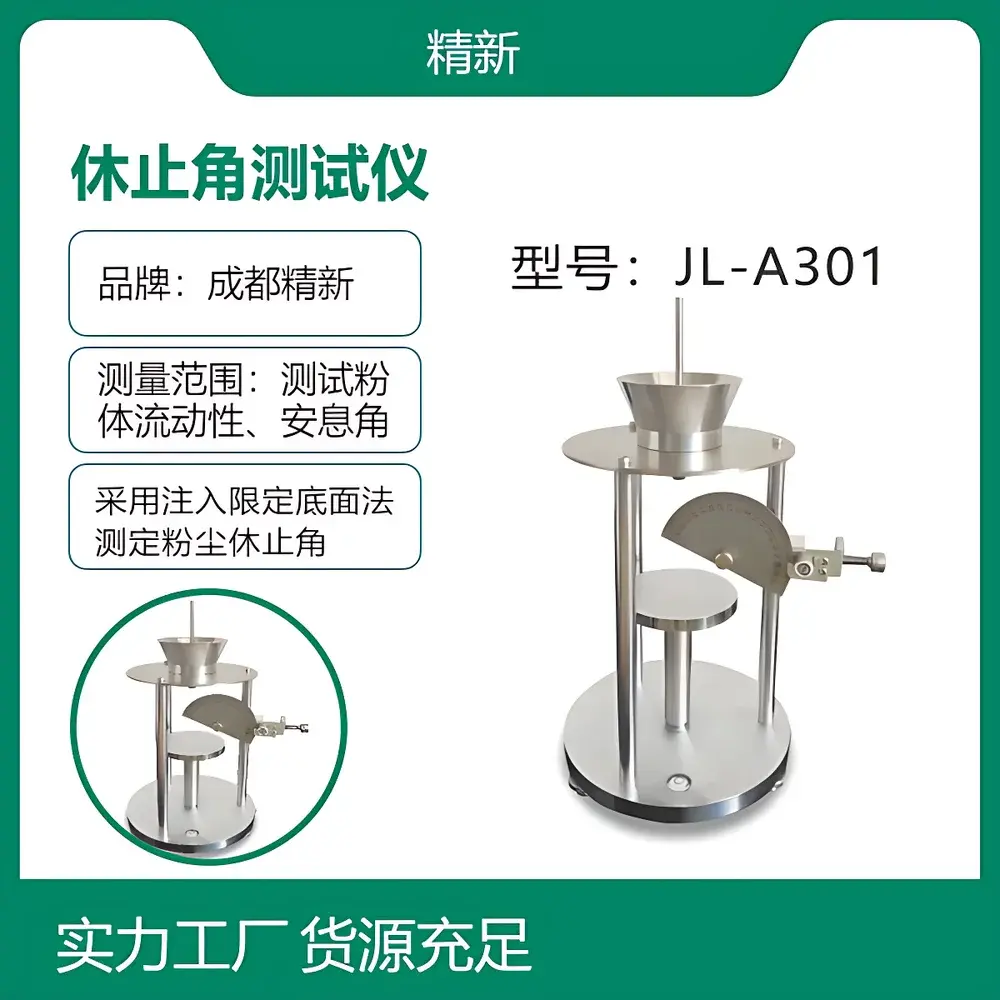
Chengdu Jingxin JL-A301 Angle of Repose Tester
| Brand | Chengdu Jingxin (CDJX) |
|---|---|
| Origin | Sichuan, China |
| Manufacturer Type | Direct Manufacturer |
| Country of Origin | China |
| Model | JL-A301 |
| Price Range | USD 310 – 395 |
| Standard Compliance | GB/T 16913–2008, GB/T 31057.3–2018 |
| Funnel Cone Angle | 60° ± 0.5° |
| Funnel Orifice Diameter | 5 mm (optional 10 mm) |
| Receiving Pan Diameter | 80 mm |
| Vertical Distance Between Funnel Tip and Pan Surface | 80 mm ± 2 mm |
| Protractor Scale | 10 cm (range: 7.5–10 cm) |
| Probe Rod Material | Stainless Steel |
| Measurement Principle | Fixed-base funnel deposition method (conical pile geometry) |
Overview
The Chengdu Jingxin JL-A301 Angle of Repose Tester is a precision-engineered instrument designed for the standardized determination of the angle of repose—a fundamental bulk powder property reflecting dynamic flow behavior under gravity-driven conditions. Based on the fixed-base funnel deposition method (also referred to as the “funnel method” or “conical pile method”), the device quantifies the maximum stable slope formed when dry, free-flowing particulate material is discharged from a defined-height funnel onto a horizontal, rigid receiving surface. The resulting conical pile’s apex angle—measured between the cone’s lateral surface and the horizontal plane—is reported as the angle of repose (AoR), expressed in degrees (°). This parameter serves as a primary indicator of interparticulate friction, cohesion, and surface energy effects, and is widely adopted in process engineering for sizing hoppers, chutes, silos, pneumatic conveying lines, and dust collection systems. The JL-A301 strictly implements the geometric and procedural requirements specified in two key Chinese national standards: GB/T 16913–2008 (“Test methods for characterization of dust—Angle of repose”) and GB/T 31057.3–2018 (“Powder technology—Part 3: Test methods for flowability—Angle of repose”). Its robust mechanical architecture ensures long-term dimensional stability and repeatability across routine QC environments.
Key Features
- Calibrated stainless-steel funnel with precisely machined 60° ± 0.5° internal cone angle and interchangeable orifices (standard 5 mm; optional 10 mm) to accommodate varying particle size distributions.
- Horizontally adjustable base plate and rigid mounting frame ensure consistent leveling—critical for eliminating gravitational bias during pile formation.
- Integrated protractor assembly with 10 cm scale (7.5–10 cm usable range) and fine angular resolution for direct visual measurement of cone geometry.
- Dedicated 100 mL sample cup and stainless-steel probe rod for controlled powder loading and gentle agitation—minimizing compaction artifacts during discharge initiation.
- Fixed vertical drop height of 80 mm ± 2 mm between funnel tip and pan surface, maintaining strict compliance with GB/T 16913–2008 test boundary conditions.
- Non-electronic, purely mechanical design eliminates calibration drift, power dependency, and electromagnetic interference—ideal for cleanrooms, explosion-hazard zones, and field deployment.
Sample Compatibility & Compliance
The JL-A301 is validated for use with dry, non-cohesive to moderately cohesive powders, granules, and milled solids ranging from ~10 µm to 2 mm in median particle size. It is unsuitable for hygroscopic, electrostatically charged, or highly adhesive materials without pre-conditioning (e.g., drying, anti-static treatment). All structural dimensions—including funnel geometry, orifice tolerance, pan diameter (80 mm), and drop height—are traceable to GB/T 16913–2008 Annex A and GB/T 31057.3–2018 Clause 5. Instrument setup and operator protocol align with ISO 4490:2018 (Metallic powders — Determination of flow rate using the Hall flowmeter) foundational principles, though the JL-A301 is not certified for Hall flow testing. While not inherently compliant with FDA 21 CFR Part 11 or EU GMP Annex 11, its manual operation supports GLP-aligned documentation when paired with standardized lab notebooks and witnessed test records.
Software & Data Management
The JL-A301 operates without embedded firmware or digital interfaces. Data acquisition is manual: users record three independent angle measurements per sample batch and compute the arithmetic mean. To support audit-ready workflows, laboratories commonly integrate the instrument into paper-based or LIMS-linked SOPs specifying minimum replicate count (n ≥ 3), outlier rejection criteria (e.g., Grubbs’ test at α = 0.05), and environmental controls (temperature: 20–25 °C; RH < 50%). Digital supplementation—such as image-capture via calibrated smartphone cameras and post-processing in ImageJ (NIH)—is permissible for secondary verification but does not replace primary protractor readings per standard requirements.
Applications
- Pre-formulation screening of pharmaceutical excipients and APIs to assess blend uniformity and tablet compression suitability.
- Quality control of ceramic raw materials, metal powders, and catalyst carriers prior to sintering or coating processes.
- Design validation of bulk storage and transfer equipment—including hopper angles, screw feeder pitch, and cyclone inlet geometry.
- Comparative assessment of surface modification efficacy (e.g., silica coating, fatty acid treatment) on flow enhancement.
- Educational demonstration of powder rheology fundamentals in materials science and chemical engineering curricula.
FAQ
What standards does the JL-A301 comply with?
It fully conforms to GB/T 16913–2008 and GB/T 31057.3–2018 for angle of repose determination.
Can the instrument measure cohesive powders?
Yes—with operator-assisted techniques such as light tapping or probe agitation per Section 4.3 of GB/T 16913–2008; however, results must be annotated to reflect non-standardized flow initiation.
Is calibration required before each test?
No formal calibration is mandated; however, daily verification of funnel alignment, pan levelness, and protractor zero position is recommended per laboratory quality procedures.
What is the typical repeatability of measurements?
Under controlled ambient conditions and trained operation, standard deviation across three replicates is typically ≤ 1.2° for free-flowing powders (D50 > 50 µm).
Does the JL-A301 include software or data export capability?
No—it is a fully manual, analog instrument. Data recording and analysis are performed externally using laboratory documentation systems.



