
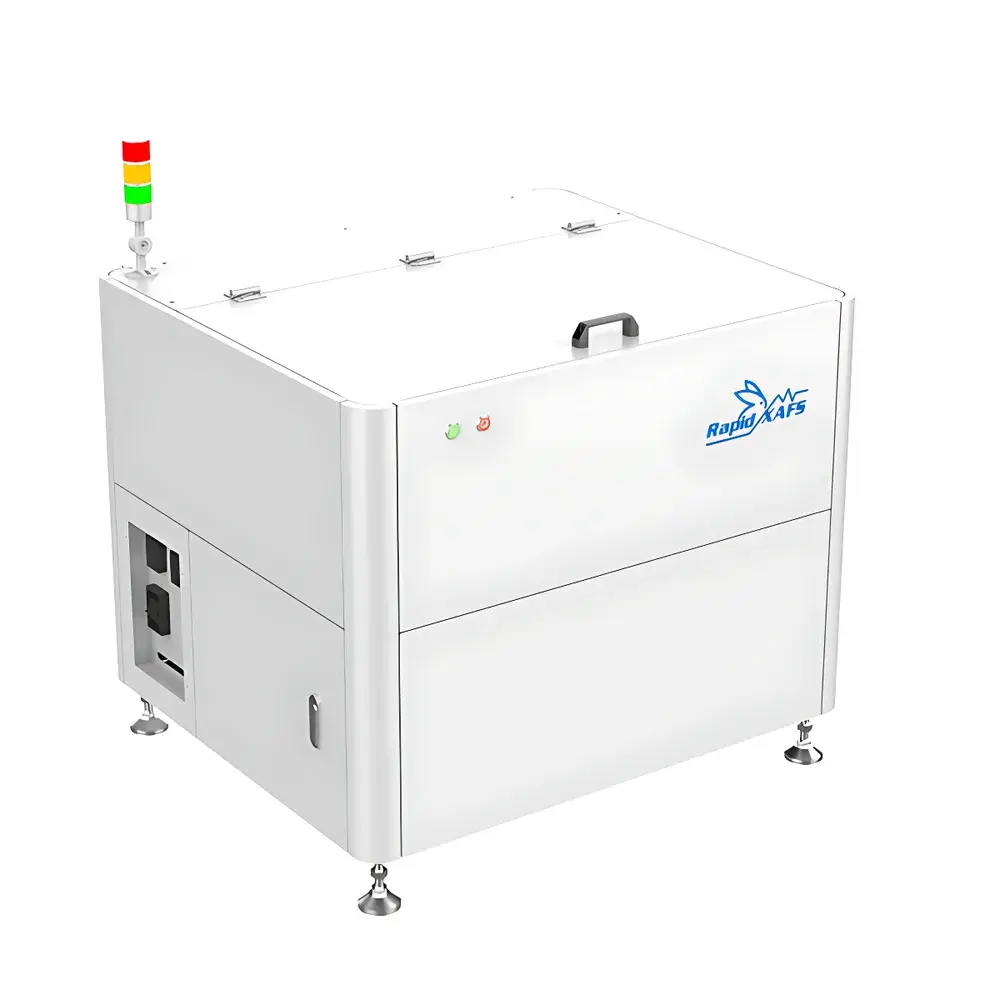
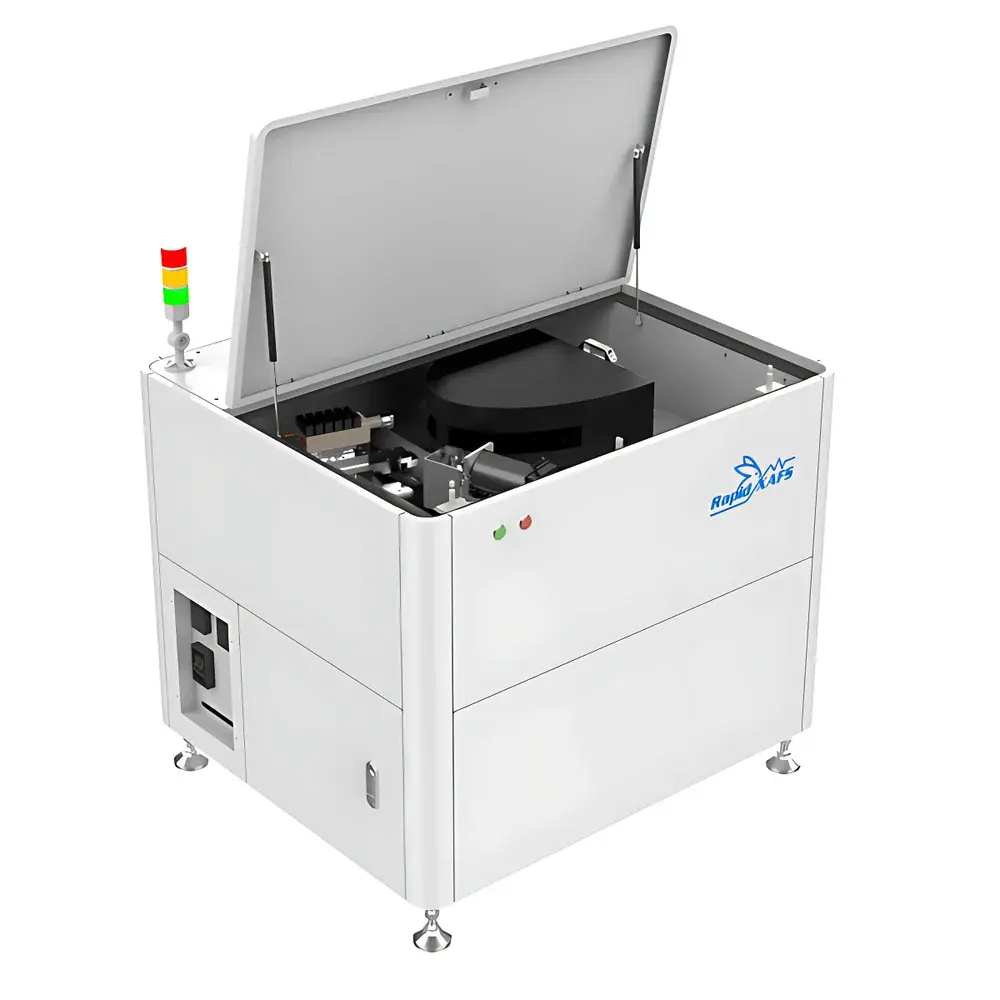
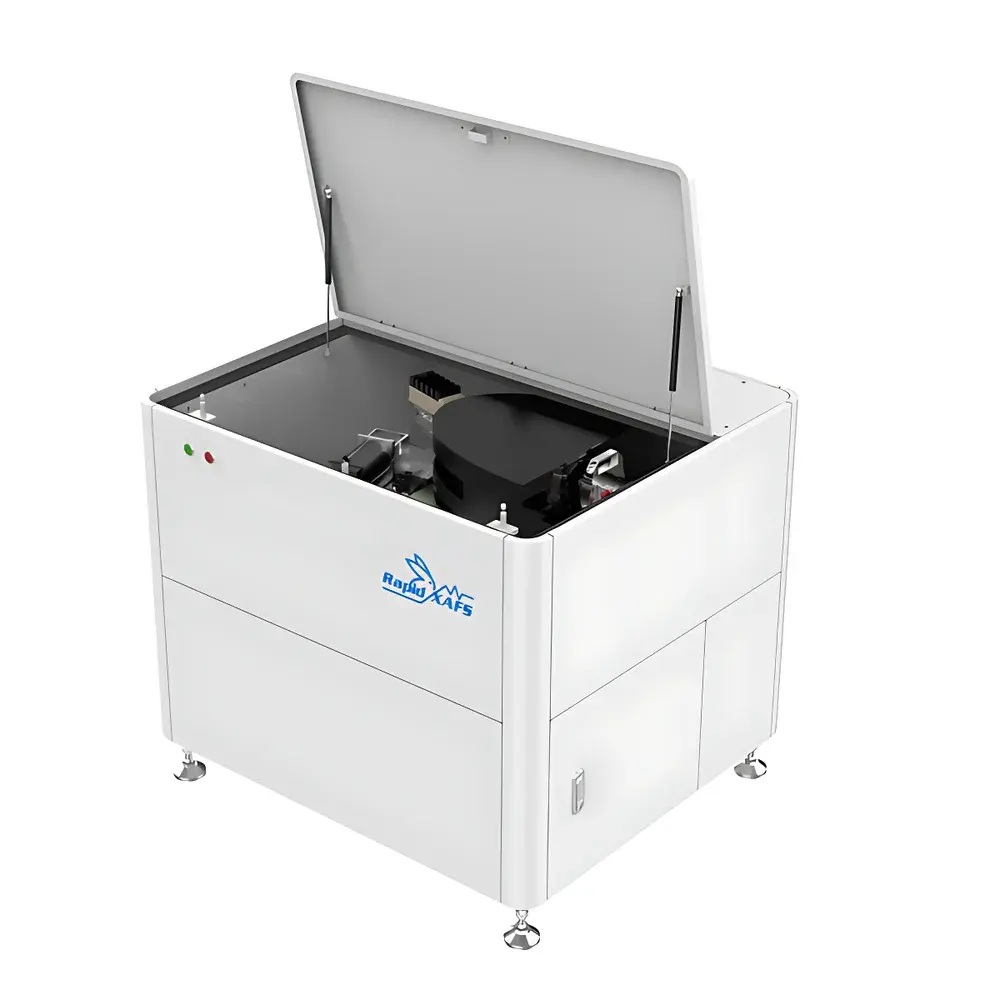
RapidXAFS X-ray Emission Spectroscopy (XES) Spectrometer
| Brand | RapidXAFS |
|---|---|
| Origin | Anhui, China |
| Manufacturer Type | Authorized Distributor |
| Country of Origin | China |
| Model | RapidXAFS Emission Spectrometer |
| Price Range | USD 390,000 – 490,000 |
| X-ray Source Power | ≤100 W |
| Minimum Detectable Elemental Content | ≤1 wt% |
| Tunable X-ray Absorption Energy Range | 2.5–5 keV |
| Fluorescence Detection Energy Range | 5–15 keV |
| Detectable Edges | 3d transition metal K-edges, 5d transition metal L-edges, actinide L-edges |
| Energy Resolution | ≤1.5 eV @ Cu Kα |
| Detector Efficiency | ≥1×10¹¹ counts per photon |
| Spectral Reproducibility | Energy drift <50 meV across repeated scans |
| Ambient Control | Helium-purged measurement chamber |
| Monochromator | High-purity Si or Ge single-crystal analyzer |
| In Situ Capability | Modular reaction cells for high/low temperature, multiphase catalysis, electrocatalysis, and operando studies |
| Data Acquisition | Real-time XES spectral output during acquisition |
Overview
The RapidXAFS X-ray Emission Spectroscopy (XES) Spectrometer is a high-performance, laboratory-scale hard X-ray spectrometer engineered for element-specific electronic structure analysis. Unlike conventional X-ray fluorescence (XRF) systems, XES measures the energy distribution of photons emitted following core-level excitation—providing direct access to valence electronic configurations, ligand field splitting, charge transfer dynamics, and spin states. The instrument operates in the hard X-ray regime (5–15 keV), enabling bulk-sensitive probing of 3d transition metals (e.g., Fe, Co, Ni K-edges), 5d elements (e.g., Ir, Pt L-edges), and light actinides (e.g., U, Th L-edges). Its design integrates a low-power (<100 W) microfocus X-ray source with a high-efficiency crystal analyzer and helium-purged detection path—minimizing atmospheric absorption while preserving sub-eV energy resolution (≤1.5 eV at Cu Kα). This architecture supports both static characterization and time-resolved operando measurements under controlled chemical environments.
Key Features
- High-resolution crystal spectrometer using selectable high-purity Si or Ge monochromator crystals for optimal throughput/resolution trade-off across target edges
- Helium-purged optical path ensuring quantitative transmission of low-energy fluorescence photons (down to 2.5 keV) without air attenuation
- Modular in situ cell interface supporting standardized flange-mounting of temperature-controlled stages (−196 °C to 1000 °C), electrochemical flow cells, gas-dosing reactors, and ambient-pressure catalytic modules
- Real-time spectral acquisition engine: raw XES spectra are generated and timestamped during data collection—no post-acquisition reprocessing or software mode switching required
- Detector system optimized for high count-rate stability and linearity, achieving ≥1×10¹¹ photon-to-electron conversion efficiency with <50 meV spectral drift over multi-hour acquisitions
- Compliance-ready architecture: audit trail logging, user role management, and metadata tagging aligned with GLP/GMP documentation workflows
Sample Compatibility & Compliance
The RapidXAFS XES spectrometer accepts solid powders, pressed pellets, thin films, frozen solutions, and encapsulated liquid samples in standard X-ray sample holders (Ø10–25 mm). It accommodates heterogeneous catalysts, battery electrode composites, mineral specimens, and metalloprotein crystals without matrix-matched calibration requirements. Measurement protocols are compatible with ASTM E1758 (standard guide for X-ray emission spectroscopy), ISO 21372 (X-ray spectrometry terminology), and USP <851> (elemental impurities in pharmaceuticals). All spectral data files include embedded EXIF-style metadata (excitation energy, dwell time, sample position, environmental conditions), satisfying FDA 21 CFR Part 11 requirements for electronic records and signatures when deployed with validated LIMS integration.
Software & Data Management
Control and analysis are performed via the RapidXAFS Analysis Suite—a Qt-based native application with dual-mode operation: interactive experiment sequencing and script-driven batch acquisition. Core functions include automatic peak deconvolution using Voigt-profile fitting, self-absorption correction based on fundamental parameter modeling, and pre-edge background subtraction using polynomial or spline algorithms. Spectra are exported in NeXus/HDF5 format compliant with IAEA XAFS Data Exchange Standards. Integrated Python API enables custom preprocessing pipelines (e.g., normalization against reference foils, principal component analysis of time-series datasets) and direct interfacing with Jupyter-based notebooks for collaborative data review. Audit logs record every parameter change, user login, and file export event with SHA-256 hashing for integrity verification.
Applications
- Catalysis Science: Mapping oxidation state evolution at active sites during CO₂ hydrogenation or water oxidation—correlating spectral shifts in Fe Kβ mainline and valence-to-core (VtC) regions with turnover frequency
- Battery Materials: Tracking Mn/Ni/Co redox asymmetry in layered NMC cathodes during cycling via L-edge XES, resolving charge compensation mechanisms beyond conventional XANES
- Environmental Geochemistry: Speciation of As, Cr, and Se in soil extracts using S Kα VtC emission—distinguishing thiol-bound vs. oxide-bound forms without chemical extraction artifacts
- Metalloenzyme Studies: Probing Fe–S cluster electronic delocalization in nitrogenase variants through Kβ’ satellite intensity ratios, validated against DFT-calculated spin densities
- Nuclear Materials: Quantifying U oxidation state distribution in spent fuel simulants using U Lγ emission profiles—achieving ±0.2 valence unit precision under inert glovebox coupling
FAQ
Is this system capable of simultaneous XANES and XES acquisition?
Yes—the spectrometer supports dual-beam geometry with independent beamline routing, enabling concurrent X-ray absorption near-edge structure (XANES) and emission measurements on the same sample position without mechanical realignment.
What vacuum or purge requirements apply to the sample chamber?
The detector arm and analyzer crystal chamber operate under continuous helium purge (≥99.999% purity, flow rate 1.2 L/min); the sample stage itself is ambient-compatible but may be enclosed in optional differential pumping or glovebox-integrated housings.
Can the system be upgraded for resonant inelastic X-ray scattering (RIXS)?
The optical layout and detector timing resolution support RIXS configuration; upgrade kits—including variable-incidence monochromator stages and time-of-flight electronics—are available as factory-installed options.
Does the software provide automated calibration against certified reference materials?
Yes—preloaded calibration libraries include NIST SRM 1832 (Fe foil), SRM 1833 (Ni foil), and IAEA-375 (UO₂ powder), with automated energy alignment routines traceable to Si(111) d-spacing standards.
Related Products






