
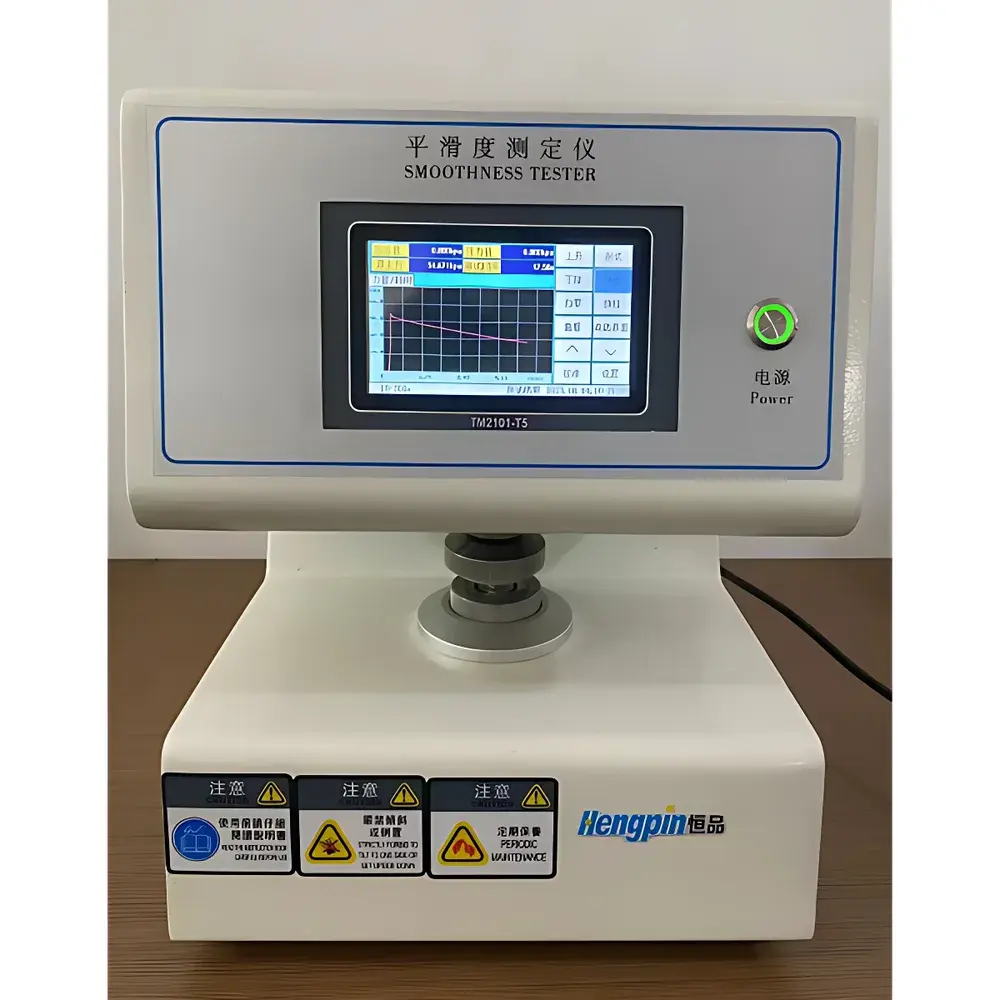
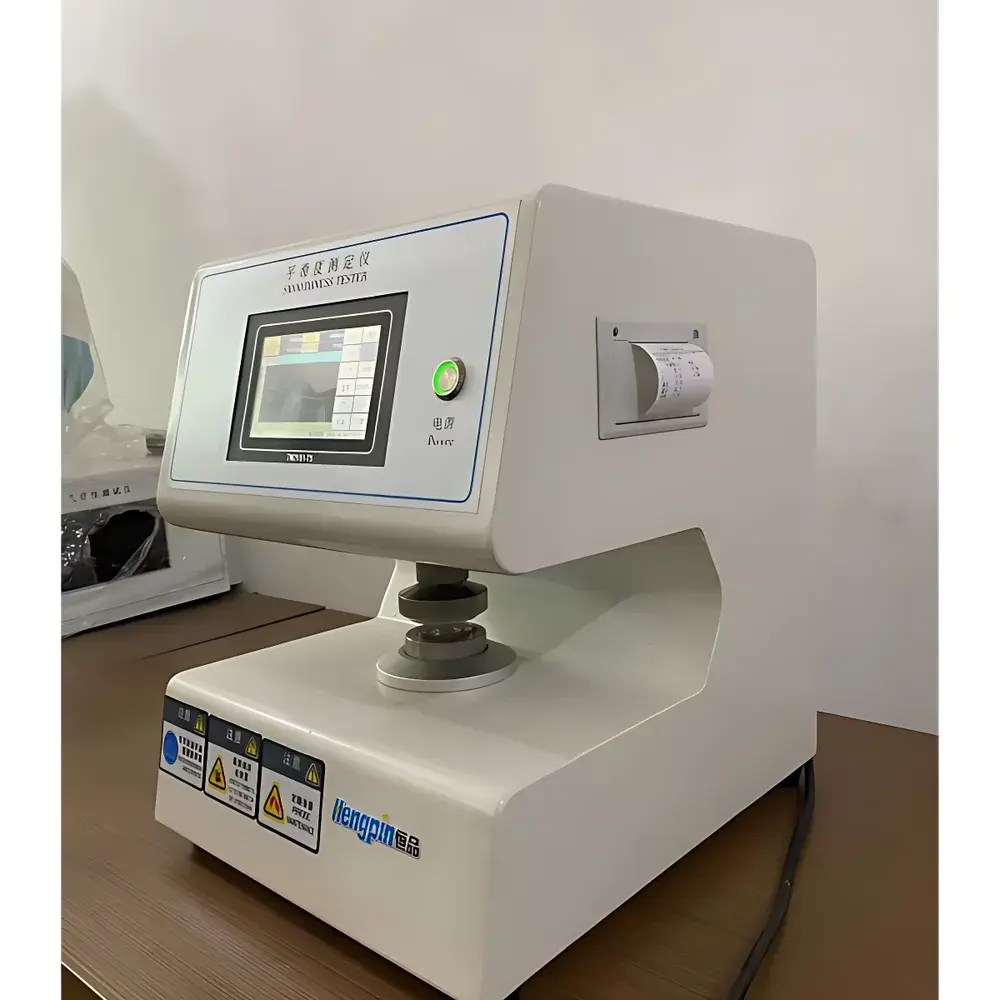
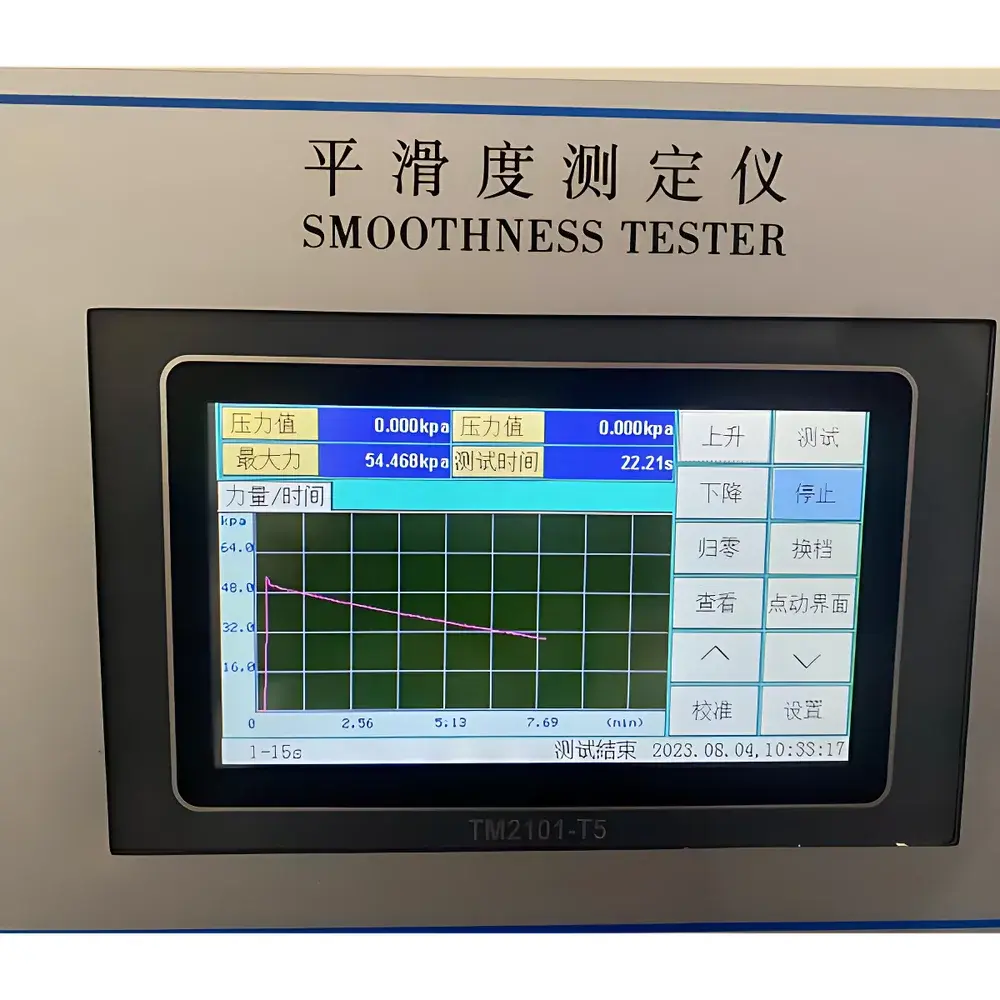
Hengpin HP-PHD-02 Bekk-Type Paper and Paperboard Smoothness Tester
| Brand | Hengpin (Ji'nan) |
|---|---|
| Origin | Shandong, China |
| Manufacturer Type | Direct Manufacturer |
| Country of Origin | China |
| Model | HP-PHD-02 |
| Price Range | USD 1,400 – 2,800 |
| Measurement Range | 0–9999 s |
| Accuracy | ±0.1 s |
| Test Area | 10 ± 0.05 cm² |
| Power Supply | AC 220 V, 50 Hz |
| Dimensions | 360 × 390 × 510 mm |
| Weight | ~40 kg |
| Vacuum Source | Oil-free Imported Vacuum Pump |
| Display | LCD with Chinese UI |
| Data Output | Integrated Thermal Micro Printer |
| Chamber Modes | Auto-switching between Large and Small Volume Chambers (Small Chamber Test Time ≈ 1/10 of Large Chamber) |
Overview
The Hengpin HP-PHD-02 Bekk-Type Paper and Paperboard Smoothness Tester is an ISO- and GB-compliant instrument engineered for precise determination of surface smoothness in paper, board, and corrugated packaging substrates. It operates on the fundamental principle of the Bekk air-leak method—measuring the time required for a defined volume of air to pass between a standardized flat glass anvil and the test specimen under controlled vacuum pressure. This physical measurement directly correlates with surface topography, inter-fiber bonding density, calendering efficiency, and coating uniformity. Designed for routine quality control in pulp & paper mills, packaging converters, and print service providers, the HP-PHD-02 delivers repeatable, traceable results aligned with international testing protocols essential for process validation and supplier qualification.
Key Features
- Microprocessor-controlled vacuum regulation ensures stable test pressure (typically 38 kPa or 5.5 psi per ISO 5627), minimizing operator-induced variability.
- Automatic chamber selection logic identifies specimen thickness and porosity in real time, switching between large-volume (standard) and small-volume (accelerated) test modes without manual intervention.
- Oil-free imported vacuum pump eliminates hydrocarbon contamination risk—critical for maintaining calibration integrity and avoiding interference with sensitive surface measurements.
- LCD interface with native Chinese menu navigation supports intuitive operation in production environments; real-time display includes elapsed time, statistical mean (n ≥ 3), and pass/fail status against preset thresholds.
- Integrated thermal micro printer provides immediate hard-copy documentation of individual test records—including date/time stamp, sample ID, chamber mode used, and measured smoothness value in seconds.
- Rugged cast-aluminum frame and precision-machined anvil surfaces ensure long-term dimensional stability and resistance to workshop vibration and ambient temperature drift.
Sample Compatibility & Compliance
The HP-PHD-02 accommodates standard sheet specimens measuring ≥ 60 mm × 60 mm, with thickness up to 1.2 mm—covering uncoated kraft, bleached hardwood/softwood papers, clay-coated board, folding boxboard, and recycled linerboard. It strictly conforms to the geometric and procedural requirements of ISO 5627:2022, GB/T 456–2002, and QB/T 1665–2015, including anvil flatness tolerance (≤ 0.002 mm), sealing ring hardness (Shore A 60 ± 5), and vacuum decay rate specifications. While not inherently 21 CFR Part 11 compliant, its deterministic analog signal path and non-volatile print log support GLP-aligned documentation practices when paired with lab-controlled SOPs and manual audit trails.
Software & Data Management
The HP-PHD-02 operates as a standalone benchtop instrument with no embedded PC or network interface. All data handling occurs locally via the built-in microcontroller: measurements are stored in volatile RAM during session runtime and committed to printed output upon completion. For laboratories requiring digital archiving, users may manually transcribe values into LIMS or Excel-based QC dashboards. The absence of firmware-updatable software minimizes cybersecurity exposure and eliminates version-control dependencies—advantageous in regulated manufacturing settings where change control rigor is prioritized over feature expansion.
Applications
- Monitoring calender stack performance in paper machine finishing sections by trending smoothness shifts across basis weight and moisture gradients.
- Evaluating coating formulation efficacy (e.g., PVA vs. starch binders) through comparative smoothness profiles before and after drying.
- Verifying incoming roll stock compliance for high-speed flexographic or gravure printing lines—where surface irregularities > 200 s Bekk correlate with ink transfer inefficiency and dot gain.
- Supporting FSC® or PEFC chain-of-custody audits by generating timestamped, operator-identified test reports for raw material release.
- Conducting R&D trials on fiber refining energy optimization—linking freeness (CSF) values to final sheet smoothness at fixed pressing pressure.
FAQ
What standards does the HP-PHD-02 explicitly support?
ISO 5627:2022, GB/T 456–2002, and QB/T 1665–2015—all verified via third-party metrology report (certificate available upon request).
Can the instrument measure coated duplex board with a 200 g/m² face layer?
Yes, provided specimen thickness remains ≤ 1.2 mm and surface roughness does not exceed 1,500 s Bekk; pre-conditioning at 23 °C / 50% RH for 24 h is mandatory.
Is calibration traceable to national standards?
Vacuum sensor calibration is traceable to CNAS-accredited labs (certificate included); anvil flatness and test area verification tools are supplied with initial shipment.
Does the small-chamber mode affect measurement accuracy?
No—the small chamber reduces test duration while preserving the same pressure differential and airflow physics; ISO 5627 Annex B validates its equivalence for routine QC use.
What maintenance is required beyond periodic vacuum pump filter replacement?
Monthly cleaning of sealing rings with isopropyl alcohol and annual verification of anvil parallelism using optical flats—no user-serviceable electronics or firmware updates.






