
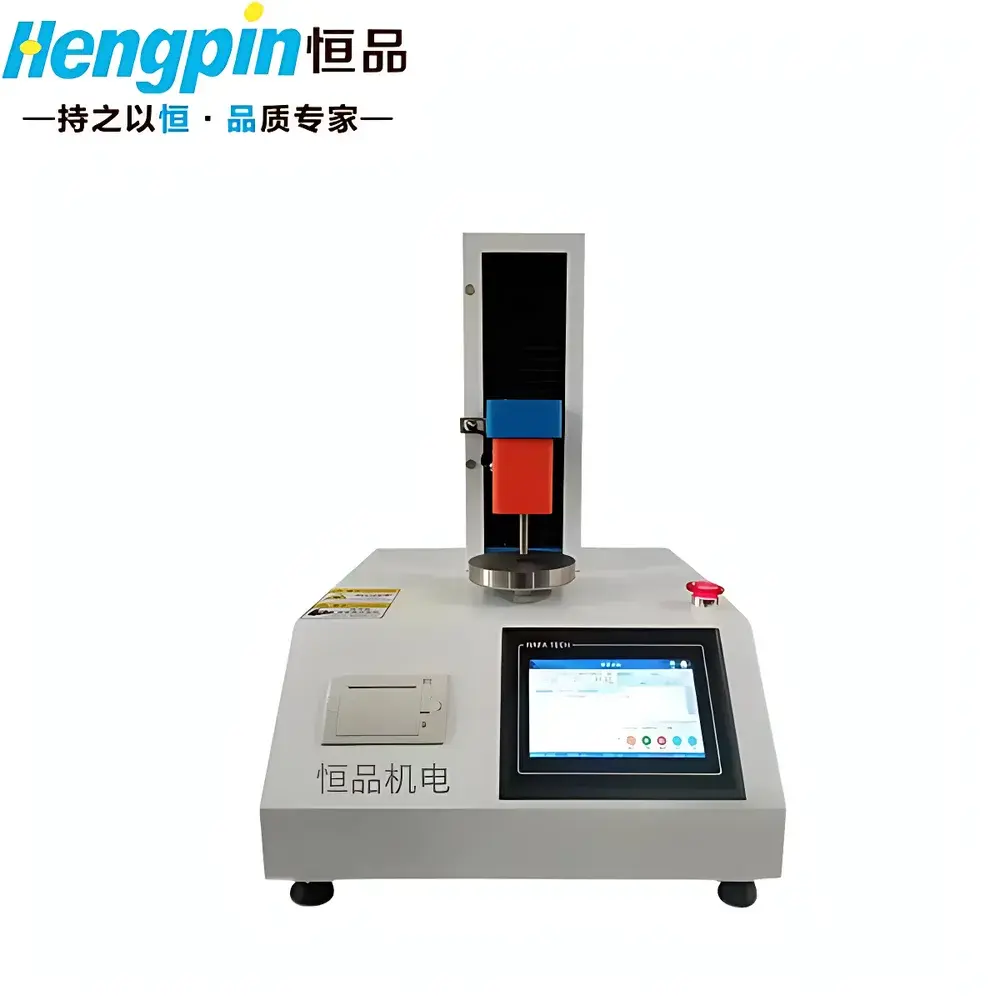
Jihengpin HP612H Lipstick Hardness Tester
| Brand | Jihengpin |
|---|---|
| Origin | Shandong, China |
| Manufacturer Type | Manufacturer |
| Country of Origin | China |
| Model | HP612H |
| Price Range | USD 1,400 – 4,200 |
| Load Capacity Options | 50 N (also available: 100 N, 500 N, 1000 N) |
| Resolution | 0.1 N |
| Accuracy | ±0.5% FS |
| Test Speed | 1–300 mm/min |
| Probe Diameter | 2 mm |
| Parallelism of Compression Plates | <0.025 mm |
| Lower Platen Diameter | 100 mm |
| Dimensions (W×D×H) | 430 × 350 × 710 mm |
| Weight | 65 kg |
| Power Supply | 220 V, 50 Hz |
| Compliance | ASTM D1321-10 |
Overview
The Jihengpin HP612H Lipstick Hardness Tester is a precision-controlled mechanical compression instrument engineered for quantitative hardness evaluation of lipstick and lip cosmetic formulations. It operates on the principle of axial force-displacement measurement: a standardized 2 mm diameter cylindrical probe applies controlled downward displacement at programmable speed onto a vertically mounted lipstick sample, while high-fidelity load cells record the peak resistance force (in newtons) required to achieve a defined penetration depth. This method directly correlates with the structural integrity, wax-oil matrix rigidity, and thermal stability of the formulation—critical parameters influencing consumer perception, packaging compatibility, and shelf-life performance. Unlike subjective tactile assessment, the HP612H delivers objective, repeatable metrics traceable to ASTM D1321-10 (“Standard Test Method for Penetration of Bituminous Materials”), adapted for cosmetic solid dosage forms through validated probe geometry, loading rate, and environmental conditioning protocols.
Key Features
- Integrated 7-inch capacitive touchscreen interface with real-time graphical display of force vs. displacement curves, test speed, displacement, and peak load value—enabling immediate visual validation of test consistency.
- Brushless DC motor drive system coupled with precision planetary gear reducer and ball-screw actuation, delivering smooth, low-vibration motion across the full speed range (1–300 mm/min) with <±0.2% speed stability.
- High-accuracy S-type load cell (0.1 N resolution, ±0.5% full-scale accuracy) calibrated per ISO 376:2011 for force transducers, ensuring metrological reliability in QC and R&D environments.
- Automated test sequence execution: auto-zeroing, pre-load application, displacement ramping, peak detection, and data retention—all configurable via on-device menu or optional PC software.
- Standard thermal-stable aluminum compression platens (100 mm lower platen; parallelism <0.025 mm) minimize lateral deflection and ensure uniform stress distribution during testing.
- Built-in thermal paper micro-printer for immediate hardcopy output of individual test results—including max force, test duration, speed, and timestamp—with batch statistics (mean, min, max, SD) calculated over up to 99 cycles.
Sample Compatibility & Compliance
The HP612H accommodates standard commercial lipstick sticks (diameter 8–12 mm, length ≥50 mm) mounted vertically in a dedicated holder that maintains axial alignment within ±0.5°. The 2 mm probe geometry complies with ASTM D1321-10’s requirement for standardized penetrator dimensions when adapted to non-bituminous solids. While not certified for regulatory submission per se, the instrument supports GLP-aligned workflows: all test parameters (speed, target displacement, dwell time), raw force-time-displacement data, and operator ID are digitally logged with timestamps. When paired with optional PC control software, audit trails, electronic signatures, and 21 CFR Part 11–compliant data archiving (including curve export in CSV and PNG formats) become achievable—meeting internal quality system requirements for cosmetic product development and manufacturing sites operating under ISO 22716 or ICH Q5C guidelines.
Software & Data Management
The optional Windows-based control software provides synchronized dual-view visualization: live force-time and force-displacement plots alongside numeric parameter readouts updated at 100 Hz. All raw data—including interpolated peak detection points, slope analysis (initial stiffness), and hysteresis quantification upon probe retraction—are stored in encrypted SQLite databases with automatic versioning and user-defined project tagging. Export functions support A4-formatted PDF reports (with lab header, sample ID, instrument calibration status, and technician signature field) as well as tabular CSV files compatible with JMP, Minitab, or Python pandas for statistical process control (SPC) and DoE analysis. Data integrity safeguards include write-once storage mode, checksum verification, and role-based access controls (admin/operator modes).
Applications
- Formulation optimization: Quantifying hardness shifts resulting from wax type (carnauba vs. candelilla vs. beeswax), oil saturation level, or polymer thickener concentration.
- Batch release testing: Verifying hardness consistency across production lots against established specification limits (e.g., 25–35 N at 3 mm displacement).
- Stability studies: Monitoring hardness drift after accelerated aging (40°C/75% RH for 8 weeks) to assess crystallization or oil bloom propensity.
- Packaging interaction analysis: Evaluating deformation thresholds under cap-torque-induced compression or tube extrusion forces.
- Competitive benchmarking: Objective comparison of hardness profiles against market-leading reference products using identical test protocols.
FAQ
What ASTM standard does the HP612H implement for lipstick hardness testing?
It follows ASTM D1321-10 methodology—specifically adapted for cosmetic solids via probe diameter, displacement rate, and sample orientation modifications validated by Jihengpin’s application lab.
Can the HP612H measure other cosmetic solids besides lipstick?
Yes—its modular design supports interchangeable probes and fixtures; it has been successfully used for lip gloss sticks, solid perfumes, and pressed powder compacts with appropriate calibration and fixture adaptation.
Is calibration traceable to national standards?
Load cell calibration certificates are provided with NIST-traceable reference standards (certified weights and dead-load testers), and annual recalibration services are available through authorized Jihengpin service centers in APAC and EU regions.
Does the instrument require environmental conditioning before testing?
For metrologically rigorous results, samples must be equilibrated at 23 ± 1°C and 50 ± 5% RH for ≥2 hours prior to testing, per ISO 18871:2016 recommendations for cosmetic physical testing.
How is data integrity ensured during long-term deployment in regulated environments?
With PC software enabled, the system logs all user actions, parameter changes, and instrument errors in tamper-evident audit trails compliant with FDA 21 CFR Part 11 Annex 11 expectations for electronic records in GMP settings.




