
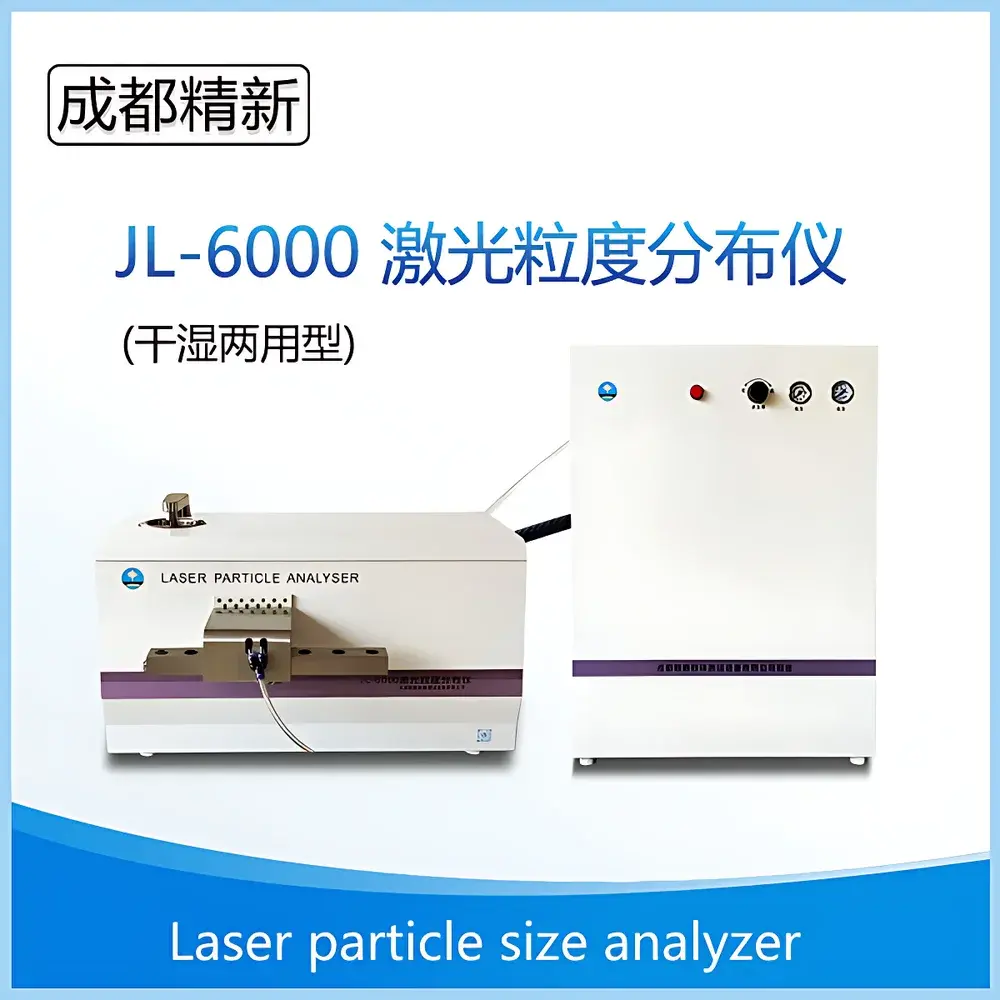
Chengdu Jingxin JL-6000 Dry/Wet Dual-Mode Laser Particle Size Analyzer
| Brand | Chengdu Jingxin (CDJX) |
|---|---|
| Origin | Sichuan, China |
| Manufacturer Type | Direct Manufacturer |
| Regional Category | Domestic (China) |
| Model | JL-6000 |
| Price Range | USD 21,000–22,500 (FOB) |
| Dispersion Method | Dry & Wet Dispersion |
| Instrument Type | Laboratory Laser Particle Size Analyzer |
| Measurement Range | 0.01–3000 µm |
| Repeatability | <1% (wet), <3% (dry) |
| Measurement Time | <10 s (per measurement), <2 min (wet cycle incl. dispersion/cleaning), <60 s (dry cycle incl. auto-feed/clean) |
Overview
The Chengdu Jingxin JL-6000 Dry/Wet Dual-Mode Laser Particle Size Analyzer is a laboratory-grade instrument engineered for high-fidelity particle size distribution (PSD) analysis across diverse material classes. It operates on the principle of static light scattering, applying Mie scattering theory across the full 0.01–3000 µm dynamic range to deliver physically rigorous, model-independent size distributions. Unlike fixed-optics or heuristic algorithms, the JL-6000 implements an unconstrained free-distribution inversion algorithm—validated per ISO 13320:2020 and GB/T 19077–2016—to resolve subtle population shifts in multimodal or polydisperse samples without bias from assumed distribution shapes. Its inverted Fourier optical architecture minimizes stray light from sample cell–lens interface reflections, while dual-wavelength illumination (650 nm primary + 405 nm auxiliary) enhances resolution in the sub-100 nm regime. The system’s fully sealed metal enclosure provides electromagnetic shielding and meets environmental safety requirements for routine lab use.
Key Features
- Inverted Fourier optical design with 128-element multi-angle detector array capturing forward, side, and backward scattered light for comprehensive angular intensity sampling.
- Dual-laser source: 30 mW @ 650 nm (≥70,000 h lifetime) and 20 mW @ 405 nm for improved small-particle sensitivity and cross-validation capability.
- Integrated dry and wet dispersion modules—no hardware reconfiguration required; mode selection executed via software menu with automatic parameter switching.
- Wet dispersion system: 500 mL stainless-steel (304) sample cell with integrated 60 W ultrasonic transducer, mechanical stirrer, and peristaltic circulation pump; features auto-fill, auto-level detection, auto-cleaning, and anti-dry-burn protection.
- Dry dispersion system: High-velocity turbulent jet with pressure regulation (0.1–0.8 MPa), precision powder feed nozzle, and built-in dust extraction unit with waste collection canister and compressed air purification.
- Optomechanical stability ensured by elastic suspension of rigid optical bench and fused-optical-glass sample cell with metallic reinforcement for long-term alignment retention.
Sample Compatibility & Compliance
The JL-6000 accommodates both suspended particulates (aqueous/organic media: water, ethanol, isopropanol) and free-flowing dry powders—including magnetic materials (e.g., NdFeB, ferrites), pharmaceutical actives, soluble salts, and cohesive nanomaterials—without cross-contamination between modes. Its wet module complies with ISO 13320 Annex B guidelines for dispersion validation, while dry testing adheres to ASTM D7927–21 for dry powder aerosolization consistency. All firmware and data handling conform to GLP-aligned audit trail requirements: timestamped test logs, user-access control, and immutable raw scattering data storage. Though not FDA 21 CFR Part 11–certified out-of-box, the system supports traceable electronic records when deployed with validated IT infrastructure and procedural SOPs.
Software & Data Management
The embedded analysis software (Windows XP/7/10 compatible) offers bilingual UI toggling (English/Chinese), real-time scatter pattern visualization, and three distribution models: free (non-parametric), Rosin-Rammler, and normal. Standard output includes D3, D10, D25, D50, D75, D84, D90, D97, volume-weighted mean diameter (D[4,3]), surface-weighted mean (D[3,2]), and specific surface area estimation. Raw data export is supported via USB 2.0 and RS-232 interfaces in CSV, TXT, and PDF formats. Batch reporting allows comparative overlay of up to eight distributions with statistical deviation overlays (±1σ). All calibration and validation runs are archived with metadata (operator ID, date/time, dispersion parameters, laser power).
Applications
The JL-6000 serves as a reference-grade PSD tool in quality control and R&D environments across regulated and industrial sectors. In pharmaceutical manufacturing, it verifies micronized API uniformity and excipient blend homogeneity under ICH Q5A and USP <429> guidance. Cement and ceramic producers apply it for clinker fineness optimization and green-body density prediction. Battery material labs characterize cathode/anode powders (LiCoO2, graphite) for slurry rheology correlation. Cosmetics and pigment formulators rely on its sub-100 nm resolution for nano-TiO2 and ZnO dispersion stability assessment. Additional applications include catalyst support grading, food starch granule sizing, mineral filler QC (talc, kaolin, alumina), and rare-earth oxide powder certification.
FAQ
Does the JL-6000 require separate calibration for dry and wet modes?
No—optical calibration is performed once using NIST-traceable polystyrene latex standards; dispersion-specific corrections are applied algorithmically during inversion.
Can the instrument measure particles below 10 nm?
While the specified lower limit is 0.01 µm (10 nm), reliable quantification below 30 nm requires optimized dispersion stability and background subtraction protocols—not inherent instrument limitation but sample-dependent boundary.
Is compressed air purity critical for dry dispersion?
Yes—oil-free, desiccated air (dew point ≤ −40°C) or inert gas (N2, Ar) is mandatory to prevent electrostatic agglomeration and nozzle clogging.
How does the system handle highly refractive or absorbing particles?
Mie theory implementation allows input of complex refractive index (real + imaginary components); default values are provided for common materials (e.g., SiO2, TiO2, carbon black), but user-defined inputs improve accuracy.
What maintenance intervals are recommended?
Optical path inspection every 6 months; ultrasonic transducer performance verification quarterly; dry dispersion nozzle cleaning after each 50 tests; annual laser power recalibration.
Related Products



