
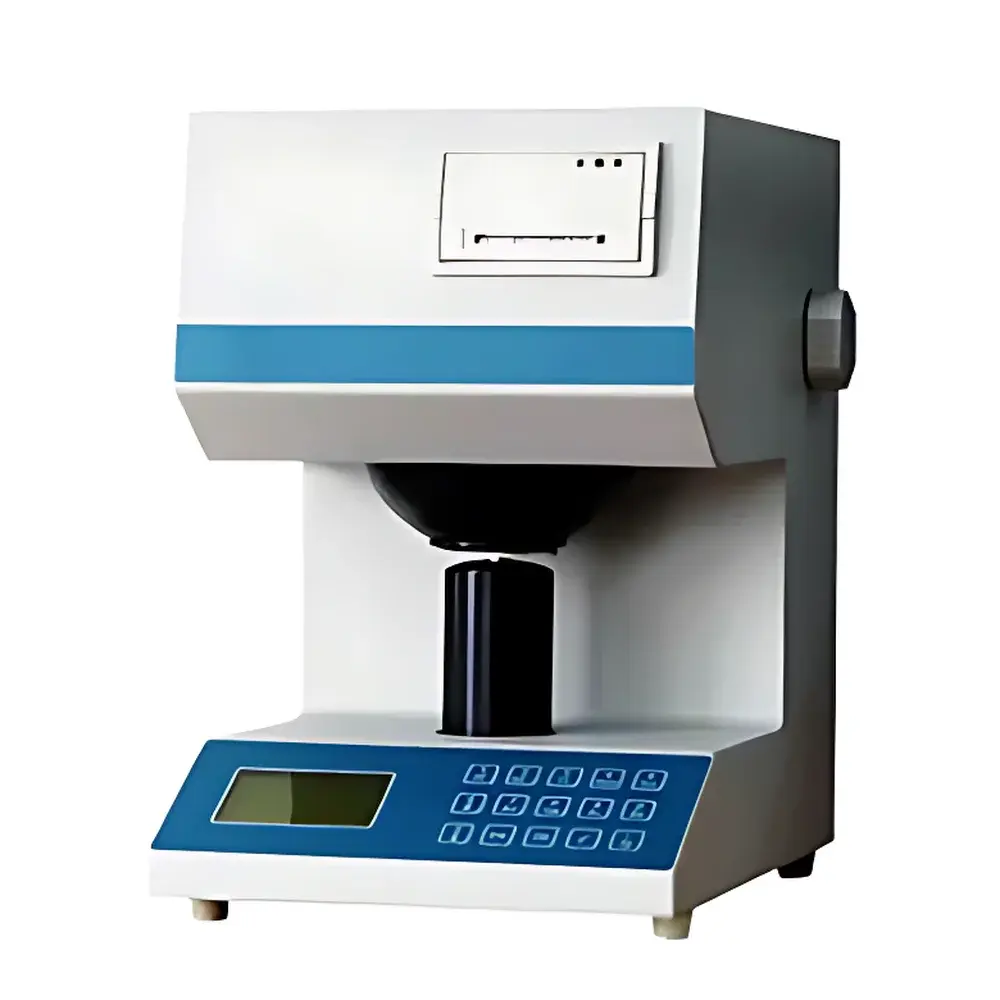
Jihengpin HP-BD48A Whiteness and Colorimeter
| Brand | Jihengpin |
|---|---|
| Origin | Shandong, China |
| Manufacturer Type | Manufacturer |
| Country of Origin | China |
| Model | HP-BD48A |
| Price Range | USD 1,400 – 2,800 |
| Illuminant | Simulated D65 |
| Geometry | Diffuse/0° (d/0) |
| Sphere Diameter | 150 mm |
| Aperture | 25 mm |
| Repeatability | σ(Y₁₀) < 0.1, σ(x₁₀, y₁₀) < 0.001 |
| Accuracy | ΔY₁₀ < 1.0, Δx₁₀/Δy₁₀ < 0.01 |
| Sample Size | ≥Φ30 mm, ≤40 mm thickness |
| Power Supply | AC 220 V, 50 Hz, 0.3 A |
| Operating Environment | 10–30 °C, RH ≤85% |
| Dimensions | 364 × 264 × 400 mm |
| Weight | 17 kg |
Overview
The Jihengpin HP-BD48A Whiteness and Colorimeter is a precision optical measurement instrument engineered for quantitative evaluation of whiteness, yellowness, color coordinates, chromaticity differences, and related optical properties in solid, planar, non-fluorescent and fluorescent materials. It operates on the principle of diffuse/0° (d/0) illumination geometry per CIE standards, utilizing a 150 mm integrating sphere with a 25 mm measurement aperture and internal light absorber to eliminate specular reflectance—ensuring compliance with ISO 2470, ISO 2471, GB/T 7973, GB/T 7974, and GB/T 3979. The instrument simulates the CIE standard illuminant D65 and implements the CIE 1964 (10° observer) supplemental colorimetric system alongside the CIE 1976 L*a*b* uniform color space and ΔE*ab color difference formula. Designed for high reproducibility in routine quality control environments, the HP-BD48A delivers traceable, standardized photometric outputs including tristimulus values (X₁₀, Y₁₀, Z₁₀), chromaticity coordinates (x₁₀, y₁₀), CIELAB parameters (L*, a*, b*, C*ab, h*ab), dominant wavelength (λd), excitation purity (Pe), and whiteness indices across multiple international definitions—including ISO (R₄₅₇), Ganz (W₁₀, Tw10), Z (Rz), Hunter (WH), and J (WJ)—as well as yellowness index (YI), opacity (OP), transparency, scattering coefficient (S), absorption coefficient (A), and ink absorbency.
Key Features
- Comprehensive spectral evaluation: Measures Y₁₀, x₁₀, y₁₀, L*, a*, b*, C*ab, h*ab, λd, Pe, ΔE*ab, ΔL*, ΔC*ab, ΔH*ab, and Hunter L, a, b values.
- Dual-mode reference handling: Supports both physical reference standards and digital reference data; stores up to ten reference profiles in non-volatile memory.
- Fluorescence compensation: Quantifies fluorescence whitening effect (FWER) for samples containing optical brightening agents (OBAs), enabling accurate ISO and CIE whiteness assessment under D65 simulation.
- Integrated thermal printer: Equipped with an imported thermal print head—ink-free, ribbon-free, silent operation, and rapid output of measurement reports with full parameter sets.
- Robust data interface: RS-232 serial port compliant with standard PC communication protocols; compatible with custom or third-party QC software for automated data logging, trend analysis, and SPC charting.
- Long-term calibration retention: Non-volatile memory preserves zero-point calibration, standardization coefficients, reference values, and system configuration—even after extended power loss.
- Dedicated functionality for specialized applications: Includes lead-core concentration measurement via reflective density (Dy, Dz) and supports industry-specific indices such as ASTM E313 YI, ISO 2470 R₄₅₇, and GB/T 2409 yellow index.
Sample Compatibility & Compliance
The HP-BD48A accommodates flat, opaque or semi-transparent specimens with minimum diameter Φ30 mm and maximum thickness 40 mm. Its d/0 optical design ensures reliable measurements on textured, matte, and lightly glossy surfaces common in paper, board, textiles, ceramics, plastics, starch, salt, detergents, pigments, coatings, and building materials. The instrument meets or exceeds requirements for regulatory and quality assurance workflows governed by ISO, ASTM, and Chinese national standards—including ISO 2470 (paper blue-light reflectance), ISO 2471 (opacity), GB/T 7974 (paper whiteness), GB/T 8425 (textile whiteness), GB/T 9338 (fluorescent whitener evaluation), GB/T 11942 (colored construction materials), and GB/T 5950 (non-metallic mineral products). It supports GLP-aligned documentation practices through timestamped printouts and structured ASCII data export, facilitating audit readiness in GMP-relevant sectors such as pharmaceutical excipient testing and food-grade packaging validation.
Software & Data Management
While the HP-BD48A functions autonomously with embedded firmware, its RS-232 interface enables bidirectional communication with Windows-based host systems. Raw measurement data—including all CIE-compliant outputs and derived indices—is transmitted in ASCII format with configurable delimiters and header metadata. Compatible software platforms may implement automated pass/fail decision logic against user-defined specification limits, generate statistical process control (SPC) charts (e.g., X̄-R, Cpk), archive historical datasets with operator ID and sample lot traceability, and export CSV/PDF reports compliant with FDA 21 CFR Part 11 requirements when deployed with validated electronic signature modules. All stored reference data and calibration records are retained independently of external software, ensuring continuity during instrument relocation or IT infrastructure updates.
Applications
This instrument serves as a primary metrology tool across regulated and industrial manufacturing settings where color consistency and whiteness uniformity are critical process indicators. Key use cases include: incoming raw material inspection of pulp, paper, and board; in-line quality verification of printed packaging substrates; formulation development and batch release testing of ceramic glazes and architectural coatings; OBA efficacy validation in detergent and textile auxiliaries; whiteness grading of food-grade salts and starches per GB/T 13025 and GB/T 1840; optical property certification of medical packaging films; and comparative analysis of pigment dispersion stability in plastics per GB/T 2913. Its adherence to harmonized test methods makes it suitable for inter-laboratory comparison studies and proficiency testing programs accredited to ISO/IEC 17025.
FAQ
Does the HP-BD48A comply with ISO 2470 for ISO whiteness measurement?
Yes—it implements the R₄₅₇ blue-light reflectance method under simulated D65 illumination and d/0 geometry, fully aligned with ISO 2470:2008.
Can it measure fluorescent samples without bias?
Yes—the instrument quantifies fluorescence contribution separately and reports corrected whiteness values per CIE 1982 Ganz definition and ISO 9166, eliminating overestimation due to OBA emission.
Is the thermal printer replaceable or serviceable in the field?
The integrated thermal print module uses industry-standard replacement heads; consumables (thermal paper rolls) are globally available and require no alignment or calibration.
What is the recommended recalibration interval?
Annual verification against NIST-traceable ceramic standards is advised; daily zeroing and weekly standard tile verification are required for routine QC use per ISO 9001 and GB/T 19022.
Does it support user-defined color tolerance ellipsoids (e.g., ΔE*cmc or ΔE*00)?
No—the device calculates only ΔE*ab per CIE 1976; advanced delta-E metrics require post-processing in external software using exported X₁₀/Y₁₀/Z₁₀ data.
Related Products






