
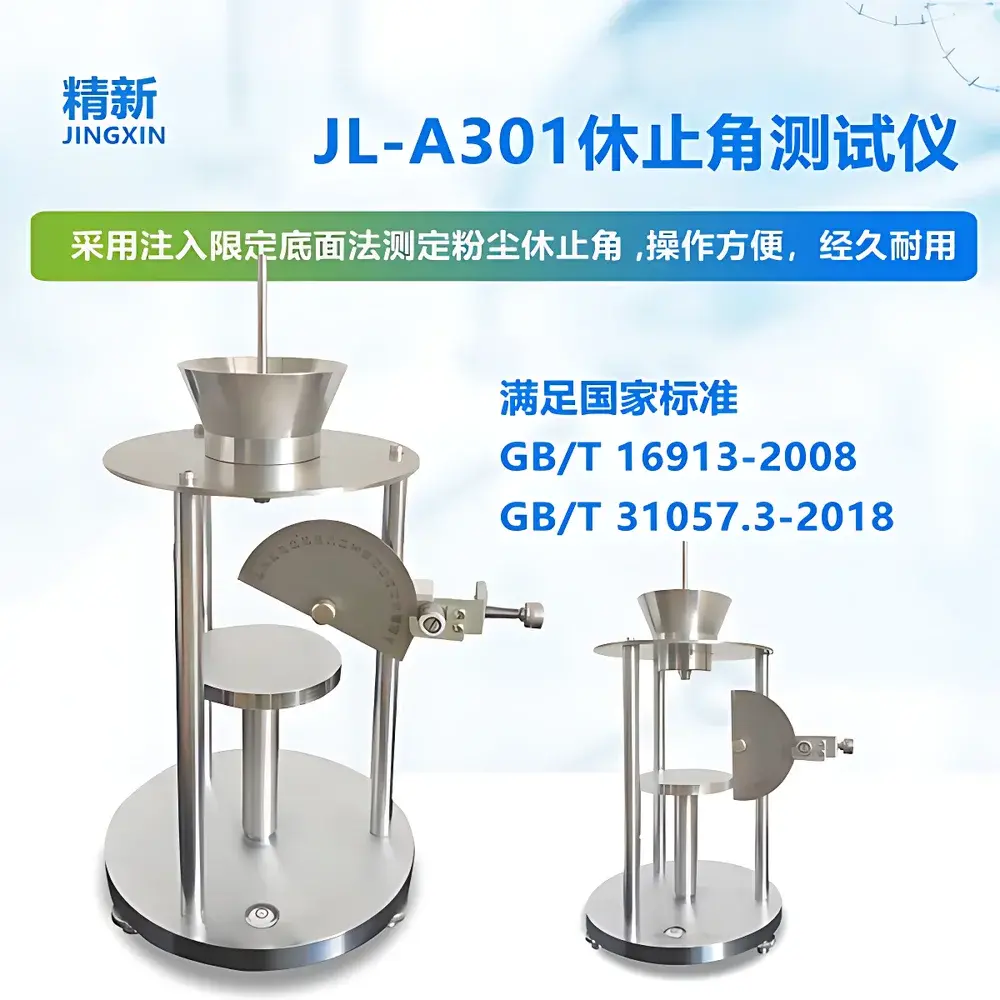
Chengdu Jingxin JL-A301 Powder Flowability Tester (Angle of Repose Analyzer)
| Brand | Chengdu Jingxin (CDJX) |
|---|---|
| Origin | Sichuan, China |
| Manufacturer Type | Direct Manufacturer |
| Country of Origin | China |
| Model | JL-A301 |
| Price Range | USD 310 – 395 |
| Standard Compliance | GB/T 16913–2008, GB/T 31057.3–2018 |
| Funnel Cone Angle | 60° ± 0.5° |
| Funnel Orifice Diameter | 5 mm (optional 10 mm) |
| Receiving Pan Diameter | 80 mm |
| Vertical Distance Between Funnel Tip and Pan Surface | 80 mm ± 2 mm |
| Protractor Scale Range | 10 cm (graduated from 0° to 90°) |
| Probe Rod Material | Stainless Steel |
| Measurement Principle | Fixed-Height Funnel Deposition Method (Cone Formation on Horizontal Plate) |
Overview
The Chengdu Jingxin JL-A301 Powder Flowability Tester is a precision-engineered instrument designed for the standardized determination of the angle of repose — a fundamental bulk property quantifying the flow behavior of dry, free-flowing powders and granular solids. Based on the fixed-height funnel deposition method defined in GB/T 16913–2008 and GB/T 31057.3–2018, the device enables reproducible formation of a conical powder pile on a horizontal stainless steel receiving plate. The angle between the cone’s sloping surface and the horizontal plane is measured directly using an integrated calibrated protractor or calculated trigonometrically from the cone’s height and base diameter. As a static flow indicator, the angle of repose correlates inversely with powder mobility: lower values (e.g., 45°) suggest cohesive or poorly flowing behavior. This parameter is critical in process engineering contexts including hopper design, pneumatic conveying system sizing, dust collector inlet configuration, and bulk material handling equipment specification.
Key Features
- Compliant mechanical architecture engineered to meet national standard tolerances: funnel cone angle maintained at 60° ± 0.5°, orifice diameter options of 5 mm (standard) or 10 mm (customizable), and precise vertical drop distance of 80 mm ± 2 mm between funnel tip and pan surface.
- Durable stainless steel probe rod and rigid aluminum alloy frame ensure long-term dimensional stability and resistance to corrosion during routine laboratory use.
- Integrated 10-cm linear protractor with 0.5° resolution allows direct visual readout of the repose angle without auxiliary instrumentation.
- Modular assembly design facilitates rapid setup, cleaning, and reconfiguration — no tools required for alignment or calibration verification.
- Receiving pan with 80 mm diameter provides consistent confinement geometry for cone formation across repeated trials, minimizing edge effects and improving inter-operator repeatability.
Sample Compatibility & Compliance
The JL-A301 is suitable for testing non-cohesive to moderately cohesive dry powders with particle sizes ranging from ~10 µm to 2 mm, including pharmaceutical excipients, metal powders, ceramic granules, food ingredients, and mineral dusts. It excludes slurries, moist agglomerates, or thermoplastic materials that undergo deformation under gravity alone. All mechanical dimensions and procedural steps adhere strictly to GB/T 16913–2008 (“Methods for Determination of Powder Bulk Properties — Angle of Repose”) and GB/T 31057.3–2018 (“Powder Technology — Part 3: Test Methods for Flowability of Powders”). While not certified to ISO 4762 or ASTM D6393, its methodology aligns conceptually with these international standards for static angle measurement. For regulated environments (e.g., pharmaceutical QC labs), operators may document procedural adherence and instrument verification per internal SOPs supporting GLP/GMP traceability.
Software & Data Management
The JL-A301 operates as a manual, hardware-only measurement system with no embedded electronics or digital interface. Data acquisition relies on operator-recorded protractor readings or manual calculation from measured cone dimensions. To support quality systems, users are advised to record raw measurements (height, base diameter, three replicate angles), calculate arithmetic mean and standard deviation, and retain annotated photographs of formed cones as part of test documentation. When integrated into LIMS or ELN platforms, results can be entered manually with metadata fields for batch ID, environmental conditions (temperature/humidity), operator name, and date/time stamp — satisfying basic audit trail requirements under FDA 21 CFR Part 11 when combined with controlled electronic records procedures.
Applications
- Hopper and silo design validation: correlating repose angle with arching and ratholing thresholds.
- Pneumatic and screw conveyor feasibility assessment for bulk solid transport.
- Comparative evaluation of flow aid efficacy (e.g., silica addition) in formulation development.
- Batch release testing of raw materials in chemical, food, and nutraceutical manufacturing.
- Root cause analysis of caking or bridging incidents in production-scale feeders.
- Academic research on powder rheology fundamentals and granular mechanics modeling.
FAQ
What is the recommended sample volume for each test?
A nominal 100 mL volume is used — transferred from a calibrated measuring cup into the funnel. This ensures sufficient mass to form a stable, measurable cone without overflow or incomplete discharge.
Can the instrument measure cohesive or slightly damp powders?
No. The JL-A301 is validated only for free-flowing, dry powders. Cohesive or hygroscopic materials require dynamic methods (e.g., shear cell or rotational rheometry) or conditioned humidity testing environments.
Is calibration required before each use?
Periodic verification is recommended: confirm funnel verticality using a spirit level, check orifice diameter with pin gauges, and validate protractor zero alignment against a reference flat surface — all traceable to lab-level metrology standards.
How many replicates are necessary for statistically valid results?
Per GB/T 16913–2008, a minimum of three independent determinations must be performed; the arithmetic mean is reported as the final angle of repose, with standard deviation optionally included for uncertainty estimation.
Does the device comply with FDA or EU GMP requirements?
The instrument itself is not certified, but its use within a documented, validated test method — with defined operator training, equipment verification logs, and raw data retention — supports compliance with general GMP principles for physical property testing of starting materials.



