
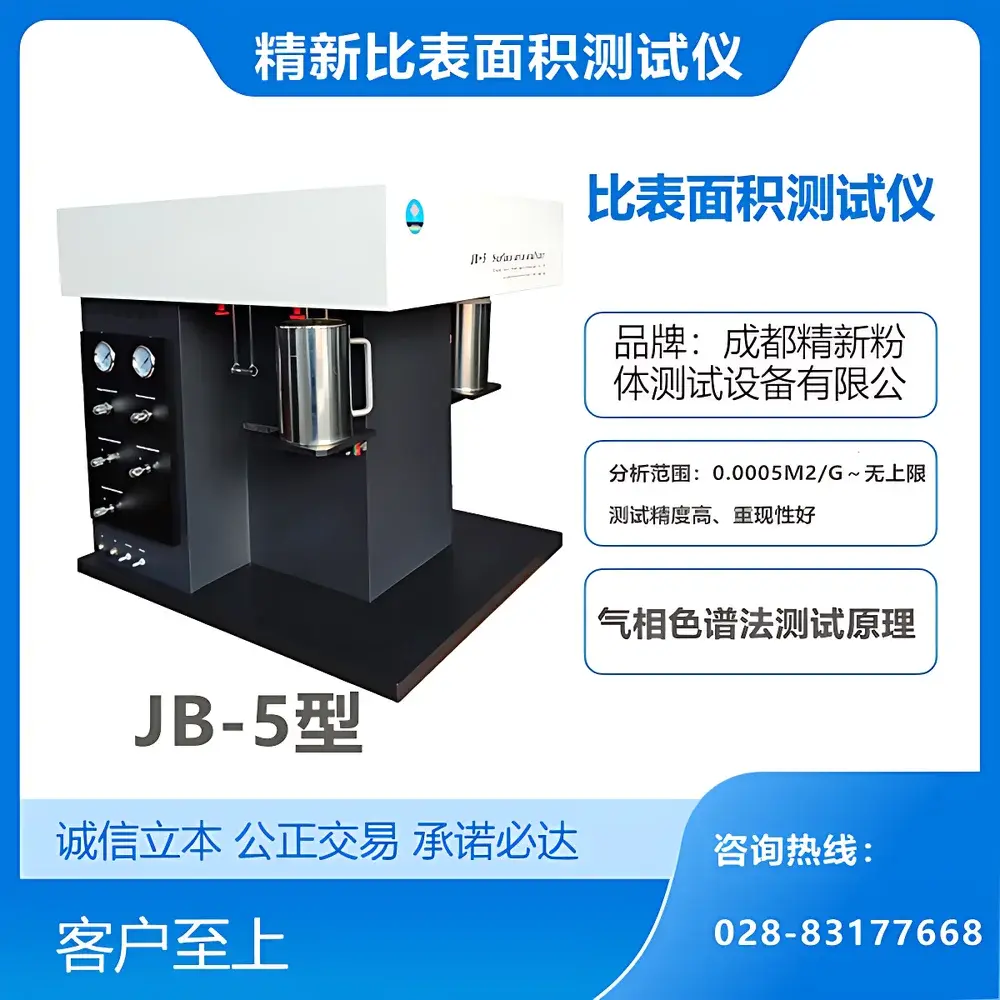
CDJX JB-5 Dynamic Nitrogen Adsorption Specific Surface Area Analyzer
| Brand | CDJX |
|---|---|
| Origin | Sichuan, China |
| Manufacturer Type | Direct Manufacturer |
| Country of Origin | China |
| Model | JB-5 |
| Instrument Category | Specific Surface Area Analyzer |
| Measurement Principle | Dynamic (Flow) Method |
| Number of Analysis Stations | 4 |
| Measurement Range | 0.0005 m²/g to no upper limit |
| Repeatability | ≥99% |
| Calibration Standard | Certified Reference Materials per ISO 9277 & GB/T 19587–2004 |
| Carrier Gas | Ultra-High-Purity Helium (≥99.999%) |
| Adsorptive Gas | Ultra-High-Purity Nitrogen (≥99.999%) |
| Sample Tube Material | Borosilicate Glass (GG-17 U-tube) |
| Typical Analysis Time per Sample | 5–7 min |
| Operating System Compatibility | Windows XP / Windows 7 / Windows 10 |
| Power Supply | AC 220 V ±22 V, 50 Hz ±0.5 Hz |
| Dimensions (L×W×H) | 700 × 300 × 600 mm |
| Software Features | Real-time data visualization, comparative analysis tools, audit-ready result export (CSV/PDF), GLP-compliant reporting templates |
Overview
The CDJX JB-5 Dynamic Nitrogen Adsorption Specific Surface Area Analyzer is an engineered solution for rapid, high-throughput quantification of specific surface area (SSA) in solid particulates and powders using the dynamic (flow) nitrogen adsorption method. Unlike static volumetric or gravimetric techniques, the JB-5 employs a continuous-flow gas chromatographic configuration—where helium serves as the inert carrier gas and nitrogen as the adsorptive probe—to monitor transient concentration changes downstream of a heated sample zone. This principle enables real-time detection of nitrogen uptake under controlled temperature and flow conditions, yielding SSA values based on the monolayer adsorption capacity derived from BET theory (multi-point or single-point). Designed for routine industrial QC/QA laboratories, the instrument delivers traceable, reproducible results compliant with ISO 9277:2010 (Determination of specific surface area of solids by gas adsorption using the BET method) and GB/T 19587–2004 (Gas adsorption method for specific surface area determination of solids), supporting both regulatory validation and internal method transfer.
Key Features
- Four independent analysis stations enable parallel processing of up to four samples without cross-contamination or manual intervention—ideal for high-volume production environments requiring batch consistency verification.
- High-sensitivity thermal conductivity detector (TCD) with low-temperature operation ensures extended service life and immunity to gas composition drift, eliminating recalibration between helium/nitrogen switching cycles.
- Precision mass flow control via dual-stage stainless-steel pressure regulators and needle valves maintains stable carrier gas velocity (±0.5% full scale) and consistent nitrogen partial pressure across all stations—critical for BET linearity and repeatability.
- 500 mL vacuum-insulated Dewar flask with borosilicate glass inner liner provides ≥4-hour cryogenic hold time at liquid nitrogen temperature (77 K), minimizing refills during extended unattended runs.
- U-shaped sample tubes fabricated from GG-17 borosilicate glass withstand thermal shock during degassing (up to 400 °C) and ensure chemical inertness with aggressive catalysts, battery cathode materials, and pharmaceutical excipients.
- Fully automated sequence control—from sample loading and outgassing to gas dosing and signal acquisition—reduces operator dependency and supports 24/7 operation with minimal supervision.
Sample Compatibility & Compliance
The JB-5 accommodates a broad spectrum of powdered and granular solids, including but not limited to lithium-ion battery cathode precursors (LiCoO₂, LiMn₂O₄, Li₄Ti₅O₁₂), graphite anodes, pharmaceutical APIs and excipients, heterogeneous catalysts (Pt/C, Ni/Al₂O₃), cement clinkers, ceramic raw materials (Al₂O₃, SiO₂), and activated carbons. All sample handling protocols adhere to ISO 18871:2016 (Pre-treatment of solid samples prior to surface area measurement) and ASTM D3663–20 (Standard Test Method for Surface Area of Catalysts). The system supports GLP-compliant workflows through timestamped, user-locked test logs, electronic signatures, and non-editable raw data archives—fully aligned with FDA 21 CFR Part 11 requirements for regulated environments.
Software & Data Management
The proprietary JB-5 Control Suite runs natively on Windows platforms and provides real-time chromatogram visualization, automatic baseline correction, and dynamic peak integration. Users may select single-point, multi-point BET, or comparative reference analysis modes with built-in uncertainty propagation per ISO/IEC 17025 guidelines. All reports include metadata (gas purity certificates, calibration history, environmental conditions), raw TCD voltage traces, and exportable CSV datasets compatible with LIMS integration. Audit trails record every parameter change, user login/logout event, and result modification—ensuring full traceability for internal audits or regulatory inspections.
Applications
This analyzer is routinely deployed in quality control labs across advanced materials manufacturing, where surface area directly correlates with electrochemical performance (e.g., rate capability in Li-ion batteries), catalytic activity (turnover frequency in petrochemical reforming), dissolution kinetics (bioavailability of micronized APIs), and sintering behavior (green strength in ceramic forming). Its speed and robustness make it particularly suited for incoming raw material screening, in-process lot release testing, and stability studies involving thermal aging or humidity exposure.
FAQ
What standards does the JB-5 comply with for surface area measurement?
The instrument implements methodologies defined in ISO 9277:2010 and GB/T 19587–2004, and supports validation against NIST-traceable reference materials such as SRM 1990 (silica gel) and SRM 2973 (graphitized carbon black).
Can the JB-5 perform pore size distribution analysis?
No—the JB-5 is optimized exclusively for specific surface area determination via dynamic nitrogen adsorption. It does not support full isotherm acquisition or BJH/Kelvin equation-based pore modeling.
Is helium consumption high during routine operation?
Helium usage averages 15–20 mL/min per station under standard flow conditions; total consumption remains below 100 mL/min for quad-station operation, enabling >8 hours of continuous runtime from a standard 10-L cylinder.
How is instrument calibration verified?
Calibration is performed using certified reference materials with known SSA values, and system performance is validated daily via blank runs and control chart monitoring of TCD response stability and retention time reproducibility.
Does the software support networked deployment or remote access?
Yes—the JB-5 Control Suite supports TCP/IP-based client-server architecture, allowing centralized data repository management and remote diagnostics via secure RDP or VNC connections within enterprise intranets.



