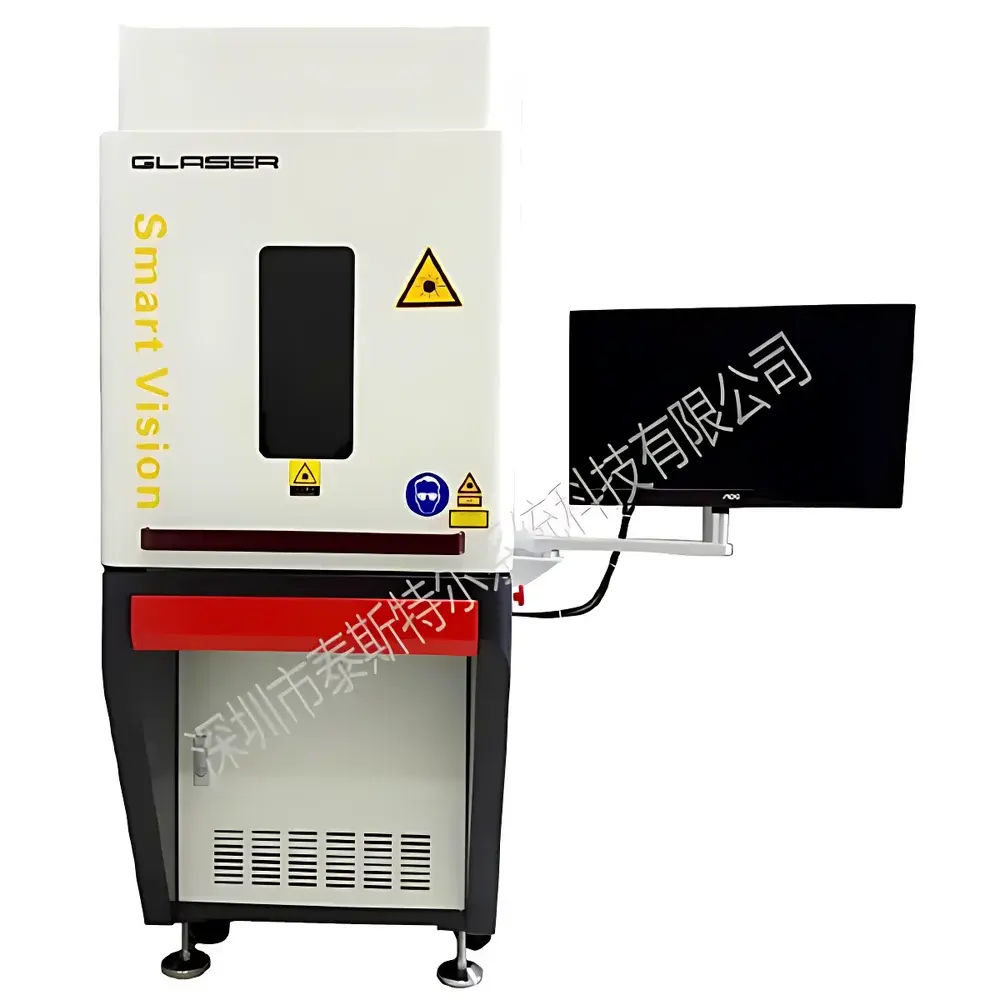
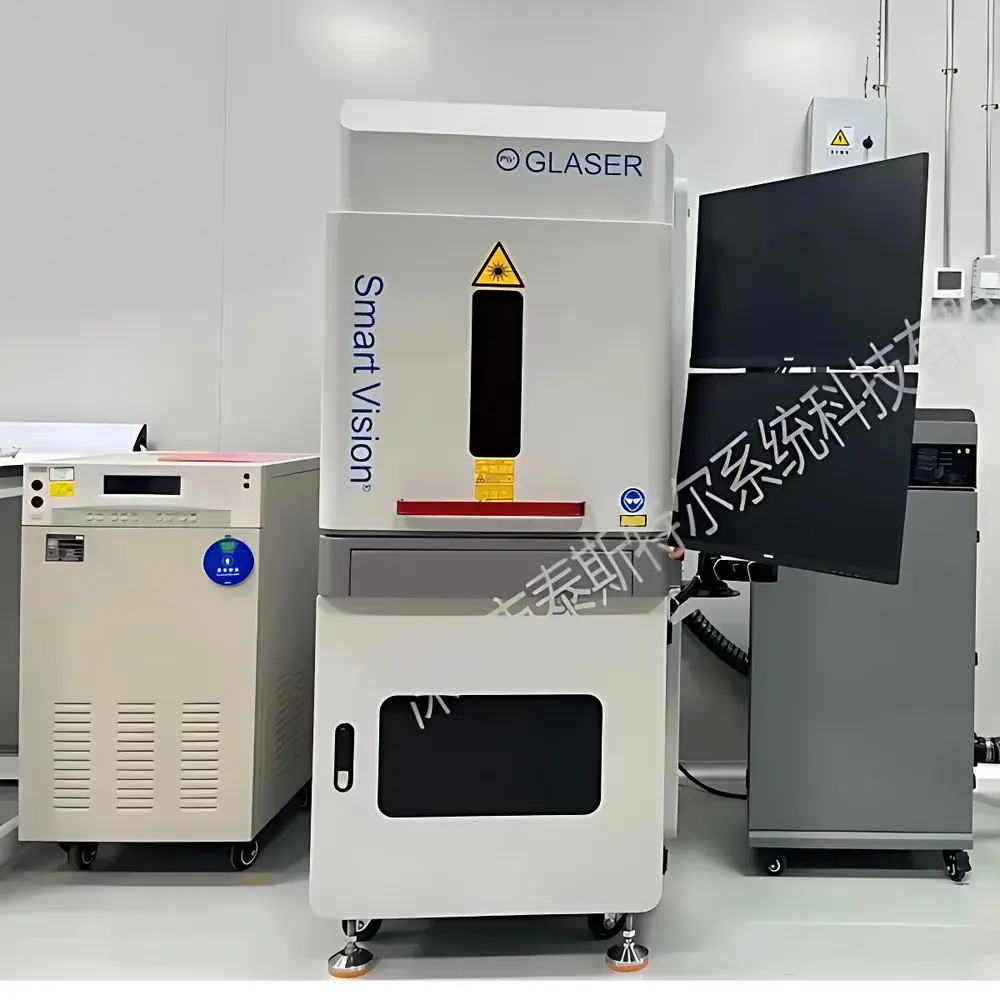
GLASER SMART ETCH II Laser Decapsulation System
| Brand | GLASER |
|---|---|
| Origin | Jiangsu, China |
| Manufacturer Type | Authorized Distributor |
| Country of Origin | China |
| Model | SMART ETCH II |
| Price | Upon Request |
| Laser Type | Air-Cooled Fiber Laser |
| Scanning Head | German High-Precision Digital Galvo Scanner |
| Wavelength | 1064 nm |
| Output Power | 20 W (Adjustable 1–100%) |
| Pulse Width | 1 ns – 250 ns |
| Beam Quality | M² ≤ 1.3 |
| Repetition Rate | 1 kHz – 4000 kHz |
| Decapsulation Depth Range | 0.01 mm – 3 mm |
| Maximum Scan Area | 150 mm × 150 mm |
| Focusing | Motorized Auto-Focus with Real-Time Red Dot Indicator |
| Imaging System | Integrated Coaxial Color CCD (Same-Optical-Path, Confocal Design) |
| Image Import Formats | X-Ray, SAM, SEM, JPG, PLT |
Overview
The GLASER SMART ETCH II Laser Decapsulation System is a precision-engineered semiconductor failure analysis tool designed for non-destructive, controlled removal of encapsulant materials from IC packages—including epoxy molding compounds (EMC), silicone gels, and underfill resins—without damaging underlying die, bond wires, or interconnect structures. Utilizing pulsed nanosecond fiber laser ablation at 1064 nm, the system operates on the principle of selective photothermal interaction: high peak power pulses induce localized thermal decomposition of organic polymer matrices while minimizing heat-affected zones (HAZ) in adjacent silicon or metal features. Its coaxial confocal imaging architecture ensures sub-micron spatial registration between the laser focal point and the live video feed—enabling true “what-you-see-is-what-you-ablate” operation. This eliminates manual alignment drift and significantly reduces operator dependency, making it suitable for both routine QA labs and advanced FA laboratories requiring traceable, repeatable decapsulation protocols compliant with JEDEC J-STD-033 and IPC-A-610 verification workflows.
Key Features
- Coaxial confocal optical path: Single-color CCD imaging system shares the same optical axis as the laser delivery path—ensuring pixel-perfect overlay accuracy between targeting frame and ablation zone.
- Real-time red-dot auto-focus: Motorized Z-axis stage synchronizes with a visible red pilot beam that dynamically tracks optimal focus position across varying package thicknesses (0.01–3 mm), eliminating manual refocusing during multi-layer decapsulation.
- High-fidelity image-guided ablation: Direct import and overlay of industry-standard failure localization files (X-ray radiographs, SAM C-scan images, SEM micrographs, JPG/PLT vector outlines) enables precise ROI definition without physical sample repositioning or coordinate transformation.
- German-engineered galvanometric scanning head: Delivers <1.3 M² beam quality and scan repeatability <±0.5 µm over full 150 mm × 150 mm field—supporting batch processing of QFN, BGA, SOIC, and stacked-die packages.
- Adjustable pulse parameter control: Independent tuning of pulse width (1–250 ns), repetition rate (1–4000 kHz), and energy density (1–100% of 20 W max) allows optimization for diverse encapsulant chemistries and substrate sensitivities.
- Embedded adaptive filtering algorithm: Enhances real-time contrast of laser scan paths against complex background textures (e.g., mold compound grain, filler particles), improving operator confidence during fine-feature exposure.
Sample Compatibility & Compliance
The SMART ETCH II accommodates standard semiconductor packaging formats up to 200 mm × 200 mm footprint and 50 mm height—including leaded and leadless packages, wafer-level CSPs, fan-out WLPs, and multi-chip modules. It supports decapsulation of thermoset epoxies (e.g., EMC-700 series), silicone gels (e.g., Dow Corning OE-6xxx), polyimide-based underfills, and ceramic-lid sealed devices. The system conforms to IEC 60825-1:2014 Class 4 laser safety requirements and integrates interlocked enclosure, fume extraction interface (compatible with ISO 10121-2 compliant scrubbers), and emergency stop circuitry. All ablation logs—including timestamp, pulse count, energy per pulse, Z-position history, and imported reference image metadata—are stored in audit-ready binary format, supporting GLP/GMP documentation needs and FDA 21 CFR Part 11-compliant electronic records when paired with validated third-party LIMS integration.
Software & Data Management
Controlled via Windows-based SMART ETCH Suite v4.x, the software provides intuitive graphical workflow management—from image registration and polygonal ROI drawing to multi-step depth profiling and layer-by-layer ablation sequencing. Each session generates an immutable .decap project file containing raw camera frames, laser parameter history, motor position traces, and user annotations. Export options include TIFF-stacked depth maps, CSV-aligned coordinate logs, and PDF reports with embedded calibration certificates. The software architecture supports role-based access control (RBAC), electronic signature capture, and optional integration with enterprise document management systems via RESTful API. Audit trails record all configuration changes, user logins, and critical events with SHA-256 hashing for integrity verification.
Applications
- Fault isolation for electrical opens/shorts confirmed by ICT or boundary-scan testing
- Post-reliability test analysis (e.g., HAST, TCT, uHAST) to assess delamination, popcorning, or wire bond lift
- Counterfeit detection through die marking inspection, metallization pattern verification, and process signature analysis
- Process development support for new encapsulant formulations or molding parameters
- Root cause analysis of thermal runaway events via post-test die surface morphology examination
- Academic research in microelectronics packaging mechanics and laser–polymer interaction physics
FAQ
Does the SMART ETCH II require external water cooling or compressed air?
No—its air-cooled fiber laser source and solid-state galvo scanner eliminate dependency on auxiliary utilities beyond standard 230 V AC power and fume extraction ducting.
Can the system perform depth-controlled ablation for partial decapsulation (e.g., exposing only bond pads without removing die passivation)?
Yes—layer-specific ablation is achieved via programmable Z-axis stepping combined with real-time endpoint detection using reflected intensity monitoring and optional integrated NIR reflectance sensor.
Is the software validated for use in regulated environments (e.g., automotive AEC-Q200 or medical ISO 13485 labs)?
While the base software is not pre-validated, GLASER provides IQ/OQ documentation templates, configuration control procedures, and change management guidelines aligned with GAMP5 principles to support customer-led validation.
What maintenance intervals are recommended for the optical path and laser source?
Annual preventive maintenance is advised, including galvo mirror calibration, CCD sensor flat-field correction, and laser output power verification using NIST-traceable thermopile sensor—no consumables or periodic part replacements are required within first 20,000 operational hours.
How does the system handle highly reflective or transparent encapsulants (e.g., glass-filled EMC or clear silicone)?
The adjustable pulse width and repetition rate allow empirical optimization of ablation threshold; additionally, optional UV pre-treatment module (sold separately) can be integrated to increase absorption cross-section for low-absorbance materials.