
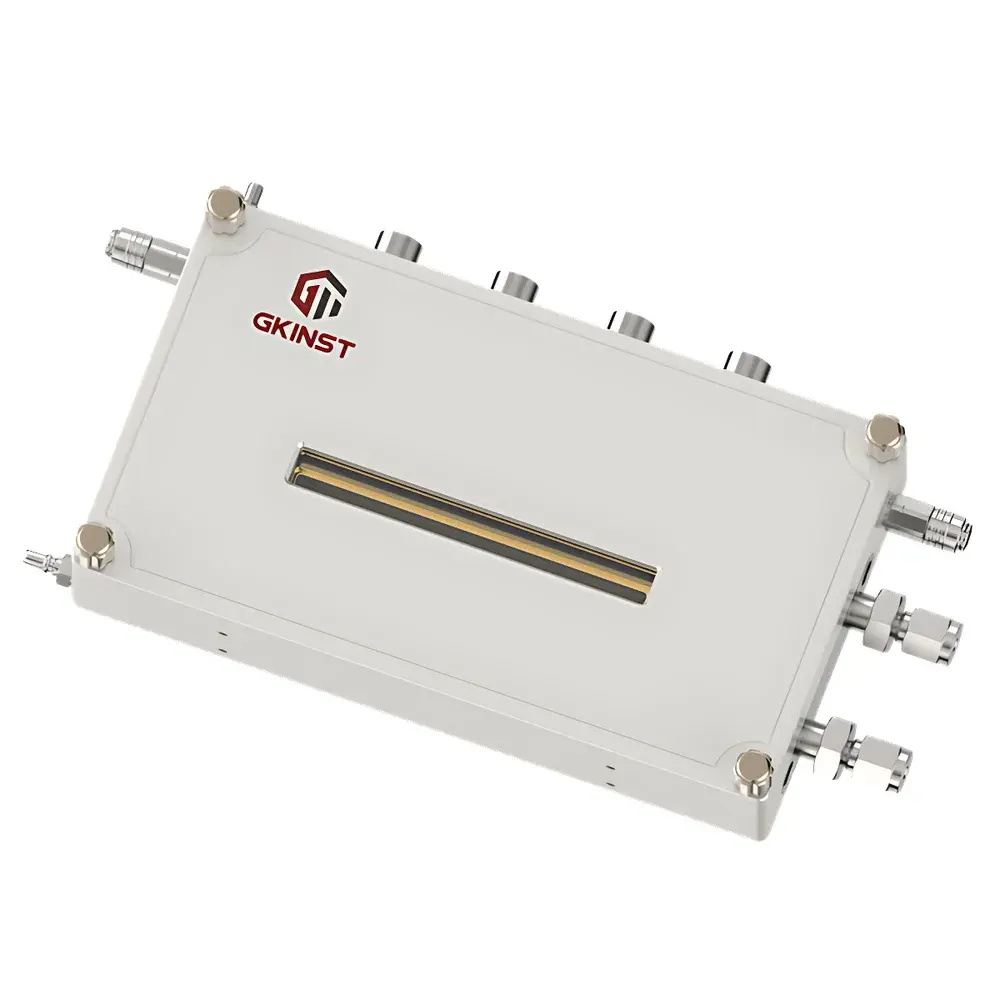
Gradient Heating Stage VGHS200 by GKINST
| Brand | GKINST |
|---|---|
| Origin | Anhui, China |
| Model | VGHS200 |
| Maximum Temperature | 200 °C |
| Minimum Temperature | Room Temperature (RT) |
| Max. Heating Rate | 30 °C/min |
| Temperature Stability | < 0.5 °C |
| Temperature Resolution | 0.1 °C |
| Temperature Sensor | PT100 Platinum Resistance Thermometer |
| Temperature Control | PID Dynamic Regulation |
| Application Domain | In-situ XRD for Materials Science, Semiconductor Characterization, Battery Research, Pharmaceutical Solid-State Analysis, and Mineralogical Studies |
Overview
The VGHS200 Gradient Heating Stage is a precision-engineered thermal stage designed specifically for in-situ and operando X-ray diffraction (XRD) experiments. It enables real-time structural characterization of crystalline and semi-crystalline materials under controlled thermal conditions—spanning from ambient temperature up to 200 °C. Built upon the fundamental principle of Bragg’s law and thermal lattice response, the VGHS200 facilitates quantitative monitoring of phase transitions, thermal expansion anisotropy, texture evolution, and residual stress relaxation during heating or cooling cycles. Its compact, vacuum-compatible design integrates seamlessly with standard XRD goniometers and synchrotron beamlines, supporting both reflection and transmission geometries. The stage is optimized for high angular reproducibility and minimal thermal drift—critical for time-resolved diffraction pattern collection and Rietveld refinement accuracy.
Key Features
- Wide operational temperature range: RT to 200 °C, with programmable ramping profiles and isothermal holds
- High-precision temperature control via closed-loop PID regulation using calibrated PT100 sensors (IEC 60751 Class A)
- Temperature stability better than ±0.5 °C over 30-minute dwell periods—validated under inert atmosphere and low-vacuum conditions
- Resolution of 0.1 °C enables fine-grained mapping of subtle solid-state transformations (e.g., polymorphic transitions, dehydration steps, or order–disorder phenomena)
- Uniform thermal gradient distribution across the sample area (< 1.5 °C variation over 10 mm diameter zone), minimizing spurious peak broadening
- Low thermal mass architecture supports rapid heating rates up to 30 °C/min without overshoot or hysteresis
- Non-magnetic stainless-steel housing and ceramic insulation ensure compatibility with magnetic field environments and prevent X-ray scattering artifacts
Sample Compatibility & Compliance
The VGHS200 accommodates standard XRD sample holders—including zero-background silicon wafers, capillary mounts, and custom-designed crucibles—with maximum sample dimensions of Ø10 mm × 2 mm thickness. It supports ambient air, nitrogen, argon, and forming gas atmospheres via optional gas inlet ports. The stage conforms to ISO 17025 calibration traceability requirements when used with external reference thermocouples. While not certified for GMP manufacturing environments, its thermal performance documentation aligns with ASTM E220–22 (Standard Test Method for Calibration of Thermocouples by Comparison Techniques) and supports GLP-compliant data acquisition workflows when paired with validated XRD software platforms.
Software & Data Management
The VGHS200 communicates via RS-485 or USB-to-serial interface, enabling bidirectional synchronization with major XRD control suites (e.g., PANalytical HighScore Plus, Bruker DIFFRAC.SUITE, Rigaku SmartLab Studio II). Real-time temperature logging is embedded directly into XRD scan metadata, ensuring full audit trail integrity per FDA 21 CFR Part 11 requirements when deployed with compliant electronic lab notebook (ELN) systems. Temperature ramps and hold segments are scriptable via ASCII command protocol, allowing integration into automated multi-step experimental sequences—such as thermal cycling protocols for battery cathode degradation studies or humidity–temperature co-varied analysis in pharmaceutical hydrate stability testing.
Applications
- Polymorph screening and thermal stability assessment of active pharmaceutical ingredients (APIs) and excipients
- In-situ observation of Li-ion battery electrode phase evolution during charge/discharge thermal aging
- Texture development analysis in epitaxial thin films and sputtered semiconductor layers
- Thermal decomposition kinetics of metal–organic frameworks (MOFs) and perovskite precursors
- Residual stress quantification in additively manufactured alloys through sin²ψ method at elevated temperatures
- Mineral phase transitions in geological samples under simulated diagenetic conditions
FAQ
Is the VGHS200 compatible with synchrotron beamlines?
Yes—it features a low-scatter geometry and vacuum flange options (CF-35 or KF-25) for direct integration with beamline sample stacks.
Can it operate under reducing atmospheres?
Yes, with optional quartz or alumina gas-tight enclosures and compatible feedthroughs for H₂/N₂ mixtures.
Does it support cooling below room temperature?
No—the VGHS200 is a heating-only stage; cryogenic operation requires complementary Peltier or liquid-nitrogen stages.
What calibration documentation is provided?
Each unit ships with a factory temperature uniformity map and PT100 calibration certificate traceable to NIM (China National Institute of Metrology).
Is firmware upgradeable in the field?
Yes—via UART bootloader mode using GKINST-provided configuration utilities; version history and change logs are maintained per ISO/IEC 17025 clause 5.9.




