
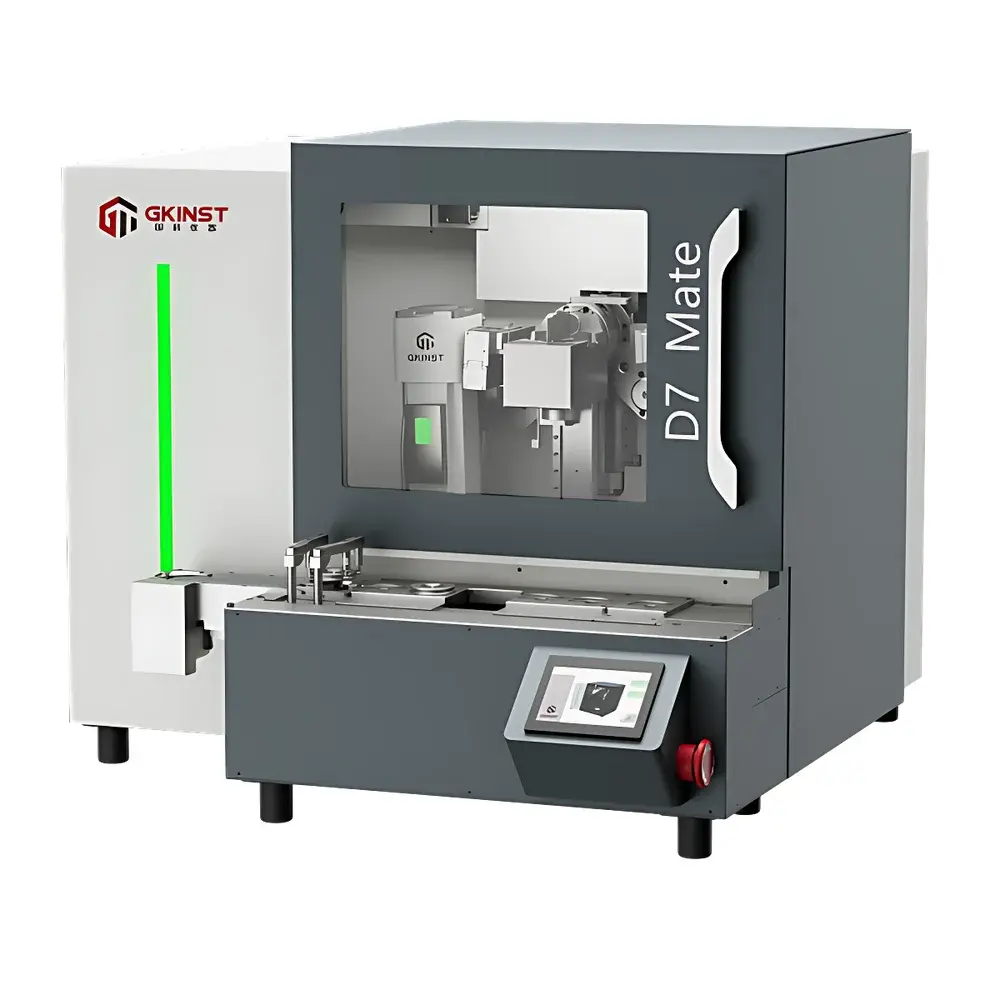
Bruker D7 Mate Benchtop X-ray Diffractometer (XRD)
| Brand | GKInst |
|---|---|
| Origin | Anhui, China |
| Manufacturer Type | Authorized Distributor |
| Product Category | Domestic |
| Model | D7 Mate |
| Price Range | USD 28,000 – 140,000 |
| Instrument Type | Powder X-ray Diffractometer |
| Configuration | Benchtop |
| Power Rating | 600 W / 1200 W (Selectable) |
| Angular Accuracy | ±0.0001° |
| High-Voltage Generator | 40 kV / 600 W or 40 kV / 1200 W |
| Target Materials | Cu, Cr, Mo |
| Goniometer Geometry | Horizontal θ/2θ or ω/θ |
| Goniometer Radius | 150 mm |
| Angular Range | −3° to 152° (140° with automatic beam-defining slit) |
| Repeatability | <0.0001° (2σ) |
| Detector | 640-channel 1D silicon strip detector, active area 32 mm × 8 mm |
| Cooling | Integrated recirculating water chiller (standard), optional external chiller interface |
| Beam Path | Air-scatter suppression module with motorized divergence slit and automatic anti-scatter device |
| Sample Stages | Fixed stage, in-situ heating stage, multi-axis rotating stage, capillary stage, thin-film stage, multifunctional stage, pouch-cell battery stage, high-throughput 8-position rotary stage, optional 6-position automated sample loader |
| Data Reproducibility | NIST SRM 660c LaB₆ reference standard, RSD ≤ 0.003% (peak position, 2θ) |
| Control Interface | External PC or integrated 10.1″ capacitive touchscreen |
| Dimensions (L×W×H) | 880 mm × 705 mm × 735 mm |
| Mass | ≤180 kg |
| Electrical Supply | AC 200–240 V, 50/60 Hz |
Overview
The Bruker D7 Mate Benchtop X-ray Diffractometer is a fully engineered powder X-ray diffraction (XRD) system designed for rigorous analytical workflows in industrial quality control, academic research, and applied materials development. Based on Bragg’s law and the fundamental principles of constructive interference from crystalline lattices, the D7 Mate employs a fixed-anode sealed-tube X-ray source with selectable high-voltage/high-power operation (40 kV / 600 W or 40 kV / 1200 W), enabling optimized intensity and resolution across diverse sample classes. Its horizontal θ/2θ goniometer—mechanically stabilized with a 150 mm radius and precision-ground bearing assembly—delivers angular reproducibility better than ±0.0001° (2σ), meeting the metrological requirements for phase identification, quantitative Rietveld refinement, crystallite size analysis (Scherrer), and microstrain evaluation per ISO 21399, ASTM E975, and ICH Q5E guidelines. Unlike conventional floor-standing systems, the D7 Mate achieves comparable data fidelity in a compact footprint (0.46 m³), eliminating the need for dedicated radiation vaults while maintaining full compliance with IEC 61000-6-3 (EMC) and IEC 62471 (photobiological safety).
Key Features
- Modular X-ray source platform supporting Cu, Cr, and Mo anodes—enabling wavelength selection for optimal Kα separation, fluorescence suppression, or penetration depth tuning
- Motorized, air-scatter-optimized beam path with programmable divergence slits and dynamic anti-scatter collimation—reducing background by >40% versus fixed-optics configurations
- High-resolution 640-channel 1D silicon strip detector with 0.02° effective step size and <15 µs dead time—capable of single-scan acquisition times under 30 seconds for routine phase ID
- Thermally stable goniometer architecture featuring low-thermal-expansion ceramic bearings and real-time encoder feedback—ensuring long-term angular drift <0.0005° over 8-hour continuous operation
- Dual-control architecture: seamless integration with external Windows-based PCs or embedded 10.1″ industrial touchscreen with deterministic real-time OS—supporting audit-trail-enabled method execution per FDA 21 CFR Part 11 Annex 11 requirements
- Comprehensive sample handling ecosystem—including in-situ heating stages (up to 1200°C), thin-film reflectivity modules, capillary holders for air-sensitive compounds, and GLP-compliant 8-position rotary stages with barcode-assisted sample tracking
Sample Compatibility & Compliance
The D7 Mate accommodates solid powders, pressed pellets, thin films, bulk metals, geological specimens, pharmaceutical tablets, battery electrode coatings, and encapsulated electrochemical cells (e.g., pouch-type Li-ion). All sample stages comply with ISO 17025:2017 clause 6.4.3 for environmental stability and mechanical repeatability. Radiation shielding meets national Class II cabinet X-ray equipment standards (GBZ 138–2002) and EU Directive 2013/59/Euratom. Software-generated reports include mandatory metadata fields for traceability: operator ID, calibration timestamp, NIST SRM verification record, and raw scan checksums—fully aligned with GLP and GMP documentation frameworks.
Software & Data Management
Controlled via DIFFRAC.SUITE™ (v5.2+), the system provides unified access to EVA (phase search/match), TOPAS-Academic (Rietveld quantification), and DIFFRAC.LEPTOS (crystallite size/strain modeling). All processing workflows support batch-mode automation, version-controlled method templates, and encrypted database storage with role-based permissions. Audit trails log every parameter change, file export, and calibration event with ISO 8601 timestamps and SHA-256 hash integrity verification. Raw .raw and .udf files are natively compatible with third-party tools including GSAS-II, FullProf, and Match!—ensuring long-term data portability beyond vendor lock-in.
Applications
- Semiconductor: Quantitative analysis of SiC polytypes, Ge/Si strain mapping, and gate oxide thickness validation via grazing-incidence XRD (GIXRD)
- Energy materials: In-situ monitoring of cathode structural evolution (NMC, LFP) during electrochemical cycling; anode graphite disorder assessment via (002) peak broadening
- Cement & metallurgy: Rapid clinker phase quantification (alite, belite, ferrite), slag reactivity indexing, and residual austenite measurement in heat-treated steels
- Pharmaceuticals: Polymorph screening, hydrate/solvate identification, and tablet crystallinity profiling per USP <941> and ICH Q6A
- Environmental geochemistry: Clay mineral assemblage deconvolution in soil/sediment cores; heavy metal speciation via co-precipitated phase detection
- Food science: Starch gelatinization kinetics, crystalline fat content in dairy analogs, and amorphous content in spray-dried powders
FAQ
Is the D7 Mate compliant with FDA 21 CFR Part 11 for regulated environments?
Yes—the integrated DIFFRAC.SUITE software includes electronic signature support, immutable audit trails, and configurable user roles with password complexity enforcement.
Can the system perform in-situ heating experiments up to 1000°C?
The optional HTK 1200N stage supports continuous heating to 1200°C under inert gas or vacuum, with real-time temperature synchronization to diffraction data acquisition.
What level of maintenance is required for the X-ray tube?
The sealed-tube anode has a rated lifetime of ≥15,000 hours; no filament replacement or vacuum service is needed during normal operation.
Does the detector support time-resolved measurements?
Yes—via external trigger input and sub-second frame readout, enabling kinetic studies with temporal resolution down to 100 ms per pattern.
How is data integrity verified during instrument qualification?
Each installation includes NIST SRM 660c (LaB₆) verification with documented RSD ≤0.003% for 2θ peak position and intensity linearity across the full angular range.
Related Products






