
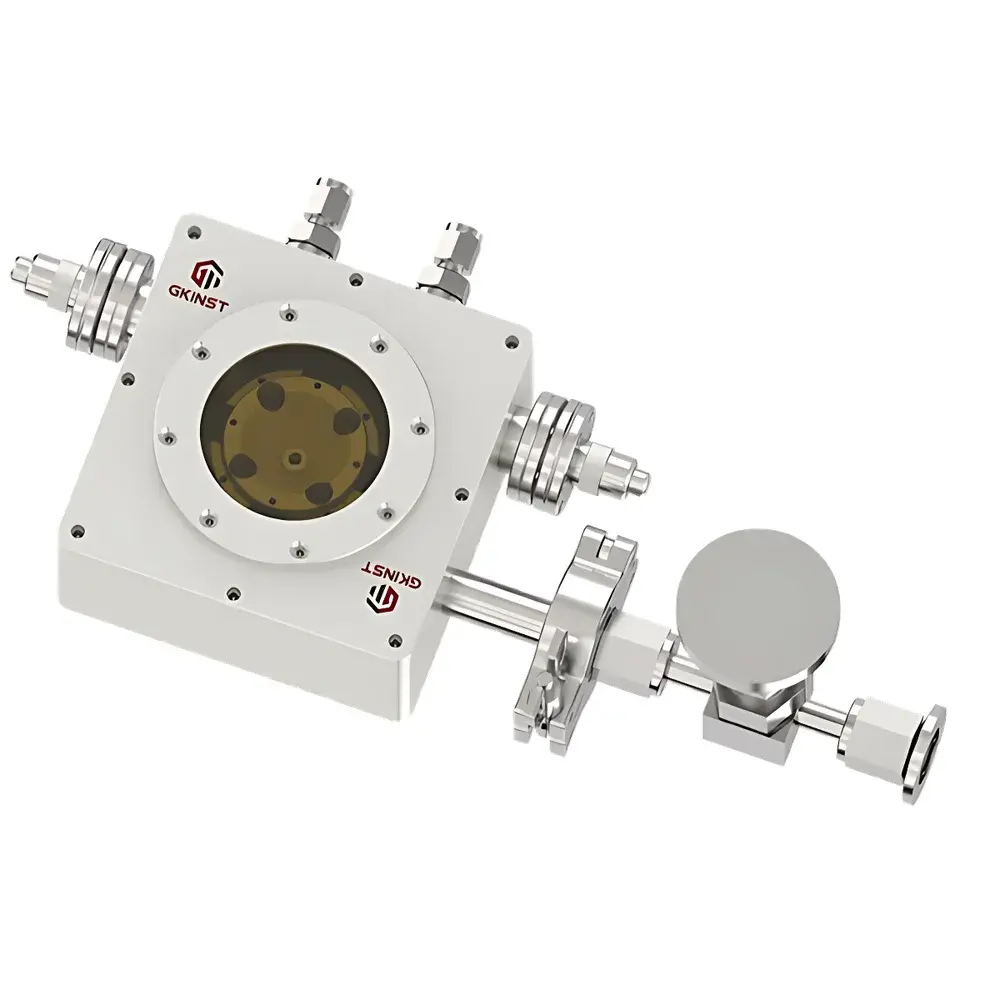
DAC-HTP700 High-Temperature High-Pressure Diamond Anvil Cell System
| Brand | GKINST |
|---|---|
| Model | DAC-HTP700 |
| Origin | Anhui, China |
| Press Type | BX90 (optional) |
| Press Material | Inconel 718 superalloy |
| Temperature Range | RT to 700 °C |
| Temperature Control Accuracy | ±1 °C |
| DAC Components | Tungsten Carbide gasket, Type-Ia diamond anvils |
| Temperature Regulation | PID dynamic feedback control |
| Thermocouple | K-type |
| Vacuum Chamber Leak Rate | <1×10⁻⁸ Pa·L/s |
Overview
The DAC-HTP700 is a precision-engineered high-temperature, high-pressure diamond anvil cell (DAC) system designed for in situ characterization of materials under extreme thermodynamic conditions. It operates on the fundamental principle of hydrostatic or quasi-hydrostatic pressure generation via opposed diamond anvils compressing a microsample confined within a gasketed chamber, while simultaneously enabling precise resistive heating and real-time monitoring. Integrated with a BX90-type high-strength press frame constructed from Inconel 718—a nickel-based superalloy selected for its exceptional creep resistance and thermal stability up to 700 °C—the system supports synchrotron X-ray diffraction (XRD), Raman spectroscopy, electrical transport measurements, optical absorption, and magnetic susceptibility studies under controlled atmospheres or ultra-high vacuum. Its architecture conforms to standard beamline interface requirements for third-generation light sources, facilitating compatibility with downstream detectors including Pilatus, Eiger, and CCD-based X-ray imaging systems.
Key Features
- Robust mechanical design featuring a BX90-compatible press frame fabricated from Inconel 718, ensuring dimensional stability and minimal thermal drift during prolonged heating cycles.
- DAC module equipped with polished Type-Ia single-crystal diamond anvils (typically 300–500 µm culet diameter) and pre-indented tungsten carbide gaskets (thickness 50–200 µm), optimized for pressure generation up to ~50 GPa at elevated temperatures.
- PID-driven dynamic temperature regulation with K-type thermocouples embedded in proximity to the sample chamber, delivering ±1 °C accuracy across the full RT–700 °C operational range.
- Hermetically sealed gas/vacuum chamber with leak rate <1×10⁻⁸ Pa·L/s, supporting inert gas purging (Ar, He), reactive gas environments (H₂, NH₃), or UHV conditions for oxidation-sensitive experiments.
- Modular electrical feedthroughs rated for >1 A DC current and <500 V isolation, enabling concurrent resistivity, Hall effect, or dielectric spectroscopy measurements.
- Standardized flange interfaces (CF-63 or KF-40) compatible with commercial vacuum pumps, residual gas analyzers (RGAs), and cryogenic cooling stages for hybrid T–P–T experiments.
Sample Compatibility & Compliance
The DAC-HTP700 accommodates solid powders, thin films, microcrystals, and fluid inclusions (e.g., aqueous electrolytes, molten salts) encapsulated in noble metal or borosilicate glass capsules. Sample volumes range from 10⁻¹² to 10⁻⁹ m³. The system complies with ISO 27327 (vacuum equipment leak testing), ASTM E29 (significant digits in test data reporting), and supports GLP-compliant documentation when paired with validated data acquisition software. All metallic components meet RoHS Directive 2011/65/EU restrictions on hazardous substances.
Software & Data Management
While the DAC-HTP700 operates as a hardware platform requiring external instrumentation control, it integrates seamlessly with industry-standard data acquisition environments including LabVIEW, Python-based PyVISA frameworks, and EPICS IOC configurations. Temperature ramp profiles, pressure calibration logs (via ruby fluorescence or gold equation-of-state references), and time-stamped experimental metadata can be exported in HDF5 or NeXus format—ensuring traceability per FDA 21 CFR Part 11 requirements when deployed in regulated R&D settings. Audit trails, user access levels, and electronic signatures are supported through optional middleware extensions.
Applications
- Phase transition mapping of battery cathode materials (e.g., NMC, LFP) under operando thermal stress.
- In situ XRD analysis of semiconductor heterostructures during epitaxial strain relaxation at 500–700 °C.
- Thermal conductivity quantification of thermoelectric skutterudites using time-domain thermoreflectance (TDTR) coupled with DAC confinement.
- High-P/T reaction kinetics of mineral precursors relevant to geophysical mantle modeling.
- Structural evolution of bioactive glasses under simulated physiological pressure–temperature conditions.
FAQ
Can the DAC-HTP700 be used with synchrotron radiation sources?
Yes—it features standard beamline-compatible flanges and low-Z structural elements to minimize parasitic scattering.
What is the maximum recommended pressure at 700 °C?
Hydrostatic limits depend on gasket geometry and pressure medium; typical usable range is 25–40 GPa with silicone oil or neon, verified via ruby fluorescence shift calibration.
Is remote operation supported?
Fully supported via Ethernet-connected programmable power supplies and digital I/O modules, with API documentation available for custom integration.
Does the system include pressure calibration tools?
No—calibration standards (ruby chips, gold foils) and reference equations of state must be sourced separately per experimental requirements.
Are replacement diamond anvils available through GKINST?
Yes—certified Type-Ia diamonds with specified culet size, surface roughness (<5 nm Ra), and birefringence grade are supplied with full metrology reports.






