
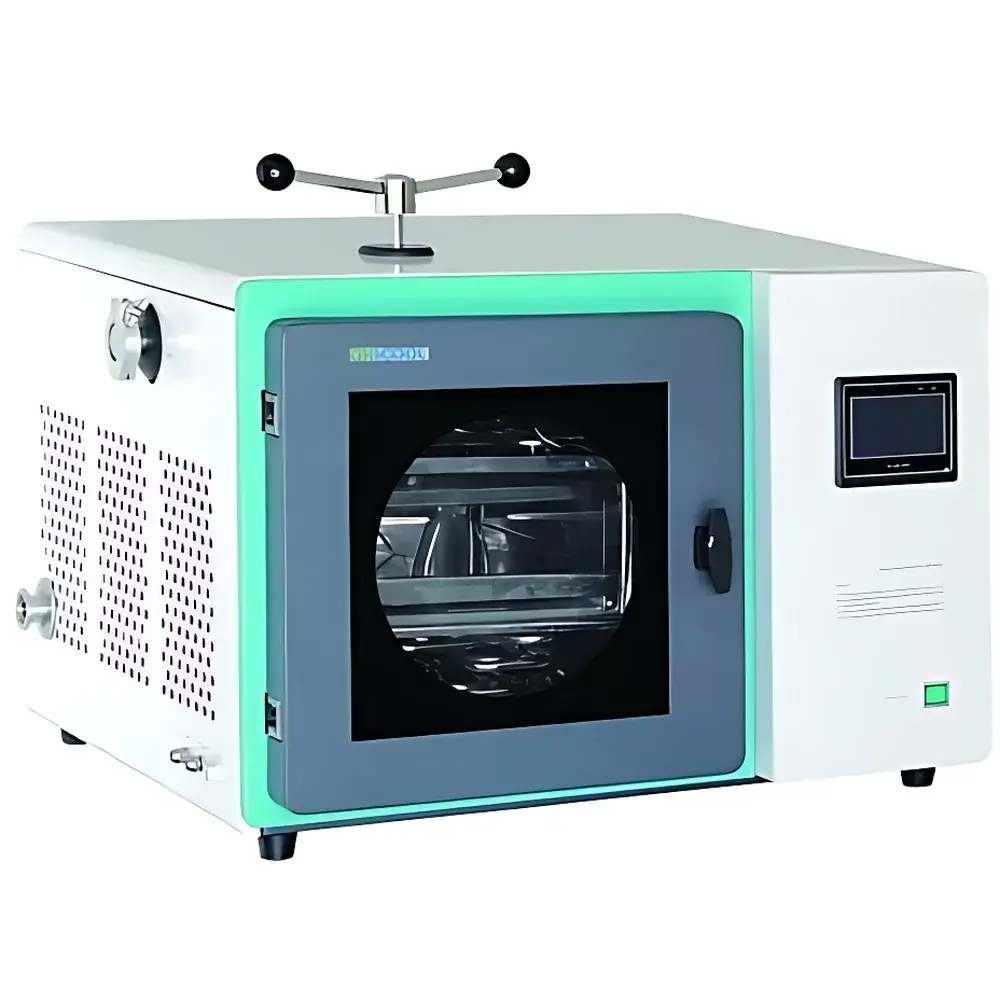
BIOCOOL Pilot1-2MD Pilot-Scale Freeze Dryer
| Brand | BIOCOOL |
|---|---|
| Origin | Beijing, China |
| Model | Pilot1-2MD |
| Type | Shelf-Type Freeze Dryer |
| Application | Pilot-Scale Processing |
| Lyophilization Area | 0.1 m² |
| Ultimate Vacuum | <7 Pa |
| Condensate Capacity (24 h) | 2 L/24h |
| Cold Trap Temperature (No Load) | <−55 °C |
| Compressor | Imported High-Efficiency Unit |
| Vacuum Pump | Imported High-Speed Rotary Vane Pump |
| Control System | Industrial Touchscreen with Programmable Logic Controller (PLC) |
| Temperature & Vacuum Monitoring Frequency | 50 ms/sample |
| Process Recipe Storage | 500 user-defined protocols |
| Data Logging Options | Internal memory (3-month retention), USB flash drive (optional), PC database (optional) |
| Safety Features | Overcurrent protection, overload protection, 36 V safe-voltage heating circuit, overtemperature cutoff, vacuum interlock, pump anti-backflow device |
| Warranty | 18 months (excl. vacuum pump) |
Overview
The BIOCOOL Pilot1-2MD is a fully programmable, shelf-type pilot-scale freeze dryer engineered for reproducible lyophilization of pharmaceuticals, biologics, diagnostics, and high-value research materials under controlled, GMP-aligned conditions. It operates on the fundamental principle of sublimation—removing water from frozen samples under deep vacuum while maintaining product integrity through precise thermal management. Designed for transitional development between lab-scale optimization and commercial manufacturing, the Pilot1-2MD supports process validation, formulation stability testing, and small-batch production (up to 0.1 m² shelf area). Its architecture integrates vacuum thermodynamics, cryogenic condensation, and closed-loop PID temperature control across heated shelves—enabling accurate replication of critical process parameters including shelf temperature ramp rates, primary drying hold times, and secondary drying vacuum setpoints.
Key Features
- Optically transparent drying chamber door with reinforced vacuum sealing—engineered for >10,000 operational cycles without seal degradation.
- Shelf pre-freezing capability: shelves cool to −40 °C prior to loading, eliminating manual pre-freezing steps and reducing nucleation variability.
- Dual independent cooling circuits: direct-cooling shelf system paired with a −55 °C cold trap (no-load), optimized for water vapor capture efficiency and minimal thermal lag.
- Fully programmable freeze-drying cycle control: supports up to 500 user-defined recipes with multi-step ramp/hold profiles for shelf temperature, vacuum pressure, and gas backfill.
- Intelligent vacuum regulation system: dynamically adjusts chamber pressure during primary and secondary drying to suppress boil-over, collapse, or vial breakage in sensitive formulations.
- Pulse-controlled inert gas backfill (N₂ or Ar): three selectable flow rates (slow/medium/fast) prevent particle dispersion in lyophilized powders and fragile cake structures.
- Non-electric cold trap defrosting: mechanical expansion-based defrost mechanism eliminates electrical hazards and reduces downtime versus resistive heating methods.
- Real-time process monitoring: 50 ms sampling interval for shelf temperature, chamber pressure, and condenser temperature—fully traceable and exportable.
- Comprehensive safety architecture: includes 36 V low-voltage shelf heating, overtemperature cutoff, vacuum interlock with drain valve, and vacuum pump anti-oil-backflow protection.
Sample Compatibility & Compliance
The Pilot1-2MD accommodates bulk trays, stoppered vials (with optional manual stoppering), and external flasks via multi-port manifold configuration. It is validated for aqueous solutions, suspensions, and pastes with eutectic temperatures above −40 °C. The system meets foundational requirements for GLP-compliant documentation and supports audit-ready operation when equipped with optional features such as end-point determination (via capacitance or pressure-rise test), temperature/vacuum calibration logs, and electronic signature-capable PC database storage. While not certified to ISO 22000 or FDA 21 CFR Part 11 out-of-the-box, its data architecture—including timestamped, non-erasable cycle records and user-access-level controls—provides a foundation for regulatory alignment in QC/QA environments.
Software & Data Management
The integrated industrial touchscreen HMI runs a deterministic real-time OS with embedded PLC logic. All process variables—including shelf temperature, chamber pressure, condenser temperature, and elapsed time—are logged continuously at 50 ms resolution. Data retention options include internal flash memory (retains ≥90 days of full-cycle data), USB export (CSV format, compatible with Excel and statistical process control tools), and optional PC-hosted SQL database with remote access capability (max. 1.5 km via Ethernet). Optional modules support ASTM E2500–based protocol generation, USP lyophilization validation templates, and automated report generation compliant with ALCOA+ principles (Attributable, Legible, Contemporaneous, Original, Accurate, Complete, Consistent, Enduring, Available).
Applications
- Pharmaceutical development: formulation screening, stability studies, and clinical trial batch production of sterile injectables and biologics.
- Vaccine and monoclonal antibody processing: preservation of conformational integrity during primary drying and residual moisture control in secondary drying.
- Diagnostic reagent manufacturing: lyophilization of enzyme conjugates, lateral flow assay components, and PCR master mixes.
- Academic and contract research: scalable process transfer from benchtop (e.g., Labconco FreeZone) to pilot scale with documented parameter mapping.
- Food science and nutraceuticals: dehydration of probiotics, enzymes, and heat-labile botanical extracts without Maillard degradation.
FAQ
What is the maximum batch capacity for vial-based processing?
Based on 0.1 m² shelf area and standard 2R vials (22 mm diameter), the unit accommodates approximately 400–450 vials per cycle—depending on fill volume and spacing requirements.
Is the system compatible with organic solvent-containing formulations?
Yes—when equipped with the optional organic solvent trap and oil mist filter, the Pilot1-2MD safely handles acetone, ethanol, and tert-butanol-based systems with condenser temperature maintained below −55 °C.
Can process data be exported for regulatory submission?
Yes—raw CSV files include timestamps, sensor IDs, and engineering units; optional PC database module adds electronic signatures, audit trails, and 21 CFR Part 11–compatible user authentication.
Does the system support in-situ determination of lyophilization endpoint?
An optional capacitance-based endpoint detection module is available, enabling automatic termination of secondary drying when residual moisture falls within predefined limits.
What calibration capabilities are built-in?
The system supports two-point calibration for shelf temperature sensors and Pirani/capacitance vacuum transducers—traceable to NIST-certified references via external calibration equipment.
Related Products



