
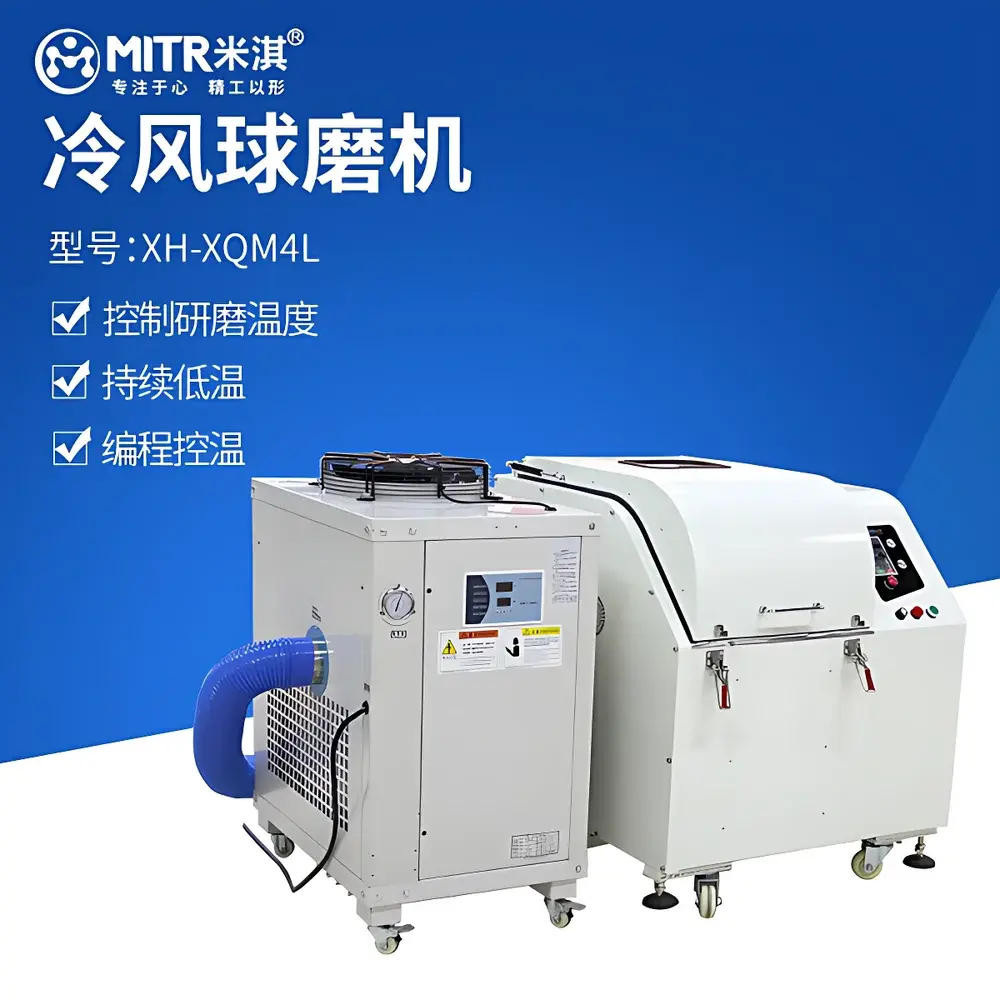
MITR XH-XQM Series Cryogenic Planetary Ball Mill with Air-Cooling System
| Brand | MITR |
|---|---|
| Origin | Hunan, China |
| Manufacturer Type | Direct Manufacturer |
| Equipment Type | Planetary Ball Mill |
| Sample Applicability | Hard, Brittle, Fibrous Materials (Dry/Wet Grinding) |
| Final Particle Size | <100 nm |
| Feed Particle Size | <3 mm |
| Batch Capacity | 1 L |
| Cooling Method | Integrated Air-Cooling System (Temperature Control Range: 1–20 °C) |
| Max. Acceleration | 100 g |
| Simultaneous Processing | Up to 4 Independent Grinding Jars |
| Compliance | Designed for GLP/GMP-aligned lab environments |
Overview
The MITR XH-XQM Series Cryogenic Planetary Ball Mill with Air-Cooling System is an engineered solution for high-energy, temperature-controlled comminution of hard, brittle, and thermally sensitive materials. Operating on the principle of planetary motion—where grinding jars simultaneously revolve around a central axis while rotating on their own axes—the system delivers controlled mechanical energy through impact, shear, and compressive forces between grinding media and sample. Unlike conventional ball mills, this design enables reproducible nanoscale particle size reduction (<100 nm) without thermal degradation, making it indispensable for advanced material synthesis, alloying, solid-state reactions, and dispersion of nanocomposites. The integrated air-cooling system maintains chamber temperatures between 1–20 °C via programmable PLC-controlled cold-air circulation, eliminating reliance on liquid nitrogen while ensuring stable thermal management during extended operation. This architecture supports both dry and wet grinding modes, vacuum/inert-atmosphere processing (with optional sealed jars), and compatibility with multi-material jar systems—including stainless steel, zirconia, alumina, agate, PTFE, polyurethane, and tungsten carbide—to minimize cross-contamination and elemental leaching.
Key Features
- Programmable dual-axis motion control: independent adjustment of revolution (5–400 rpm) and rotation (10–800 rpm) speeds to fine-tune kinetic energy input and shear rate.
- Four-jar configuration with symmetrical loading capability—enabling parallel processing of up to four distinct samples or replicate batches under identical mechanical and thermal conditions.
- Air-cooling system featuring high-efficiency scroll compressor (Panasonic-sourced), insulated chamber housing, and closed-loop cold-air recirculation—reducing power consumption by >30% compared to standard cryogenic setups.
- Patented oil-sealed transmission with polymer-metal rolling interface eliminates gear wear, reduces acoustic noise to <62 dB(A), and extends service life beyond 20,000 operational hours.
- Integrated safety architecture: interlocked access door with行程 switch (power cutoff upon opening), overload protection, emergency stop, and automatic pause/resume after power interruption.
- PLC-based HMI panel supporting time-programmed cycles, directional reversal, interval pauses, and real-time parameter logging—including speed, duration, direction, and cooling status.
- Modular jar compatibility: standardized mounting interface accepts 50–3000 mL jars across 12 material classes, ensuring optimal selection for chemical inertness, hardness, and contamination control per application.
Sample Compatibility & Compliance
The MITR XH-XQM series accommodates a broad spectrum of inorganic and organic feedstocks—including metal oxides (Al₂O₃, Fe₃O₄), alloys (Mg, Al, Ti powders), ceramics (SiC, ZrO₂), geological specimens (quartz, limestone, kaolin), pharmaceutical excipients and APIs, botanical matrices (ginseng, dendrobium), polymers, catalysts, and spent battery cathode materials. Its capacity to maintain sub-20 °C operating temperatures prevents agglomeration, oxidation, phase transition, or decomposition during milling—critical for preserving metastable phases in mechanochemical synthesis. The system conforms to laboratory quality infrastructure requirements: audit trails support FDA 21 CFR Part 11 compliance when paired with validated software; grinding repeatability meets ISO 5725-2 precision criteria; and particle size distribution outputs align with ASTM E29 rounding rules and ISO 13320 laser diffraction validation frameworks.
Software & Data Management
While the base unit operates via embedded PLC controller with local parameter storage, optional Ethernet-enabled firmware upgrades allow remote monitoring and data export via CSV/Excel formats. Timestamped cycle logs include start/stop times, rotational profiles, cooling setpoints, and fault codes—facilitating traceability in regulated environments. For GLP/GMP labs, optional software modules provide electronic signature capability, user-level access control, and automated report generation compliant with ALCOA+ principles (Attributable, Legible, Contemporaneous, Original, Accurate, Complete, Consistent, Enduring, Available). All firmware revisions undergo IEC 62304 Class B medical device software lifecycle validation protocols.
Applications
This mill serves as a core platform in academic and industrial R&D laboratories for: mechanochemical synthesis of MOFs and covalent organic frameworks; preparation of nanostructured electrode materials for Li-ion and solid-state batteries; top-down exfoliation of 2D materials (graphene, h-BN); homogenization of heterogeneous catalysts; particle size reduction of heat-labile APIs for enhanced bioavailability; dispersion of quantum dots in polymer matrices; and pretreatment of environmental samples (soil, sludge, fly ash) prior to elemental analysis. Its ability to sustain consistent mechanical activation across multiple jars ensures statistically robust experimental design—particularly valuable in DOE-based optimization studies and inter-laboratory round-robin testing.
FAQ
What temperature range does the air-cooling system maintain during operation?
The system achieves and sustains 1–20 °C within the grinding chamber, with ±0.5 °C stability over 8-hour continuous runs. Temperature is actively monitored and adjusted via PID-controlled cold-air flow.
Can the mill operate under inert gas or vacuum conditions?
Yes—optional vacuum-rated grinding jars (rated to 10⁻² mbar) and gas-purging adapters enable operation under argon, nitrogen, or forming gas atmospheres. Sealing integrity is verified per ISO 15848-1 leakage standards.
Is the equipment suitable for regulatory-compliant documentation workflows?
When configured with optional audit-trail software, it supports full 21 CFR Part 11 compliance—including electronic signatures, role-based permissions, and immutable cycle logs—with IQ/OQ documentation packages available upon request.
How is jar symmetry and mass balance enforced for reproducible results?
The machine’s dynamic balancing algorithm requires paired jars to differ in mass by ≤±2 g. An integrated load sensor validates symmetry before initiating motion, preventing vibration-induced measurement drift.
What maintenance intervals are recommended for long-term reliability?
Lubrication-free transmission requires no scheduled maintenance for first 10,000 hours. Annual inspection includes compressor oil level verification, air filter replacement, and torque calibration of jar clamping mechanisms per ISO 10816-3 vibration thresholds.



