
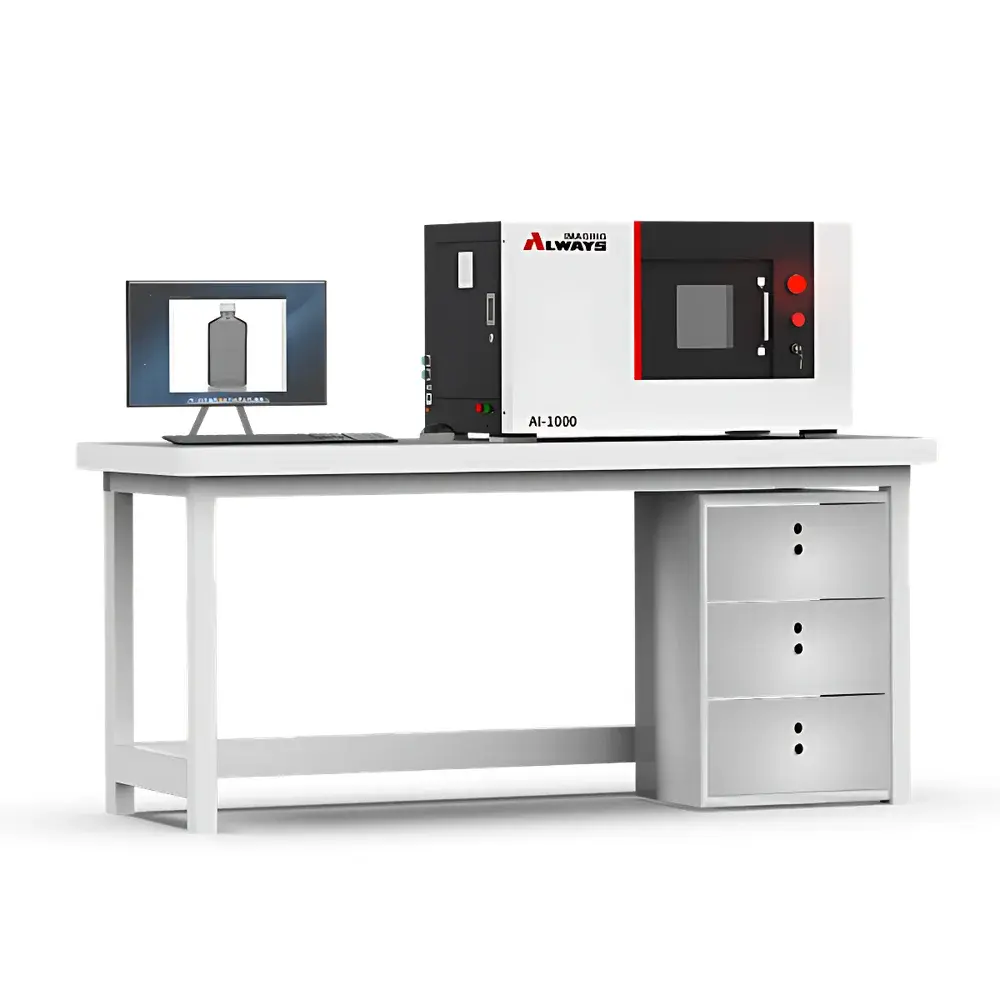
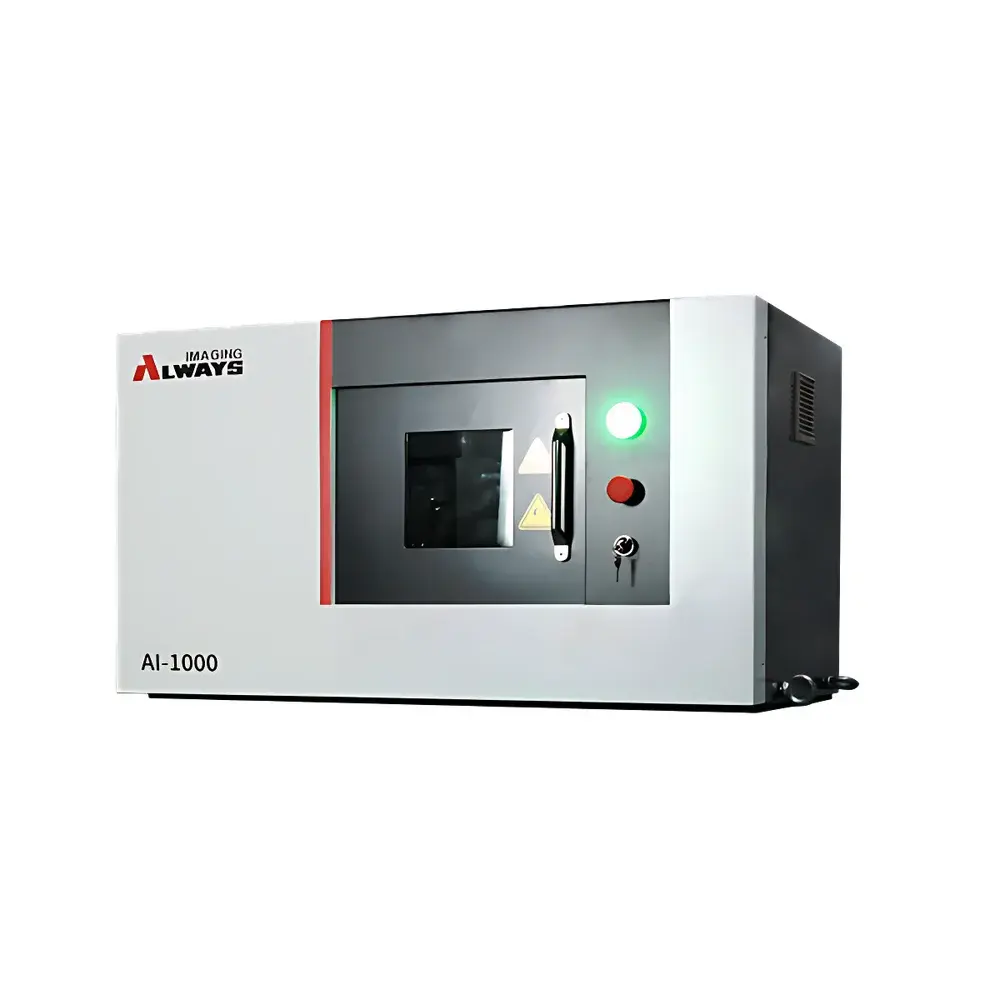
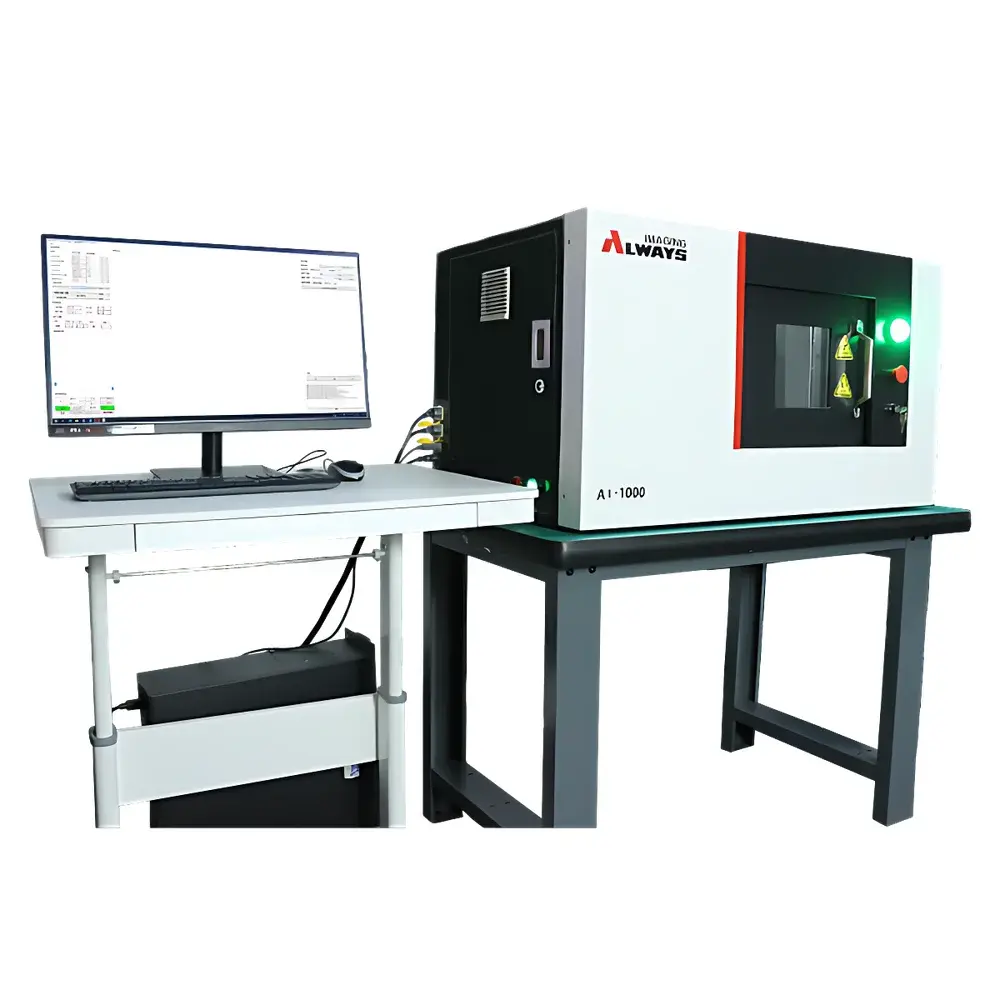
Always Imaging AI-1000 Industrial Micro-CT System for Glass Container Porosity Analysis
| Brand | Always Imaging |
|---|---|
| Origin | Shanghai, China |
| Manufacturer Type | OEM Manufacturer |
| Country of Origin | China |
| Model | AI-1000 |
| Detector Type | Flat-Panel Detector |
| Scan Mode | Translation-Rotation (TR) |
| X-ray Energy | 80 kV |
| Maximum Sample Diameter | 250 mm |
| Maximum Sample Height | 350 mm |
| Sample Weight Capacity | 5 kg |
| System Dimensions (W×D×H) | 1100 × 660 × 660 mm |
| Contrast Resolution | <1% |
| Minimum Detectable Defect Size | 0.1 mm |
| Radiation Leakage | <1 µSv/h |
| Net Weight | 350 kg |
Overview
The Always Imaging AI-1000 is a benchtop industrial micro-computed tomography (micro-CT) system engineered for non-destructive, quantitative porosity and internal defect analysis of glass and ceramic containers—particularly wine bottles, beverage bottles, and cosmetic vials. Operating on the principle of X-ray absorption contrast tomography, the AI-1000 acquires hundreds of high-fidelity projection images across a full 360° rotation combined with precise linear translation (TR scanning geometry), enabling isotropic voxel reconstruction at sub-100 µm effective resolution. Unlike conventional 2D radiography (DR), this system delivers volumetric digital twins of sample interiors—preserving spatial relationships, connectivity, and morphometric attributes of pores, inclusions, wall thickness variations, and micro-cracks. Its 80 kV microfocus X-ray source and high-dynamic-range flat-panel detector are optimized for low-Z materials such as soda-lime glass and alumina-based ceramics, ensuring high signal-to-noise ratio without beam hardening artifacts common in higher-energy systems. Designed for integration into QC laboratories and R&D facilities, the AI-1000 meets ISO 17025-aligned operational requirements and supports traceable, repeatable metrology in accordance with ASTM E1441 (Standard Practice for Computed Tomography) and ISO/IEC 17025 quality management frameworks.
Key Features
- Benchtop architecture with compact footprint (1100 × 660 × 660 mm), enabling deployment in controlled laboratory environments without dedicated shielded rooms
- Translation-rotation (TR) scanning geometry for improved geometric accuracy and reduced cone-beam artifacts compared to pure rotational CT
- 80 kV microfocus X-ray source with focal spot size ≤ 5 µm, delivering high spatial coherence and edge-enhancement capability for fine pore delineation
- High-sensitivity flat-panel detector with ≥ 2048 × 2048 active pixels and 16-bit dynamic range, supporting quantitative grayscale calibration
- Integrated radiation shielding compliant with IEC 61331-1; measured leakage dose rate <1 µSv/h at 5 cm from enclosure surface
- Motorized precision stage with ±0.01 mm positioning repeatability and 5 kg load capacity, accommodating standard 750 mL wine bottles and custom-shaped vessels
- Real-time projection preview and automatic exposure optimization to minimize scan time while preserving contrast fidelity
Sample Compatibility & Compliance
The AI-1000 accepts cylindrical and irregularly shaped glass and ceramic containers up to 250 mm in diameter and 350 mm in height. It is validated for use with annealed and tempered soda-lime, borosilicate, and lead-free crystal glass; porcelain and stoneware ceramics; and polymer-coated hybrid containers. All scanning protocols adhere to ALARA (As Low As Reasonably Achievable) radiation safety principles. The system’s mechanical and software architecture conforms to CE marking requirements (2014/30/EU EMC Directive, 2014/53/EU RED Directive) and supports audit-ready documentation for GLP and GMP-regulated environments. Optional IQ/OQ/PQ validation packages are available to meet FDA 21 CFR Part 11 data integrity requirements for pharmaceutical packaging qualification.
Software & Data Management
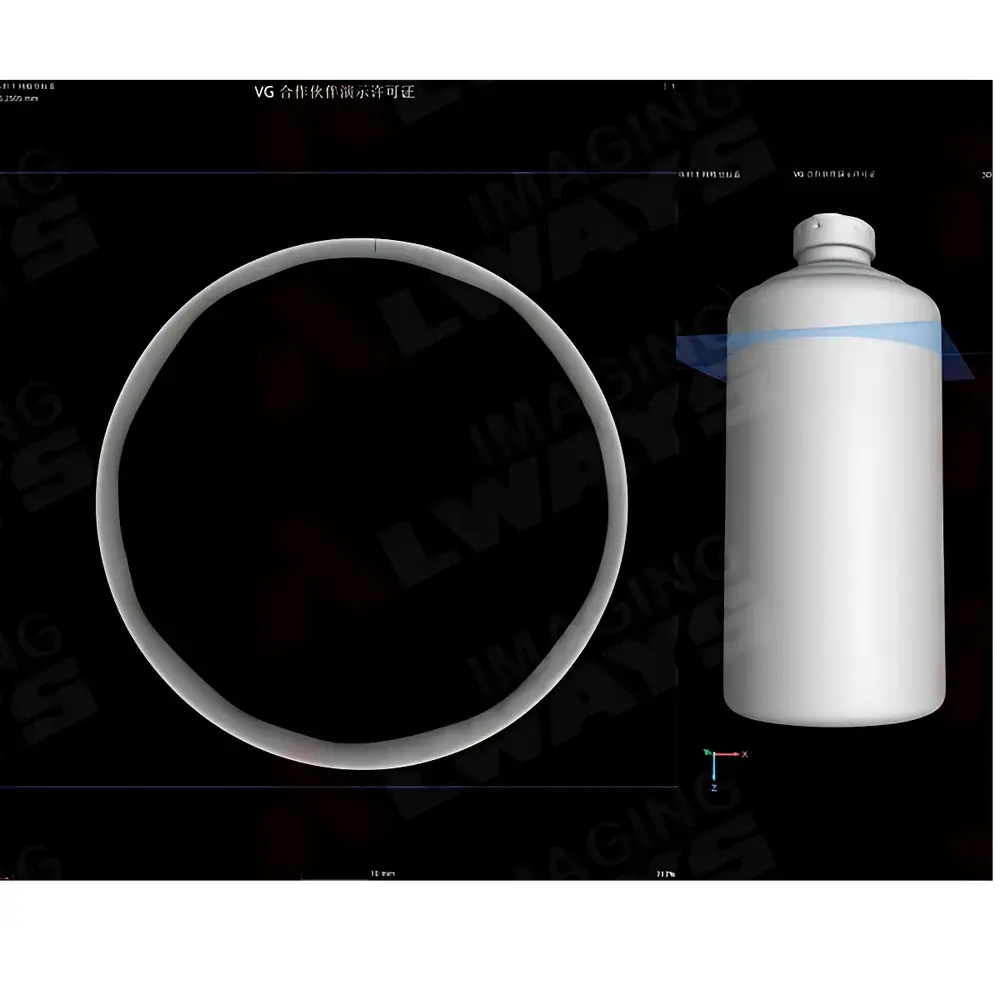
The AI-1000 is operated via Always Imaging’s proprietary CTStudio Suite—a modular, Windows-based platform built on Qt and VTK. Core modules include Acquisition Control, Reconstruction Engine (FDK + iterative SART), Volume Rendering, Quantitative Morphometry (porosity %, pore size distribution, sphericity, tortuosity), and Automated Defect Recognition (ADR) using supervised CNN classifiers trained on annotated bottle defect libraries. All datasets are stored in DICOM-CT compliant format with embedded metadata (scan parameters, calibration logs, operator ID). Audit trails record every user action—including image export, threshold adjustment, and report generation—with timestamps and digital signatures. Data export supports STL, OBJ, CSV, and HDF5 formats for integration with third-party CAE tools (e.g., ANSYS, Simpleware) or LIMS platforms via RESTful API.
Applications
- Quantitative porosity mapping of bottle neck seals and base walls to validate annealing uniformity and prevent microleakage
- Detection and classification of bulk inclusions (e.g., stones, cords, bubbles) per ASTM C142 (Standard Test Method for Inclusions in Glass Containers)
- Wall thickness distribution analysis for compliance with ISO 8512-2 (Glass containers — Dimensions — Part 2: Bottles)
- Root-cause investigation of breakage during filling, capping, or thermal shock testing
- Comparative study of raw material batches (sand, cullet, frit composition) on final product homogeneity
- Supporting design for manufacturability (DFM) of lightweighted bottle geometries through structural integrity simulation
FAQ
What is the minimum resolvable pore size under standard operating conditions?
The system achieves an effective isotropic voxel size of 40–80 µm depending on magnification and reconstruction kernel; defects ≥0.1 mm in diameter are consistently detectable with >95% recall in glass matrices.
Does the AI-1000 support automated pass/fail inspection for production line integration?
Yes—via optional ADR module with configurable rule-based and ML-driven classification engines; outputs can trigger PLC signals or feed directly into MES systems via OPC UA.
Is calibration traceable to national standards?
All geometric and intensity calibrations are performed using NIST-traceable step wedges and sphere phantoms; certificate of calibration includes uncertainty budgets per ISO/IEC 17025 Annex A.
Can the system reconstruct partial scans for tall, narrow bottles?
Yes—the TR geometry enables helical or truncated circular trajectories; proprietary reconstruction algorithms compensate for missing angular data without introducing ring artifacts.
What training and service options are available internationally?
Always Imaging provides on-site installation, operator certification (2-day course), and remote diagnostics; extended warranty and annual preventive maintenance contracts include software updates and recalibration services.



