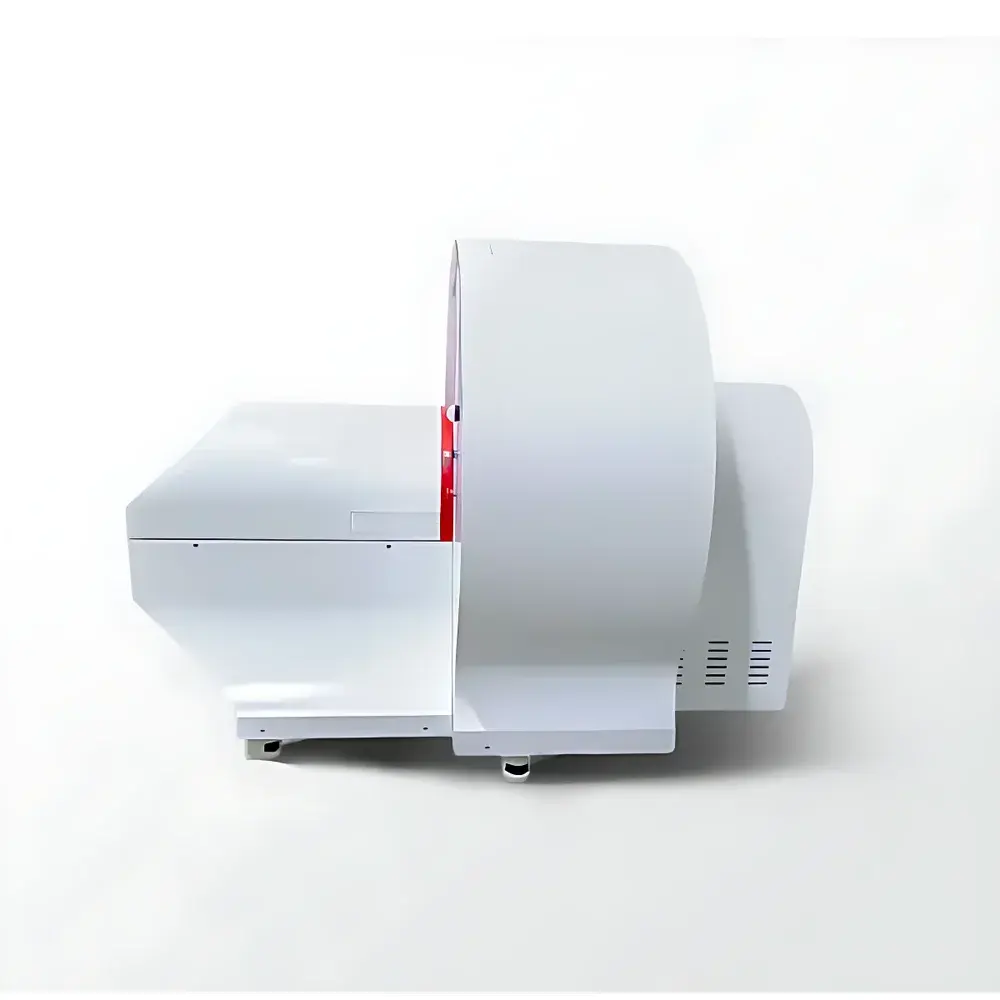
Always Imaging AX-Life 3000CT High-Resolution In Vivo Micro-CT System for Large Animals and Companion Animals
| Brand | Always Imaging |
|---|---|
| Origin | Jiangsu, China |
| Manufacturer Type | Original Equipment Manufacturer (OEM) |
| Product Origin | Domestic (China) |
| Model | AX-Life 3000CT |
| Spatial Resolution | 40 µm |
| Maximum Payload Capacity | 50 kg |
| Field of View Diameter | 100–200 mm |
| Standard Scan Length | 600 mm (customizable) |
| Detector Pixel Count | 2048 × 2560 |
| A/D Conversion | 16-bit |
| X-ray Source | Integrated Closed-Tube |
| Voltage Range | 40–130 kV |
| Current Range | 0.3 mA |
| Minimum Focal Spot Size | 40 µm |
| Max Power | 39 W |
| Cooling Method | Air-Cooled |
| Detector Pixel Pitch | 100 µm |
| Radiation Shielding | < 1 µSv/h |
| System Weight | 1000 kg |
| Dimensions (L×W×H) | 2500 mm × 1600 mm × 1800 mm |
Overview
The Always Imaging AX-Life 3000CT is a dedicated high-resolution in vivo micro-computed tomography (micro-CT) system engineered for longitudinal imaging studies in large companion animals—including cats, medium-to-large breed dogs, and other veterinary research models up to 50 kg. Unlike conventional small-animal CT platforms optimized for rodents, the AX-Life 3000CT employs a dual-source geometry with a high-stability closed-tube X-ray generator and a large-area flat-panel detector (2048 × 2560 pixels, 100 µm pitch, 16-bit A/D), enabling isotropic spatial resolution down to 40 µm across extended field-of-view (FOV) volumes (diameter 100–200 mm; standard axial length 600 mm, extendable per application). The system operates on the principle of cone-beam computed tomography, reconstructing volumetric datasets from hundreds of angular projections acquired during continuous gantry rotation. Its mechanical architecture—featuring a motorized, precision-aligned animal bed with active motion compensation—ensures reproducible positioning and minimal image artifacts during long-duration scans. Designed for compliance with international radiation safety standards (IEC 62494-1, IEC 61223-3-5), the AX-Life 3000CT delivers sub-millisievert effective dose per scan while maintaining quantitative fidelity required for bone morphometry, pulmonary airway segmentation, orthopedic implant evaluation, and soft-tissue contrast enhancement via iodinated contrast agents.
Key Features
- Sub-50 µm isotropic spatial resolution (validated at 40 µm) across full FOV—enabling visualization of trabecular microarchitecture, dental root morphology, and cortical porosity in canine and feline specimens.
- Large-bore gantry and reinforced animal handling platform supporting up to 50 kg payload, accommodating sedated or anesthetized large-breed dogs without repositioning or image stitching.
- Integrated GPU-accelerated reconstruction engine delivering full-volume reconstructions (≥2000 slices per scan) in under 90 seconds—more than 10× faster than CPU-based filtered back-projection (FBP) pipelines.
- Proprietary spatial beam shaper technology reducing absorbed dose by 2–3× relative to conventional collimation methods, validated against NIST-traceable dosimetry protocols without compromising CNR or MTF performance.
- Unified control interface with one-click acquisition workflows, real-time preview, and automated exposure parameter optimization based on subject attenuation profile.
- Modular hardware design supporting optional add-ons including respiratory gating modules, temperature-controlled animal beds, and multi-energy spectral scanning kits for material decomposition.
Sample Compatibility & Compliance
The AX-Life 3000CT is validated for in vivo imaging of conscious or lightly sedated companion animals within clinically relevant weight and anatomical constraints: domestic cats (2–7 kg), beagles, labradors, and similar mid-to-large breeds (up to 50 kg). Its adjustable FOV (100–200 mm diameter) and customizable scan length accommodate diverse anatomical regions—from whole-body thoracic/abdominal surveys to localized joint or cranial imaging. All operational parameters adhere to ISO 13485:2016 (medical device quality management systems) and meet essential requirements outlined in EU MDR Annex I (2017/745). Radiation shielding complies with IEC 60601-2-44 and national regulatory limits (<1 µSv/h at 5 cm from housing surface). The system supports GLP-compliant study execution through audit-trail-enabled software logging, electronic signature capability, and DICOM 3.0 export conformant with IHE-RAD integration profiles.
Software & Data Management
The AX-Life Control Suite is a Windows-based application built on Qt and CUDA frameworks, providing intuitive access to acquisition, reconstruction, visualization, and quantification tools. Raw projection data are stored in HDF5 format with embedded metadata (scan parameters, animal ID, timestamp, operator credentials). Reconstructed volumes are exported as DICOM-CT or NIfTI-1 compliant files, fully compatible with third-party analysis platforms including 3D Slicer, Mimics, and Amira. Quantitative analysis modules include bone volume fraction (BV/TV), trabecular thickness (Tb.Th), connectivity density (Conn.D), and Hounsfield unit (HU)-based tissue classification calibrated against NIST SRM 2088 reference phantoms. Software validation documentation includes IQ/OQ/PQ test scripts aligned with ASTM E2839-21 (standard guide for micro-CT system qualification).
Applications
- Longitudinal osteoarthritis progression monitoring in canine models using 3D cartilage thickness mapping and subchondral bone plate analysis.
- Preclinical evaluation of orthopedic implants (e.g., titanium porous scaffolds) via osseointegration quantification and micromotion tracking.
- Pulmonary structural phenotyping in feline asthma models, including airway wall thickening, lumen narrowing, and emphysematous changes.
- Dental and maxillofacial research: high-fidelity imaging of periodontal ligament space, root canal anatomy, and periapical lesion development.
- Contrast-enhanced vascular imaging using iodine-based agents for tumor angiogenesis assessment and perfusion modeling.
- Non-destructive QA/QC of ex vivo specimens—including post-mortem organ harvesting, histology correlation, and biomechanical sample preparation verification.
FAQ
What is the minimum achievable voxel size in reconstructed images?
The system achieves isotropic voxels as small as 40 µm when operating at maximum magnification and optimal geometric configuration. Actual voxel size depends on selected FOV, source-to-detector distance, and reconstruction kernel.
Does the system support respiratory or cardiac gating?
Yes—optional external physiological signal inputs (e.g., pneumatic belt, ECG leads) can be synchronized with projection acquisition to suppress motion artifacts in thoracic and abdominal imaging.
Is the software FDA-cleared or CE-marked for clinical diagnostic use?
The AX-Life 3000CT is classified as a preclinical research instrument. It is CE-marked under Class IIa (MDR 2017/745) for veterinary research applications but is not intended for human diagnostic use or FDA 510(k) clearance.
Can raw projection data be exported for third-party reconstruction?
Yes—unprocessed sinogram data (in HDF5 format with full metadata) are accessible via secure local export or network transfer for advanced iterative reconstruction or machine learning-based denoising pipelines.
What maintenance intervals and service contracts are available?
Annual preventive maintenance includes X-ray tube performance calibration, detector uniformity correction, mechanical alignment verification, and radiation safety survey—performed by Always Imaging certified field engineers under ISO/IEC 17025-accredited procedures.