
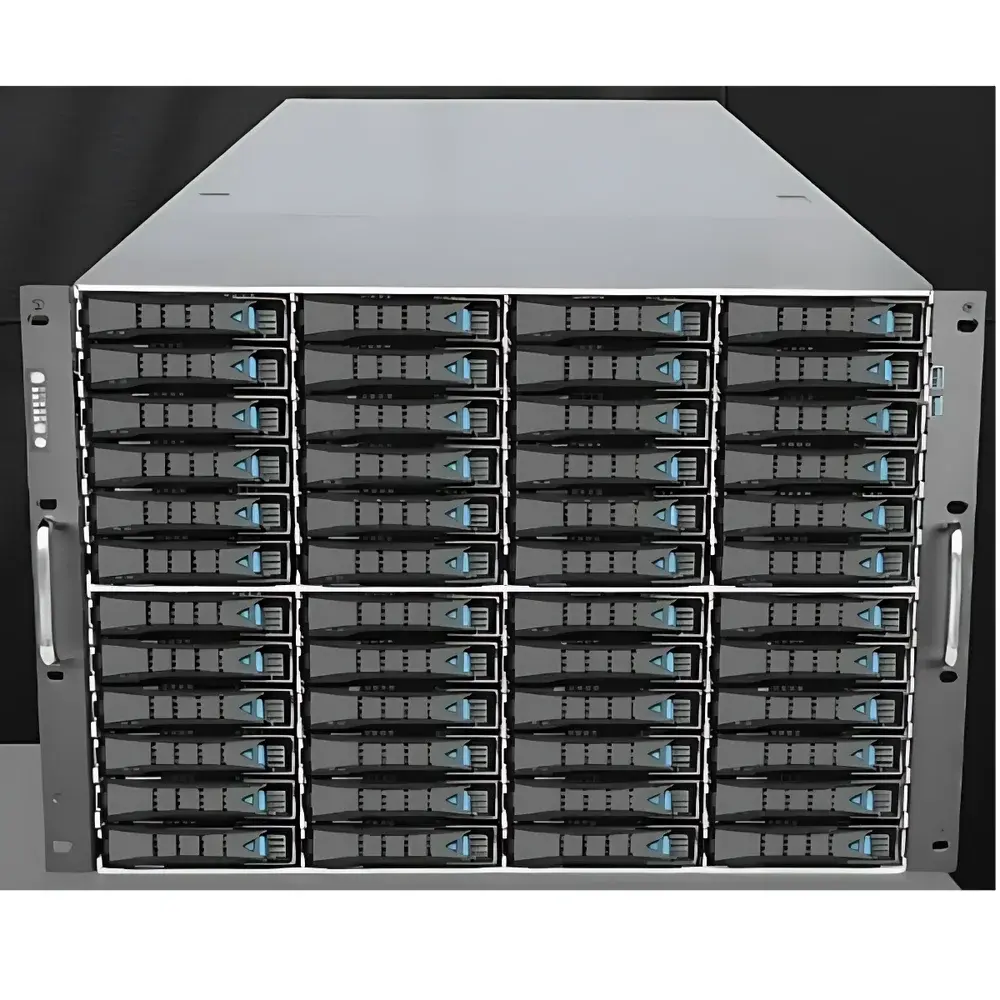
Always Imaging AI DC-48 Industrial Micro-CT Data Storage Server
| Brand | Always Imaging |
|---|---|
| Origin | Zhejiang, China |
| Manufacturer Type | Original Equipment Manufacturer (OEM) |
| Country of Origin | China |
| Model | AI DC-48 |
| Pricing | Upon Request |
| Maximum Raw Storage Capacity | 768 TB |
| Drive Bay Count | 48 hot-swappable 3.5" SATA/SAS bays |
| Per-Drive Capacity | Up to 16 TB |
| Processor | Intel Xeon Scalable Series (multi-core) |
| Memory | 64 GB DDR4 ECC Registered RAM |
| Network Interface | Dual-port 10 GbE SFP+ with LACP support |
| Data Management Features | Hierarchical metadata tagging, spatial location indexing, thumbnail-based dataset preview, DICOM-compliant query engine, role-based access control (RBAC), automated backup scheduling |
Overview
The Always Imaging AI DC-48 is a purpose-built, high-density data storage and management server engineered exclusively for industrial micro-computed tomography (micro-CT) workflows. Unlike general-purpose NAS or SAN appliances, the AI DC-48 integrates hardware architecture and firmware-level optimizations aligned with the unique I/O patterns, metadata complexity, and long-term archival requirements of micro-CT datasets. Each scan—whether acquired at sub-micron resolution on high-power benchtop systems or large-volume industrial scanners—generates volumetric datasets ranging from tens of gigabytes to multiple terabytes per acquisition. The AI DC-48 addresses this demand through a tightly coupled design: 48 hot-swappable drive bays supporting up to 16 TB nearline SAS or NL-SATA drives, delivering 768 TB of raw capacity in a 4U form factor. Its dual 10 GbE SFP+ interfaces enable sustained throughput exceeding 1.8 GB/s in bonded mode—critical for concurrent ingestion from multiple CT scanners, real-time reconstruction node offloading, and low-latency remote visualization over LAN/WAN.
Key Features
- 48-bay 3.5″ hot-swap chassis with tool-less drive sleds and front-accessible power/cooling modules for uninterrupted operation during maintenance
- Intel Xeon Scalable processor platform with 64 GB ECC registered memory—optimized for parallel metadata indexing, DICOM header parsing, and thumbnail generation across heterogeneous CT volumes
- Dual 10 GbE SFP+ ports with link aggregation (LACP) and jumbo frame support, enabling deterministic latency and guaranteed bandwidth for multi-client reconstruction pipelines
- Firmware-integrated data integrity stack: end-to-end CRC32C checksumming, RAID 60 configuration with dual parity groups, and scheduled SMART monitoring with predictive failure alerts
- Preloaded Always Imaging Data Orchestrator OS—a lightweight Linux-based appliance OS featuring CLI and RESTful API access, audit logging compliant with ISO 13485 and FDA 21 CFR Part 11 Annex 11 requirements
Sample Compatibility & Compliance
The AI DC-48 supports native ingestion of vendor-agnostic micro-CT data formats including DICOM-CT (Part 10), NIfTI-1, TIFF stacks, and proprietary binary volumes (e.g., Nikon Metrology, Zeiss, Bruker SkyScan). It enforces strict metadata validation against ASTM E2917-22 (Standard Practice for Digital Image Archiving in Nondestructive Evaluation) and maintains immutable provenance records—including scanner model, acquisition parameters (kV, µA, voxel size), reconstruction algorithm version, and operator ID—for full traceability. All stored datasets retain original bit-depth fidelity (16-bit or 32-bit float) without lossy compression unless explicitly configured. The system meets CE marking requirements for EMC Directive 2014/30/EU and Low Voltage Directive 2014/35/EU, and its enclosure complies with IP20 environmental rating per IEC 60529.
Software & Data Management
The embedded Data Orchestrator OS provides a web-based interface for hierarchical dataset organization via project–specimen–scan taxonomy. Spatial location indexing enables rapid retrieval based on physical sample coordinates (e.g., “all scans from Lot #X-2024-08, position Z=12.4 mm”). Thumbnail previews are generated using GPU-accelerated volume rendering directly from raw projections—eliminating dependency on external workstations. Query capabilities include Boolean logic across DICOM tags (e.g., “ReconstructionKernel = ‘Sharp’ AND ExposureTime > 1500 ms”) and integration with enterprise LDAP/Active Directory for centralized authentication. Audit trails record all user actions—including dataset deletion—with timestamp, IP address, and session hash—supporting GLP and GMP compliance audits.
Applications
- Manufacturing QA/QC labs requiring long-term retention of reference CT volumes for dimensional metrology (ISO 17025 accredited workflows)
- Academic micro-CT core facilities managing shared instrument time across multiple research groups and disciplines
- Aerospace component suppliers archiving pore network analyses for fatigue life modeling under AS9100 Rev D
- Medical device R&D teams storing preclinical implant scans compliant with ISO 10993-1 biocompatibility testing documentation
- Automotive casting foundries performing statistical process control using serial CT scans across production batches
FAQ
Does the AI DC-48 support direct integration with third-party reconstruction software such as Octopus, VGStudio MAX, or Dragonfly?
Yes—it exposes a standards-compliant REST API for automated dataset push/pull and includes prebuilt connectors for common reconstruction platforms via HTTP POST with JSON payload containing acquisition metadata and file path references.
Can existing micro-CT archives be migrated to the AI DC-48 while preserving original timestamps and permissions?
Yes—its migration utility performs byte-for-byte copy with POSIX attribute preservation and optional DICOM UID regeneration to avoid conflicts in federated PACS environments.
Is the system validated for use in regulated environments such as ISO 13485-certified medical device manufacturing?
Yes—validation documentation (IQ/OQ/PQ protocols, traceability matrices, and test reports) is provided upon request and aligns with Annex A of ISO/TR 80001-2-2 for medical IT networks.
What redundancy mechanisms prevent data loss during simultaneous drive failures?
RAID 60 combines striping across two independent RAID 6 arrays, tolerating up to four concurrent drive failures—two per group—without service interruption or data corruption.
How frequently are firmware updates released, and what is the update mechanism?
Firmware patches are issued quarterly via signed package delivery through the web UI; updates apply non-disruptively during scheduled maintenance windows with automatic rollback on verification failure.
Related Products



