
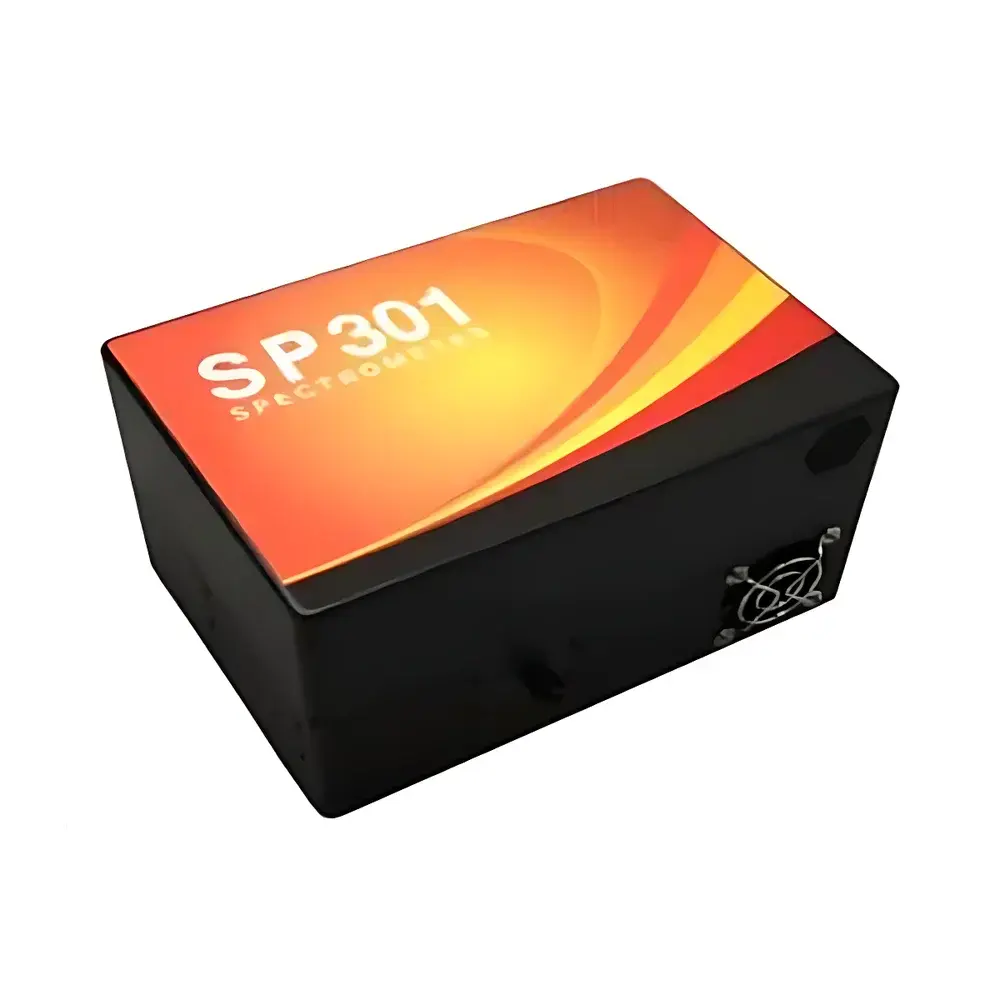
Spectral Products SP301/EX High-Performance Mid-Wave Infrared Spectrometer
| Brand | AERO |
|---|---|
| Origin | Beijing, China |
| Manufacturer Type | Authorized Distributor |
| Instrument Category | Domestic |
| Model | SP301 / SP301-EX |
| Pricing | Upon Request |
| Instrument Class | Optical Photothermal Infrared Spectrometer |
| Form Factor | Portable |
| Wavenumber Range | 3333–10000 cm⁻¹ (equivalent to 1.0–3.0 µm for PbS |
| Spectral Resolution | 10–30 nm (dependent on slit width and grating selection) |
| Signal-to-Noise Ratio | ≥20 RMS counts (16-bit digitization) |
| Detector Cooling | Thermoelectric (TE), down to –20 °C |
| Detector Type | Linear PbS or PbSe array (256 pixels, 45 µm × 450 µm active area) |
| Max Readout Rate | 2 MHz |
| Linearity | >90% |
| Pixel-to-Pixel Response Uniformity (peak-to-peak) | ±10% |
Overview
The Spectral Products SP301/EX is a portable, high-sensitivity mid-wave infrared (MWIR) spectrometer engineered for precision spectral acquisition in field-deployable and benchtop laboratory environments. It operates on the principle of dispersive spectroscopy using a crossed Czerny-Turner optical platform, enabling high-fidelity separation of incident infrared radiation across its operational range. The instrument supports two interchangeable detector configurations: PbS (1.0–3.0 µm) for near-infrared to short-wave MWIR applications, and PbSe (1.5–5.0 µm) for extended MWIR coverage—making it suitable for molecular fingerprinting of hydrocarbons, CO, NOx, H2O vapor, and other key absorbers in industrial and environmental contexts. Its thermoelectrically cooled linear array detector (down to –20 °C) minimizes dark current drift and enhances signal stability during extended acquisitions, while the integrated automatic shutter and dark-current compensation routine ensure robust baseline correction without manual intervention.
Key Features
- Thermoelectrically cooled PbS or PbSe linear array detector (256 pixels, 45 µm × 450 µm) with in situ temperature stabilization to –20 °C for low-noise, high-dynamic-range performance
- Crossed Czerny-Turner monochromator architecture with high-quality coated optics, optimized for throughput and stray-light suppression in the MWIR band
- Dual input flexibility: direct slit coupling (with adjustable slit width) or SMA-905 fiber-optic interface (compatible with standard 400–600 µm core fibers)
- Integrated hardware-level auto-shutter and automated dark-frame acquisition for real-time background subtraction
- Compact, ruggedized aluminum enclosure (IP52-rated) designed for vibration resistance and thermal stability in non-climate-controlled settings
- USB 2.0 interface with SDK support for LabVIEW™, MATLAB®, Python (via ctypes or PyVISA), and custom C/C++ integration
Sample Compatibility & Compliance
The SP301/EX accommodates transmission, reflectance, and absorbance measurements via configurable external accessories—including integrating spheres, fixed-angle reflection stages, and gas cells with CaF2 or BaF2 windows. Its spectral fidelity supports quantitative analysis per ASTM E1421 (Standard Practice for Describing and Measuring Performance of Fourier Transform Infrared (FT-IR) Spectrometers) and ISO 13757 (Optics and photonics — Spectrometers — Terminology and performance parameters). While not a regulated medical device, its data integrity features—including timestamped raw frame logging, detector temperature telemetry, and non-volatile calibration metadata storage—align with GLP-compliant workflows and facilitate audit readiness under FDA 21 CFR Part 11 when paired with validated third-party software.
Software & Data Management
The spectrometer ships with SpectralView™ v3.x—a cross-platform application supporting real-time spectrum display, multi-scan averaging, baseline correction (Rubberband, Asymmetric Least Squares), peak detection, and export in CSV, ASCII, and JCAMP-DX formats. An open API enables integration into LIMS or SCADA systems. All acquired spectra include embedded metadata: detector temperature, integration time, slit setting, grating position, and shutter state. Raw 16-bit frame buffers are retained prior to processing, ensuring full traceability for reprocessing and uncertainty analysis. Firmware updates are delivered via signed binary packages with SHA-256 verification.
Applications
- Real-time process monitoring of combustion exhaust (CO, CO2, NO, unburnt hydrocarbons) in boiler stacks and engine test cells
- Field-based environmental screening for atmospheric trace gases and particulate-bound organics
- Quality control of polymer films, coatings, and pharmaceutical excipients via characteristic C–H, O–H, and N–H absorption bands
- Non-destructive evaluation of semiconductor wafer passivation layers and thin-film photovoltaic materials
- Teaching and research in applied spectroscopy labs requiring hands-on MWIR instrumentation with minimal infrastructure dependency
FAQ
What detector cooling level is achievable, and how does it impact measurement stability?
The TE cooler maintains detector temperatures down to –20 °C, reducing dark current by >95% compared to ambient operation and enabling stable 5–10 minute integrations without significant baseline drift.
Can the SP301/EX be used with fiber optics, and what are the recommended specifications?
Yes—SMA-905 connectors accept standard multimode fibers with core diameters from 400 µm to 600 µm and NA ≤ 0.22. For optimal throughput in the 1.5–5.0 µm range, fluoride or chalcogenide fibers are recommended.
Is spectral calibration traceable to NIST standards?
Factory calibration uses certified rare-earth oxide emission lines (e.g., Ho:YAG, Er:YAG) and blackbody sources; users may perform wavelength and radiometric recalibration using optional NIST-traceable reference lamps.
Does the system support synchronized triggering with external equipment?
Yes—the rear panel includes TTL-compatible trigger IN/OUT ports for hardware-gated acquisition, enabling lock-in or pump-probe configurations.
What maintenance is required for long-term reliability?
No consumables or periodic alignment are needed; the sealed optical path and solid-state TE cooler yield >50,000 hours MTBF. Annual verification of wavelength accuracy and dark-current drift is recommended for GxP environments.






