
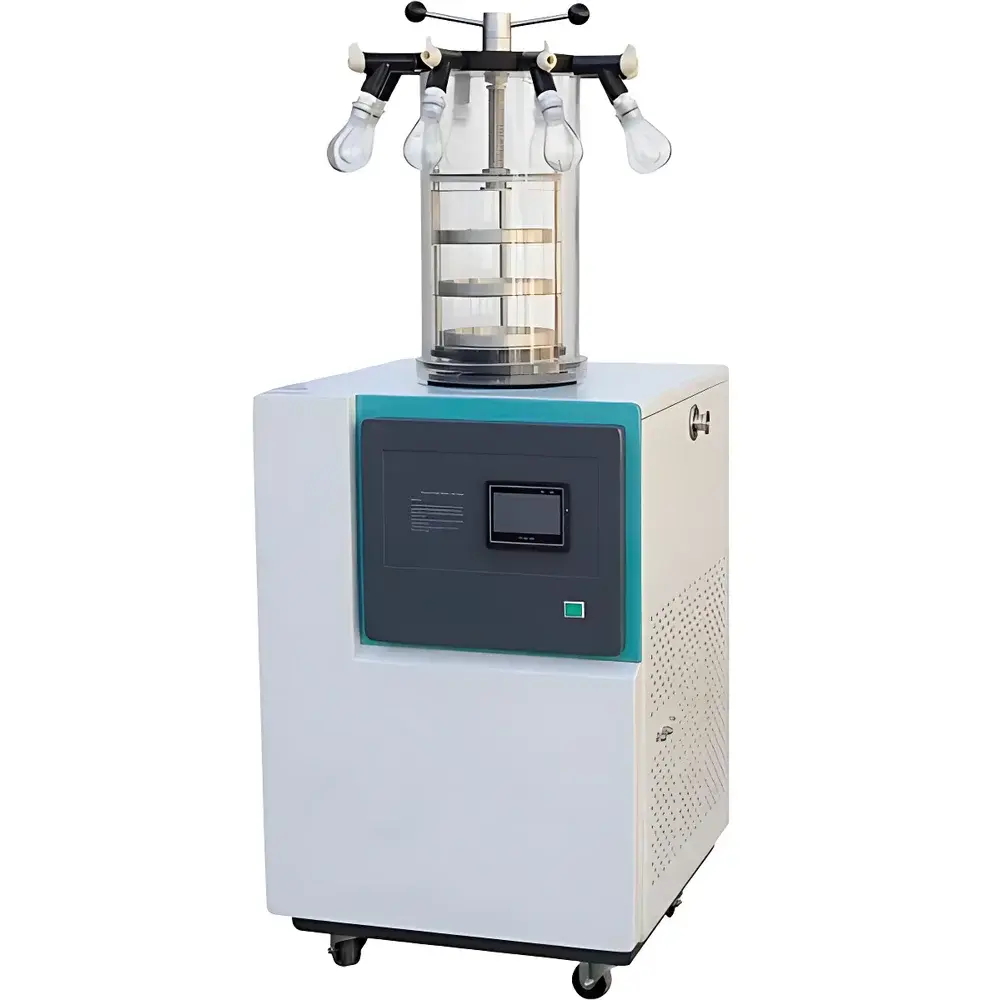
BIOCOOL Lab-1B-110E Laboratory Benchtop Freeze Dryer
| Brand | BIOCOOL |
|---|---|
| Origin | Beijing, China |
| Model | Lab-1B-110E |
| Instrument Type | Standard Shelf-Type Freeze Dryer |
| Application | Laboratory-Scale Lyophilization |
| Freeze-Drying Area | 0.08 m² |
| Ultimate Vacuum | <3 Pa |
| Condenser Temperature | −110 °C |
| Condensate Capacity (24 h) | 3 L |
| Refrigeration System | Industrial-Grade Dual-Stage Cascade Compressor |
| Vacuum Pump | Korea-Made Rotary Vane Pump (2 L/s) |
| Control Interface | Industrial Touchscreen HMI with PLC Core |
| Data Logging | Internal Memory (90-day buffer), USB Export (Optional), PC Database Sync (Optional) |
| Compliance | Designed for GLP-aligned lab environments |
Overview
The BIOCOOL Lab-1B-110E is a benchtop laboratory freeze dryer engineered for reproducible, low-temperature lyophilization of heat-sensitive biologicals, pharmaceutical intermediates, and organic-solvent-based formulations. It operates on the principle of sublimation under deep vacuum: frozen water or volatile solvents are removed directly from the solid phase to vapor without passing through liquid—preserving structural integrity, bioactivity, and chemical stability. Its −110 °C condenser enables efficient capture of both water and high-boiling-point organic solvents (e.g., ethanol, acetone, DMSO), supporting lyophilization of samples containing up to 95% (v/v) organic solvent—a capability critical for peptide formulations, nanosuspensions, and extraction-derived botanical actives. The system integrates a sealed acrylic drying chamber (aerospace-grade PMMA), non-welded construction, and dual-stage cascade refrigeration architecture to ensure long-term vacuum integrity and thermal uniformity across the shelf.
Key Features
- −110 °C ultra-low temperature condenser with 3 L/24 h ice-trapping capacity—validated for aggressive solvent capture including methanol, acetonitrile, and ethyl acetate
- Aerospace-grade transparent acrylic drying chamber: seamless monolithic structure, zero adhesive joints, leak-tight design rated for continuous operation at <3 Pa
- Programmable PLC-based control system with industrial touchscreen HMI: intuitive navigation, no manual required for routine operation
- Dual-mode operation: manual mode for process development (real-time parameter override); automatic mode for GMP-ready batch execution with one-touch start
- Intelligent shelf heating system with fuzzy PID algorithm and thermal cycle monitoring—ensures ±0.5 °C shelf temperature uniformity and prevents thermal shock during primary/secondary drying
- Non-electric condenser defrost: rapid, safe, and residue-free—eliminates immersion risks and downtime associated with water-bath defrosting
- Real-time data acquisition at 50 ms intervals for shelf temperature, condenser temperature, and chamber pressure—enabling high-fidelity process mapping
- Onboard storage for 500 user-defined or preloaded lyophilization protocols—including ramp rate, hold time, vacuum setpoint, and pressure-controlled drying stages
Sample Compatibility & Compliance
The Lab-1B-110E accommodates vial-based (via optional stoppering interface), bulk tray-loaded, and external manifold-mounted samples (e.g., flask, ampoule, or serum bottle configurations). It is routinely deployed for aqueous solutions, colloidal suspensions, hydrogels, and organic-aqueous mixtures with eutectic temperatures above −20 °C. While not certified to ISO 22000 or EU Annex 1 out-of-the-box, its architecture supports qualification under ICH Q5C, USP , and ASTM F2751-22 for laboratory-scale stability and formulation studies. Optional features—including calibrated temperature/vacuum sensors, electronic audit trail logging, and password-protected user roles—facilitate alignment with GLP documentation requirements and internal SOP enforcement.
Software & Data Management
Data integrity is maintained via three-tiered storage: internal flash memory retains ≥90 days of timestamped process logs (shelf temp, condenser temp, chamber pressure, elapsed time); USB export allows encrypted CSV transfer for offline analysis in MATLAB, Python, or JMP; and optional PC database integration enables centralized archive, role-based access control, and automated report generation compliant with 21 CFR Part 11 when paired with validated third-party software. All logged parameters include metadata (operator ID, protocol name, batch ID, instrument serial number), enabling full traceability. Calibration functions for shelf and condenser thermistors—as well as Pirani and capacitance manometers—are accessible via admin mode and generate calibration certificates with date, offset, and uncertainty values.
Applications
- Pharmaceutical R&D: Lyophilization of monoclonal antibody formulations, mRNA-LNPs, and small-molecule APIs dissolved in co-solvent systems
- Biotechnology: Stabilization of enzymes, probiotics, CRISPR-Cas reagents, and extracellular vesicles
- Academic research: Preparation of porous scaffolds for tissue engineering, freeze-dried standards for mass spectrometry, and archival of microbial cultures
- Natural product labs: Concentration and stabilization of plant extracts, essential oils, and polyphenol-rich fractions without thermal degradation
- Quality control labs: Reproducible drying of reference standards, calibration materials, and QC test samples prior to HPLC or dissolution testing
FAQ
What organic solvents can be safely lyophilized using the Lab-1B-110E?
Ethanol, methanol, isopropanol, acetone, acetonitrile, ethyl acetate, and dimethyl sulfoxide (DMSO) — up to 95% (v/v) concentration — provided the sample’s eutectic point remains above −20 °C.
Is the system compatible with regulatory-compliant data archiving?
Yes — with optional PC database integration and enabled audit trail logging, it supports ALCOA+ principles (Attributable, Legible, Contemporaneous, Original, Accurate) and may be validated for use in GLP environments.
Does the unit include vacuum regulation capability?
Vacuum modulation is available as an optional module (not standard on Lab-1B-110E), enabling dynamic pressure control during primary drying to suppress boil-over or collapse in sensitive formulations.
Can the condenser temperature be verified and recalibrated?
Yes — built-in calibration routines allow field verification and adjustment of condenser thermistor output against NIST-traceable references; calibration logs are stored with operator signature and timestamp.
What safety protections are embedded in the control architecture?
Overcurrent cutoff, compressor high-pressure shutdown, shelf overtemperature lockout (36 V SELV circuitry), vacuum interlock on drain valve actuation, and real-time pump oil-backflow detection via optional anti-return valve.



