
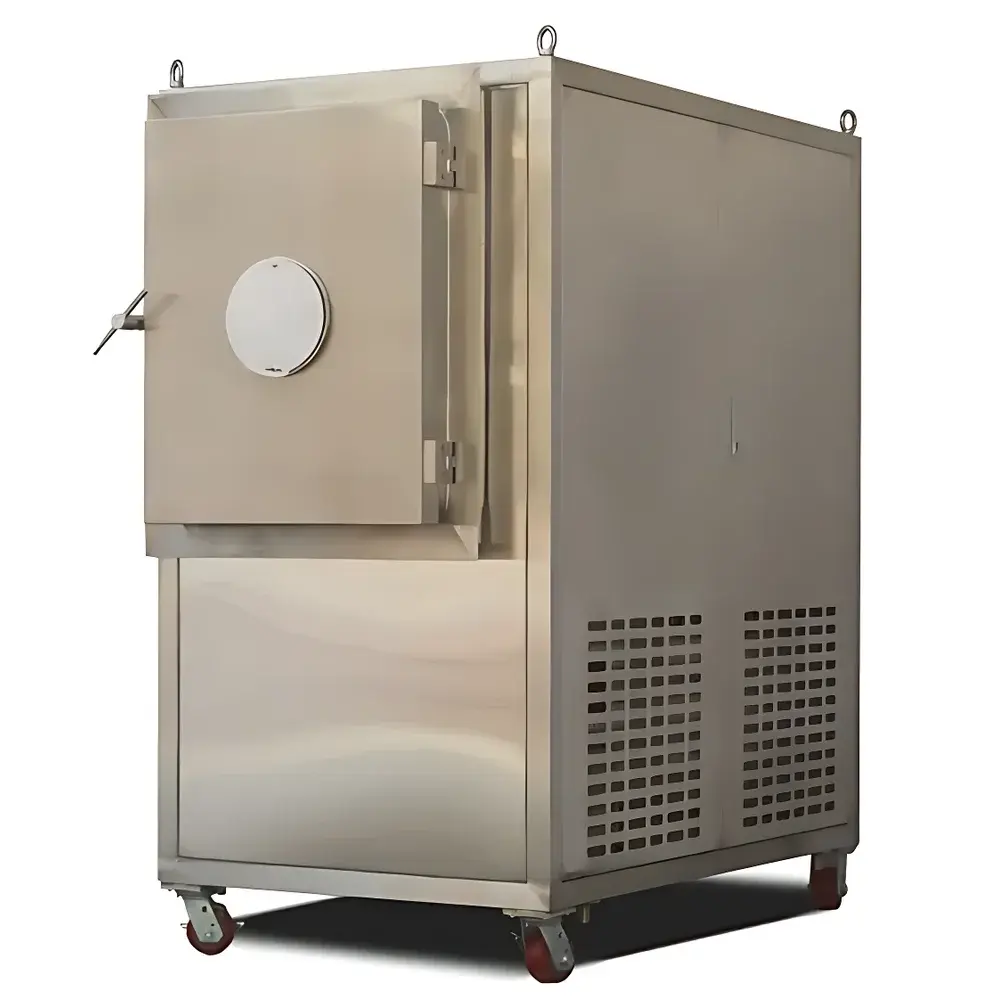
BioCoool Pilot7-12 Pro Laboratory-Scale Freeze Dryer
| Brand | BioCoool |
|---|---|
| Origin | Beijing, China |
| Model | Pilot7-12 Pro |
| Type | Shelf-Type Freeze Dryer |
| Application | Pilot-Scale Production & Process Development |
| Lyophilization Area | 0.84 m² |
| Ultimate Vacuum | <1 Pa |
| Condensate Capacity (24 h) | 12 L |
| Cold Trap Temperature | −85 °C |
| Plate Count | 4+1 |
| Plate Dimensions | 350 × 600 mm |
| Plate Spacing | 90 mm |
| Refrigeration Method | Silicone Oil Circulation |
| Dual Compressor System | Yes |
| Dual Vacuum Pump System | Yes |
| Hydraulic Stoppering System | Imported |
| Built-in Eutectic Point Tester | Yes |
| Nitrogen/Inert Gas Backfilling | Yes |
| Oil Mist Filter | Standard |
| GMP-Compliant Interior Coating | Black Absorptive Coating (SUS304 Chamber) |
Overview
The BioCoool Pilot7-12 Pro is a pilot-scale, shelf-type freeze dryer engineered for reproducible, scalable lyophilization of pharmaceuticals, biologics, diagnostics, and high-value research materials. It operates on the fundamental principles of sublimation under deep vacuum and controlled heat transfer via silicone oil–heated shelves, enabling precise thermal management across primary (ice sublimation) and secondary (bound water desorption) drying phases. Designed for process development and small-batch cGMP-compliant production, the system supports full-cycle automation—from pre-freezing and primary drying to secondary drying, endpoint detection, and inert gas backfilling—while maintaining compliance with ISO 22042, USP , and relevant sections of FDA 21 CFR Part 11 for electronic records and signatures when configured with audit-trail-enabled software.
Key Features
- Dual redundant refrigeration system: Two independent compressor units with automatic failover—ensures uninterrupted operation and thermal stability during extended cycles.
- Dual vacuum architecture: Two parallel vacuum pump systems with real-time pressure monitoring and seamless switchover—minimizes downtime and maintains vacuum integrity below 1 Pa throughout drying.
- GMP-optimized chamber design: Electropolished SUS304 stainless steel body with non-reflective black interior coating eliminates stray radiation and internal light scatter, critical for consistent product morphology and vial-to-vial uniformity.
- Advanced plate temperature control: Fuzzy PID algorithm with thermal cycle monitoring ensures ±0.5 °C stability across all 4+1 heated/cooled shelves; silicon oil circulation enables rapid ramp rates (20 °C to −40 °C in ≤25 min).
- Integrated eutectic point tester: Enables in-situ determination of collapse temperature (Tc) and glass transition (Tg’)—essential for rational formulation and cycle design per ICH Q5C and Q5D guidelines.
- Non-electric cold trap defrost: Uses compressed air or nitrogen purge—eliminates electrical hazards, avoids thermal shock to condenser coils, and reduces defrost time by >60% versus immersion methods.
- Pulse-controlled inert gas backfill: Three-stage adjustable rate (slow/medium/fast) prevents powder dispersion and vial tipping during repressurization—critical for fragile amorphous formulations and lyophilized monoclonal antibodies.
- Comprehensive safety interlocks: Independent overcurrent/overload protection per subsystem; vacuum-dependent heater enable logic; condenser temperature lockout; hydraulic pressure monitoring; and full system mutual exclusion sequencing.
Sample Compatibility & Compliance
The Pilot7-12 Pro accommodates aqueous solutions, suspensions, emulsions, and viscous pastes with eutectic points above −40 °C. Its 0.84 m² shelf area supports up to 1,500 × 20 mL vials or 3,100 × 5 mL vials per batch. Chamber and sealing components are chemically resistant to organic solvents (e.g., ethanol, acetone), weak acids (pH ≥2), and alkalis (pH ≤12), permitting lyophilization of solvent-based formulations. All wetted surfaces comply with ISO 13485 and EU Annex 1 requirements for sterile pharmaceutical manufacturing. The black absorptive chamber coating meets ASTM E1710-19 for low-reflectance surfaces in controlled environments.
Software & Data Management
The system runs on an industrial-grade 10.1″ touchscreen HMI with embedded Linux OS, supporting fully programmable multi-step cycles (up to 50 segments). It includes built-in data logging at 50 ms resolution for shelf temperature, product thermocouple (optional), chamber pressure, and condenser temperature. Data storage options include onboard flash memory (3-month retention), USB export (FAT32 formatted), and optional PC database integration via OPC UA or Modbus TCP. Audit trail functionality—with user login, timestamped parameter changes, and electronic signature support—meets FDA 21 CFR Part 11 and EU Annex 11 requirements. Remote monitoring is available up to 1.5 km via Ethernet or 4G LTE (optional module), with TLS 1.2 encryption and role-based access control.
Applications
- Pharmaceutical process development: Optimization of primary drying time, shelf temperature ramping, and vacuum ramp profiles for protein therapeutics, vaccines, and mRNA-LNPs.
- Biotech R&D: Stabilization of enzymes, antibodies, and cell lysates without denaturation; validation of residual moisture content (≤1.5% w/w) per USP .
- Diagnostic reagent manufacturing: Lyophilization of ELISA kits, PCR master mixes, and lateral flow assay components requiring long-term ambient stability.
- Academic and contract research: Reproducible scale-up from benchtop (e.g., Labconco FreeZone) to pilot scale, with direct correlation of critical quality attributes (CQAs) including reconstitution time, cake structure, and residual moisture.
- Medical device coating: Freeze-drying of hydrogel precursors and antimicrobial polymer films onto implant surfaces.
FAQ
What is the maximum batch capacity for 5 mL vials?
Up to 3,100 standard 5 mL serum vials can be accommodated on the 4 active shelves (350 × 600 mm each) with 90 mm spacing.
Does the system support IQ/OQ documentation packages?
Yes—BioCoool provides vendor-qualified IQ/OQ protocols aligned with ASTM E2500-13 and ISPE Baseline Guide Volume 5, including calibration certificates traceable to NIST standards.
Can the freeze dryer be integrated into a cleanroom environment?
Yes—the unit features wall-penetrating isolation capability (standard), HEPA-filtered hydraulic actuator vents, and optional VHP-compatible gasket materials for Grade A/B classified areas.
Is real-time PAT (Process Analytical Technology) integration supported?
Yes—via analog 4–20 mA or digital RS485 outputs for integration with NIR moisture sensors, tunable diode laser absorption spectroscopy (TDLAS), or manometric temperature measurement (MTM) systems.
What maintenance intervals are recommended for the dual vacuum pumps?
Oil change every 2,000 operating hours; inlet filter replacement every 500 hours; full pump service (bearing inspection, vanes, seals) every 6,000 hours—per Edwards nXDS and Pfeiffer Duo specifications.



