
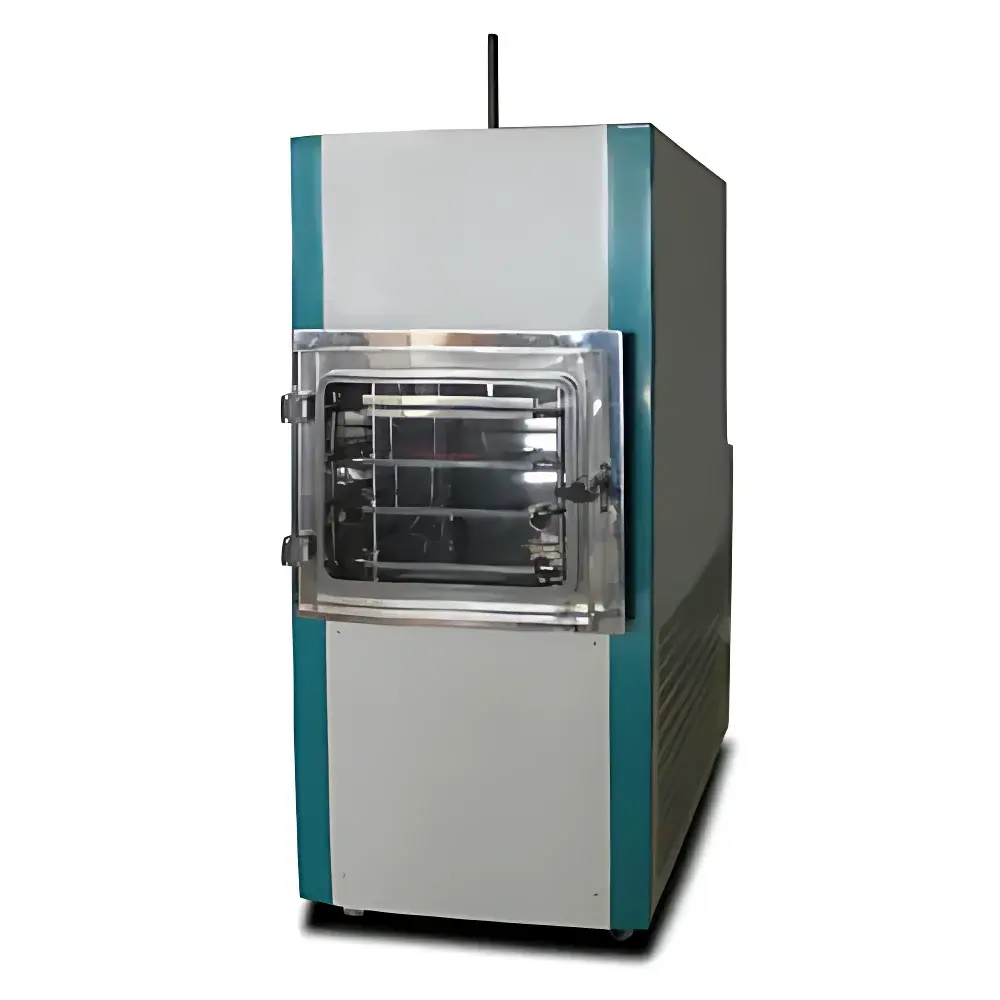
BIOCOOL Pilot5-8ES Isolation-Type Pilot-Scale Freeze Dryer
| Brand | BIOCOOL |
|---|---|
| Origin | Beijing, China |
| Model | Pilot5-8ES |
| Instrument Type | Stoppering Freeze Dryer |
| Application Scale | Pilot-Scale |
| Shelf Area | 0.5 m² |
| Ultimate Vacuum | <7 Pa |
| Condenser Capacity (24 h) | 8 L |
| Condenser Temperature (No-Load) | −85 °C |
| Shelf Temperature Range (No-Load) | −55 °C to +60 °C |
| Shelf Cooling Method | Silicone Oil Circulation |
| Shelf Spacing | 50 mm |
| Compressor Power | 2 × 2 HP |
| Vacuum Pump Speed | 6 L/s |
| Safety Features | Overcurrent Protection, Overload Protection, Overtemperature Heating Protection, Vacuum Process Interlock, Vacuum Pump Anti-Backflow Device |
Overview
The BIOCOOL Pilot5-8ES is an isolation-type pilot-scale freeze dryer engineered for reproducible, scalable lyophilization of pharmaceuticals, biologics, diagnostics, and high-value research materials under controlled GMP-aligned conditions. It operates on the fundamental principles of sublimation-based dehydration: frozen aqueous or solvent-based samples are subjected to deep vacuum (<7 Pa) while maintaining precise thermal control across heated shelves and a cryogenic condenser (−85 °C). This enables primary drying (ice sublimation) followed by secondary drying (desorption of bound water), yielding stable, porous solids with preserved structural integrity and bioactivity. Designed for process development and small-batch manufacturing, the Pilot5-8ES bridges laboratory feasibility studies and commercial production—supporting formulation optimization, stability testing, and regulatory filing batches in compliance with ICH Q5C, Q5A(R2), and USP .
Key Features
- Isolation configuration with sealed chamber and integrated stoppering mechanism, minimizing cross-contamination risk during vial sealing under inert atmosphere.
- Optically transparent aviation-grade acrylic door—non-adhesive, leak-tight, and impact-resistant—enabling real-time visual monitoring without compromising vacuum integrity.
- Shelf-integrated pre-freezing capability with independent PID-controlled heating/cooling per shelf layer (−55 °C to +60 °C), using silicone oil circulation for uniform thermal distribution and minimal gradient deviation (<±0.5 °C).
- Dual high-efficiency compressors (2 × 2 HP) and a 6 L/s Korean vacuum pump deliver rapid evacuation and stable low-pressure operation with acoustic noise <62 dB(A).
- Optional pulse backfill system with three programmable gas injection rates (slow/medium/fast) prevents particle dispersion during inert gas (N₂ or argon) reintroduction post-drying.
- Non-electric condenser defrosting method—mechanically actuated thermal exchange—eliminates electrical hazards, reduces downtime, and avoids water ingress into vacuum lines.
- Industrial-grade 10.1-inch touchscreen HMI with intuitive workflow navigation; no manual required for routine operation.
- Manual mode for empirical parameter tuning; automatic mode for validated, repeatable cycles—including auto-start, phase transition detection, and end-point confirmation.
Sample Compatibility & Compliance
The Pilot5-8ES accommodates standard 10–30 mL serum vials (up to 1,200 units per batch), as well as trays for bulk powders, gels, and suspensions. Its −85 °C condenser supports aqueous formulations and select low-boiling organic solvents (e.g., tert-butanol, acetonitrile) when equipped with optional solvent traps. The system meets mechanical safety requirements per ISO 12100 and electrical safety per IEC 61000-6-2/6-4. Data integrity functions—including audit-trail-enabled event logging, user-level access control, and timestamped cycle records—align with FDA 21 CFR Part 11 expectations for electronic records. Optional co-crystallization point (Tc) measurement and vacuum regulation modules support DOE-driven process characterization per ASTM F2720 and ISO 22095.
Software & Data Management
Embedded firmware supports up to 500 user-defined or factory-loaded lyophilization protocols, each configurable with multi-step shelf temperature ramps, hold times, vacuum setpoints, and pressure ramp rates. Cycle data—including shelf temperature, condenser temperature, chamber pressure, and time—is logged at ≤1-second intervals. Storage options include internal flash memory (retains ≥90 days of compressed cycle logs), USB 2.0 external storage (FAT32-formatted), and optional PC-based SQL database integration via Ethernet (TCP/IP). Remote monitoring is supported over LAN/WAN up to 1.5 km using encrypted HTTP(S) endpoints. Calibration routines for shelf sensors and Pirani/Penning vacuum gauges are accessible via service menu with traceable offset adjustment and validation report export.
Applications
- Pharmaceutical development: Lyophilized monoclonal antibody formulations, vaccine candidates, and peptide APIs requiring residual moisture <1.0% w/w.
- Diagnostic reagent stabilization: Enzyme conjugates, lateral flow assay components, and PCR master mixes.
- Biotechnology: Bacterial and yeast cell pellets, extracellular vesicles, and CRISPR-Cas ribonucleoprotein complexes.
- Academic research: Preservation of thermolabile natural products, nanocellulose aerogels, and electrospun scaffolds.
- Contract manufacturing: Small-volume GMP-compliant batches supporting Phase I–II clinical supply chains.
FAQ
What distinguishes the Pilot5-8ES from the Pilot5-8E model?
The “S” denotes isolation-type architecture—featuring a hermetically sealed chamber with integrated hydraulic stoppering, enabling aseptic vial capping under inert gas without external laminar flow hoods.
Is the system compliant with 21 CFR Part 11 for electronic records?
Yes—when configured with password-protected user roles, automated audit trails, and electronic signature support (optional module), it satisfies core Part 11 requirements for record retention and integrity.
Can the condenser handle organic solvents?
Standard configuration is optimized for aqueous systems. For solvents with vapor pressures >0.1 mbar at −40 °C, the optional cold trap and oil mist filter must be installed to prevent pump contamination and maintain vacuum stability.
What validation documentation is provided?
Factory acceptance test (FAT) report, IQ/OQ templates, calibration certificates for critical sensors, and a full set of operational manuals are included. PQ support and protocol drafting assistance are available under service agreement.
How is shelf temperature uniformity verified?
During commissioning, thermocouple mapping per ISO 13485 Annex C is performed across all shelf zones at −40 °C, 0 °C, and +40 °C, with results documented in the OQ report showing deviations ≤±0.8 °C.



