
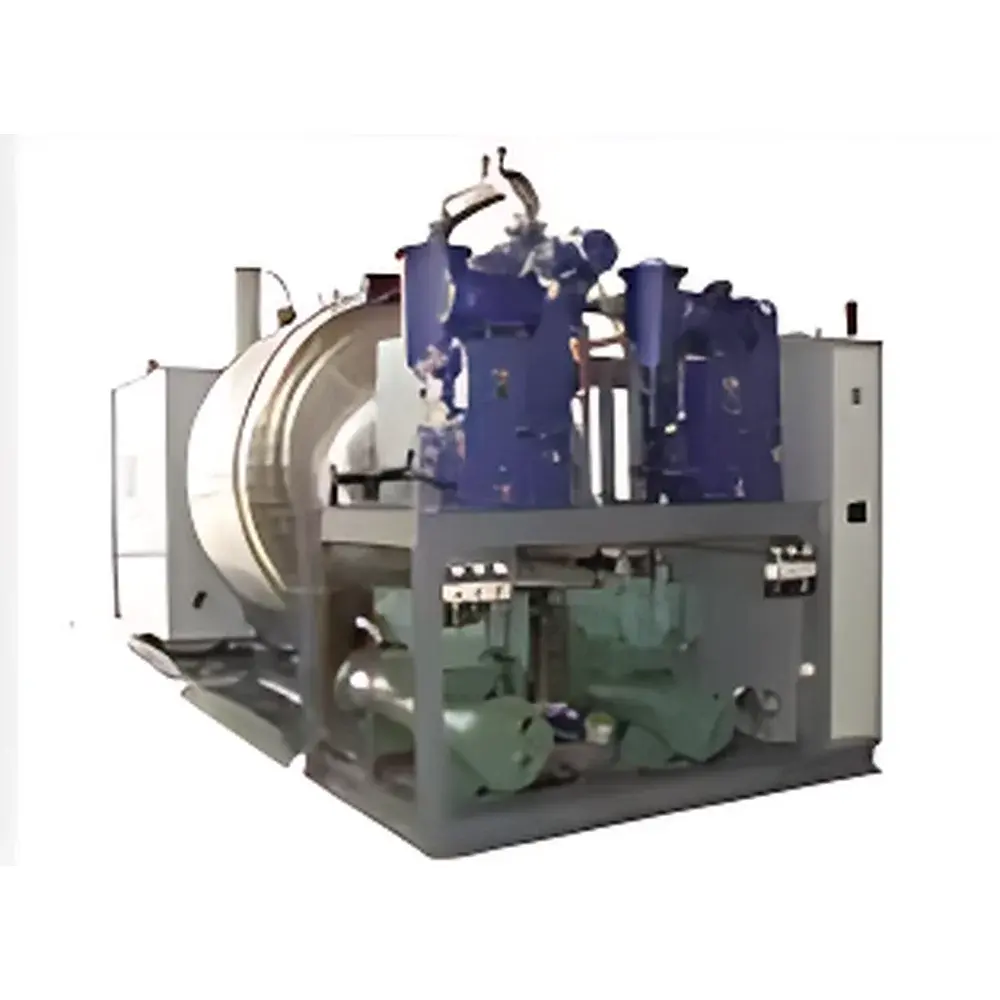
BioCool LYO-15SE Production-Scale Freeze Dryer
| Brand | BioCool |
|---|---|
| Origin | Beijing, China |
| Manufacturer Type | Authorized Distributor |
| Product Category | Domestic |
| Model | LYO-15SE |
| Instrument Type | Shelf-Type Freeze Dryer |
| Application Scope | Production-Scale |
| Lyophilization Area | 15 m² |
| Ultimate Vacuum | <4 Pa |
| Condensate Capacity (24 h) | 320 kg/24h |
| Cold Trap Temperature | <−75 °C |
Overview
The BioCool LYO-15SE is a production-scale shelf-type freeze dryer engineered for reproducible, scalable lyophilization of heat-sensitive biopharmaceuticals, herbal extracts, functional food ingredients, and advanced materials. It operates on the fundamental principles of sublimation under controlled low-pressure and low-temperature conditions: frozen product water transitions directly from solid to vapor phase without passing through liquid—preserving structural integrity, bioactivity, and chemical stability. Designed for GMP-aligned manufacturing environments (though not SIP/CIP-capable), the LYO-15SE supports batch sizes up to 15 m² of shelf area, with integrated thermal management, vacuum regulation, and endpoint detection to ensure consistent residual moisture content (<1–3% w/w, depending on formulation). Its architecture balances industrial robustness with operational flexibility—making it suitable for pilot-to-production transition, contract manufacturing organizations (CMOs), and R&D-intensive production units requiring validated, repeatable drying cycles.
Key Features
- Shelf pre-freezing capability: Uniform plate cooling down to −55 °C enables in-situ freezing—eliminating separate ultra-low temperature freezers and reducing contamination risk.
- Programmable process control system: Fully automated cycle sequencing from freezing → primary drying → secondary drying → vacuum break; supports up to 2000 user-defined or factory-stored protocols.
- Triple-mode pulse backfill system: Selectable slow/medium/fast nitrogen or inert gas reintroduction prevents powder dispersion, vial tipping, or collapse of fragile cakes (e.g., protein-based formulations or nanocellulose aerogels).
- Vacuum modulation during drying: Real-time pressure adjustment during both sublimation and desorption phases minimizes boil-over, foaming, and chamber pressure overshoot—critical for high-viscosity or volatile-solvent-containing formulations.
- Advanced condenser design: Dual-stage cascade refrigeration achieves ≤−75 °C cold trap temperature, ensuring efficient vapor capture even during high-load 24-hour operation (320 kg condensate capacity).
- High-fidelity monitoring: 50 ms data acquisition frequency for shelf temperature, product thermocouple readings (optional), and chamber vacuum—enabling precise kinetic modeling and PAT-compliant process understanding.
- Calibration-ready architecture: Built-in temperature and vacuum sensor calibration ports support periodic verification per ISO/IEC 17025 or internal QA requirements.
- Industrial HMI interface: 15.6″ capacitive touchscreen with intuitive workflow navigation—no manual required for routine operation; supports multi-language UI (English default).
Sample Compatibility & Compliance
The LYO-15SE accommodates a broad range of sample formats including serum vials (Φ22 mm, up to 42,900 units/batch), trays, and custom stainless-steel pans. It is routinely deployed for lyophilizing monoclonal antibodies, viral vectors, probiotics, botanical concentrates, nutraceutical actives (e.g., curcumin nanoparticles), and enzyme-stabilized feed additives. While the economic variant does not include Clean-in-Place (CIP) or Steam-in-Place (SIP) systems—and thus is not certified for sterile API manufacturing under FDA 21 CFR Part 211 or EU Annex 1—it fully complies with ISO 22000 (food safety), ISO 13485 (medical device QMS), and GLP documentation standards when operated with full audit trail logging (via optional PC remote monitoring module). All electrical components meet CE and GB/T standards; vacuum and refrigeration subsystems conform to ASME BPVC Section VIII and IEC 61000-6-4 EMC requirements.
Software & Data Management
The embedded control software provides real-time graphical display of shelf temperature profiles, chamber pressure trends, condenser temperature, and cumulative condensate mass estimation. Historical cycle data—including full time-stamped curves for all monitored parameters—is stored locally on an industrial-grade SSD and exportable via USB or Ethernet (CSV/Excel format). Optional modules enable remote supervision up to 1.5 km via fiber or LAN, with role-based access control (operator/engineer/admin). The system supports 21 CFR Part 11-compliant electronic signatures and audit trails when paired with validated third-party LIMS or MES platforms. Process data can be synchronized with statistical process control (SPC) tools for OOS/OOT investigation and continuous process verification (CPV) initiatives.
Applications
- Biopharmaceutical manufacturing: Lyophilization of vaccine candidates, recombinant proteins, and diagnostic reagents under non-sterile but GxP-aligned conditions.
- Traditional Chinese Medicine (TCM) processing: Stabilization of volatile terpenoids and glycosides from herbal decoctions without thermal degradation.
- Functional food & nutraceuticals: Preservation of live probiotics (e.g., Lactobacillus strains), polyphenol-rich berry extracts, and omega-3 microencapsulates.
- Food ingredient development: Production of instant coffee, soup bases, and natural colorants with minimized Maillard browning.
- Material science: Fabrication of porous scaffolds for tissue engineering, aerogel precursors, and catalyst supports via lyophilization-induced templating.
- Agrochemical R&D: Formulation of biopesticides and microbial inoculants with extended ambient-temperature shelf life.
FAQ
Is the LYO-15SE compliant with FDA 21 CFR Part 11 for electronic records?
Yes—when equipped with the optional PC remote monitoring module and configured with timestamped, immutable audit logs and user authentication, it meets baseline Part 11 requirements for record retention and signature validation.
Can this unit handle organic solvent-based formulations?
Yes—when fitted with the optional organic solvent trap and dry vacuum pump upgrade, it safely condenses acetone, ethanol, or tert-butanol vapors without compromising cold trap performance.
What is the maximum allowable shelf temperature during secondary drying?
The shelf heating range is programmable from −55 °C to +110 °C, enabling controlled desorption for low-moisture targets such as lyophilized enzymes or polymer matrices.
Does the system support IQ/OQ protocol execution?
Standard factory documentation includes DQ templates and test protocols for installation qualification (IQ) and operational qualification (OQ); PQ support requires formulation-specific validation runs conducted on-site or at BioCool’s Beijing facility.
Is remote troubleshooting supported?
Yes—via secure SSH-enabled Ethernet connection, authorized service engineers can perform diagnostics, firmware updates, and parameter diagnostics without physical site access.



