
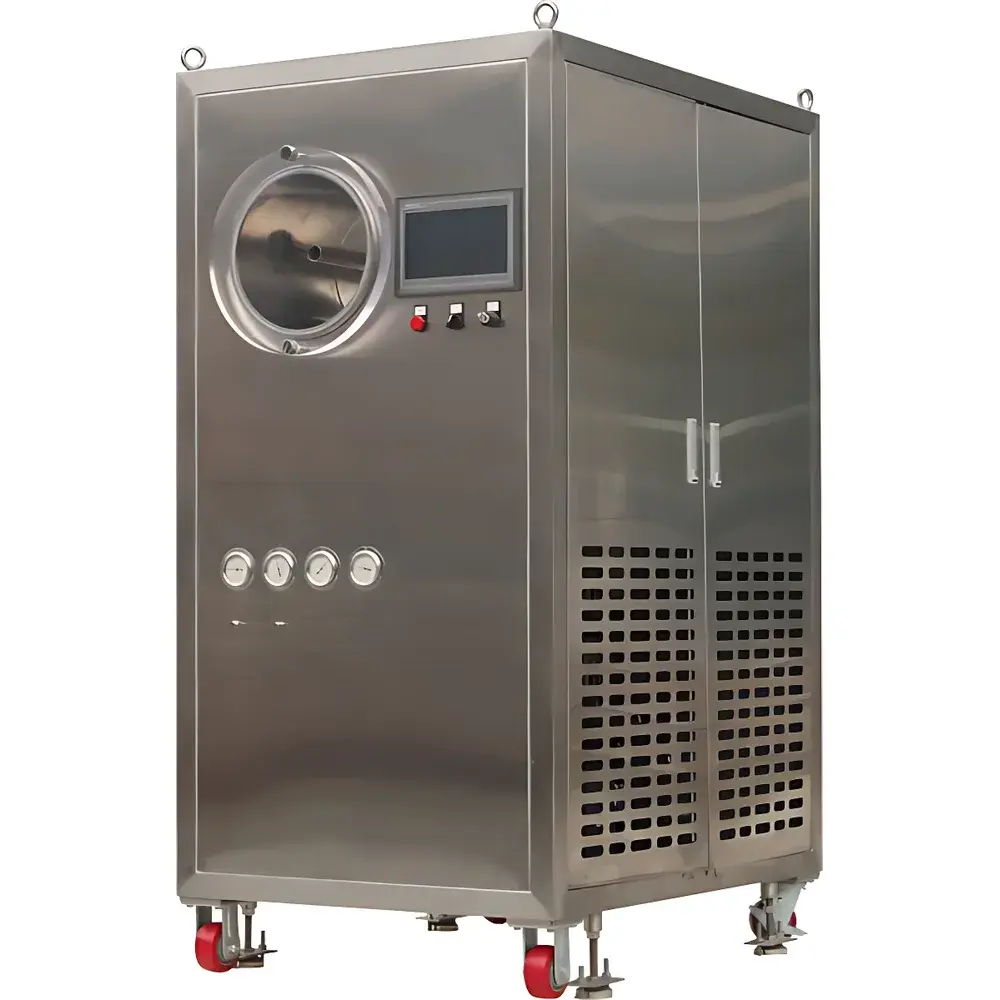
BIOCOOL Pilot5-8T Pilot-Scale Freeze Dryer
| Brand | BIOCOOL |
|---|---|
| Origin | Beijing, China |
| Model | Pilot5-8T |
| Type | Shelf-Type Freeze Dryer |
| Application | Pilot-Scale Production & Process Development |
| Lyophilization Area | 0.5 m² |
| Ultimate Vacuum | <3 Pa |
| Condenser Capacity (24 h) | 8 L/24 h |
| Condenser Temperature (No Load) | <−80 °C |
| Shelf Temperature Range | −55 °C to +70 °C |
| Control System | Industrial Touchscreen with Programmable Logic Controller (PLC) |
| Data Logging | Internal Memory (90 days), USB Export (Optional), PC Database Integration (Optional) |
| Compliance | Designed for GLP/GMP-aligned environments |
Overview
The BIOCOOL Pilot5-8T is a fully programmable, shelf-type pilot-scale freeze dryer engineered for reproducible process development, scale-up validation, and small-batch production of thermolabile pharmaceuticals, biologics, diagnostics, and high-value research compounds. It operates on the fundamental principles of lyophilization—sequential freezing, primary drying (sublimation under vacuum), and secondary drying (desorption)—with precise thermal and vacuum control across all stages. Unlike benchtop units, the Pilot5-8T integrates industrial-grade components—including a low-noise, high-efficiency imported compressor, large-capacity vacuum pump, and hydraulic stoppering system—to ensure mechanical stability, pressure integrity, and batch-to-batch consistency under extended operational cycles. Its 0.5 m² shelf area and 8 L/24 h condensing capacity support representative sample loads typical of Phase II–III formulation studies and early commercial manufacturing transfers.
Key Features
- Optically clear aerospace-grade acrylic chamber door—zero adhesives, leak-tight seal, full visual process monitoring
- Shelf pre-freezing capability with independent temperature control, enabling controlled nucleation and uniform ice crystal formation
- Hydraulic stoppering system (imported) for consistent, vibration-free vial compression during drying or post-drying sealing
- Oil mist filtration standard—eliminates hydrocarbon contamination risk during vacuum pumping and ensures operator safety
- Multi-stage vacuum regulation: dynamic adjustment during sublimation and desorption phases to suppress boil-over, collapse, or vial breakage
- Pulse backfill system with three selectable flow rates (slow/medium/fast) to prevent powder dispersion or structural disruption in fragile lyophiles
- Non-electric condenser defrosting—rapid, safe, and energy-efficient; avoids thermal shock to cold traps and eliminates manual water immersion
- Endpoint detection algorithm: automated moisture assessment via pressure rise test (PRT) at end of desorption, confirming residual moisture ≤1.0% w/w (per USP & Ph. Eur. criteria)
- Fuzzy PID-controlled shelf heating with real-time thermal loop monitoring and overtemperature cutoff
- Industrial 10.1″ touchscreen HMI with intuitive navigation—no manual required for routine operation
- Dual-mode operation: manual mode for empirical parameter exploration; automatic mode for validated protocol execution
Sample Compatibility & Compliance
The Pilot5-8T accommodates aqueous solutions, suspensions, emulsions, and viscous pastes with eutectic temperatures above −40 °C. Its −80 °C condenser enables efficient capture of water vapor without requiring cryogenic refrigerants, while optional organic solvent traps (e.g., acetone, ethanol) extend compatibility to non-aqueous formulations. All critical parameters—including shelf temperature (±0.5 °C accuracy), chamber pressure (±0.1 Pa resolution), and condenser temperature—are field-calibratable per ISO/IEC 17025 traceable standards. The system architecture supports GMP documentation requirements: electronic signatures, user access levels, change logs, and 21 CFR Part 11-compliant audit trails (when paired with optional PC database software). It conforms to ICH Q5C stability testing guidelines and aligns with ASTM F2673-20 for lyophilizer qualification.
Software & Data Management
A deterministic PLC-based control core governs all hardware subsystems with 50 ms sampling frequency for temperature and vacuum. Up to 500 custom or standardized lyophilization protocols can be stored onboard. Data logging options include internal flash memory (retains ≥90 days of timestamped shelf temp, chamber pressure, condenser temp, and valve status), USB export (FAT32 formatted), or direct streaming to SQL-based PC database (optional). Curve replay functionality allows overlay comparison of historical runs for deviation analysis. Remote monitoring up to 1.5 km via Ethernet enables off-site supervision without compromising network security. Optional co-formulation tools integrate with common LIMS platforms for batch record linkage.
Applications
- Pharmaceutical process development: optimization of primary drying time, shelf ramp rates, and chamber pressure setpoints
- Biologics stabilization: monoclonal antibodies, vaccines, viral vectors, and mRNA-LNPs requiring low-temperature desiccation
- Diagnostics: enzyme conjugates, lateral flow reagents, and lyophilized PCR master mixes
- Academic & CRO research: excipient screening, crystallinity mapping, and collapse temperature determination
- Contract manufacturing: cGMP-compliant small-batch production of clinical trial materials (CTMs)
- Regulatory filing support: generation of IQ/OQ/PQ documentation packages and comparative lyo cycle reports
FAQ
What is the maximum allowable sample load for the Pilot5-8T?
Based on its 0.5 m² shelf area and 8 L/24 h condenser capacity, the unit supports up to 5–6 kg of frozen aqueous material (assuming ~15% solids content), with optimal performance observed at 60–80% shelf utilization.
Does the system support sterile barrier integration?
Yes—the T-series configuration (e.g., Pilot5-8T) includes穿墙 isolation (wall-mounted pass-through design) compatible with Grade A/B cleanroom interfaces and SIP-ready ducting.
Can the freeze dryer operate unattended overnight?
Yes—full-cycle automation, interlocked safety logic, and real-time fault diagnostics enable continuous 72+ hour operation without intervention.
Is calibration documentation provided at commissioning?
Yes—factory calibration certificates for temperature sensors (shelves, condenser, product probes) and vacuum transducers are included; on-site verification kits are available as an option.
What maintenance intervals are recommended?
Vacuum pump oil change every 3,000 operating hours; condenser cleaning quarterly; full system IQ/OQ requalification every 12 months or after major component replacement.



