
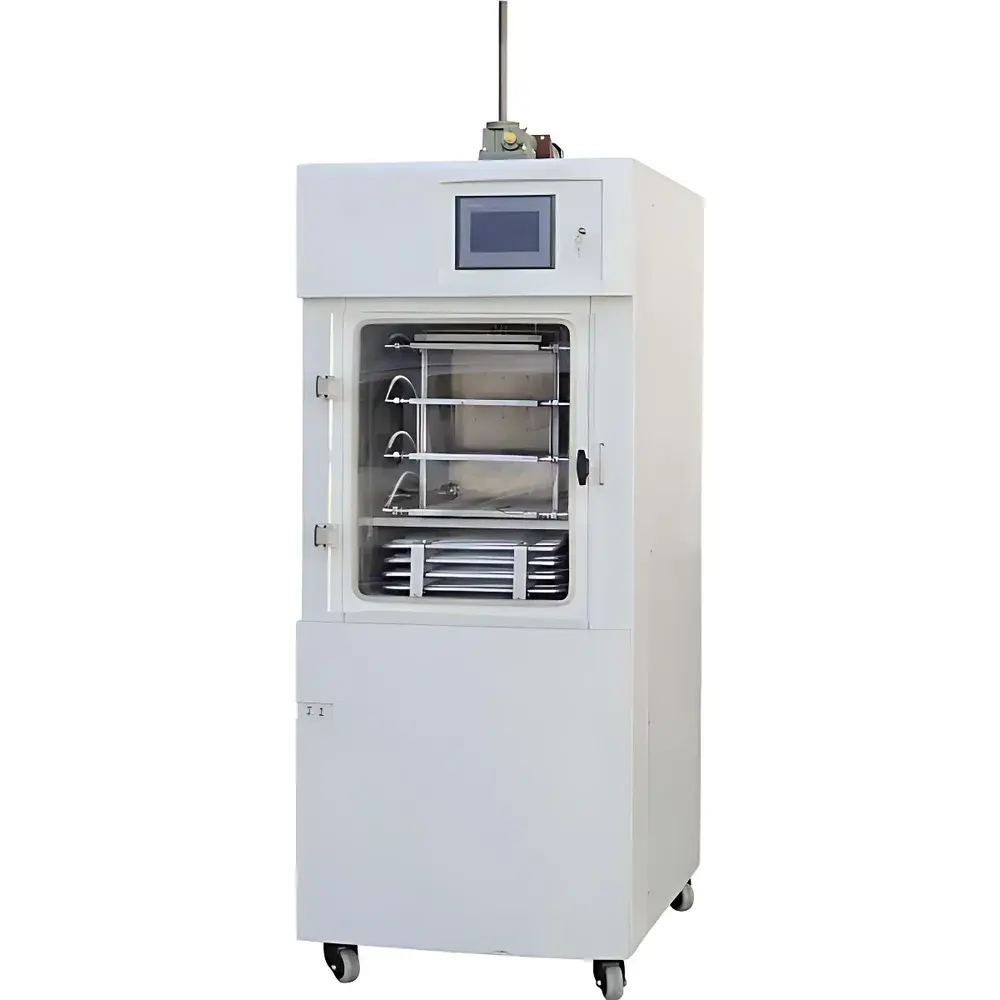
BIOCOOL Pilot7-12M Pilot-Scale Freeze Dryer
| Brand | BIOCOOL |
|---|---|
| Origin | Beijing, China |
| Model | Pilot7-12M |
| Type | Standard Shelf-Type Freeze Dryer |
| Application Scale | Pilot-Scale |
| Lyophilization Area | 0.8 m² |
| Ultimate Vacuum | ≤3 Pa |
| Condensate Capacity (24 h) | 12 L/24 h |
| Cold Trap Temperature | <−85 °C |
| Shelf Temperature Range (Empty) | −40 °C to +60 °C |
| Shelf Cooling Method | Silicone Oil Circulation |
| Shelf Spacing | 80 mm |
| Compressor Power | 2 × 3 HP |
| Vacuum Pump Speed | 4 L/s |
| Control Interface | Industrial Touchscreen HMI |
| Data Storage | Internal (3-month buffer), USB (optional), PC Database (optional) |
| Compliance | GLP-ready architecture with audit-trail-capable data logging (21 CFR Part 11 compliant configuration available) |
Overview
The BIOCOOL Pilot7-12M is a pilot-scale, shelf-type freeze dryer engineered for reproducible, scalable lyophilization of pharmaceuticals, biologics, diagnostics, and high-value research materials under controlled thermal and vacuum conditions. Based on the fundamental principles of sublimation—where ice transitions directly from solid to vapor phase below the triple point—this system enables precise removal of water or solvents while preserving thermolabile structures, enzymatic activity, and structural integrity of sensitive biomolecules. Designed for process development and clinical batch production (typically 5–50 L formulation volumes), the Pilot7-12M bridges laboratory feasibility studies and commercial manufacturing by delivering consistent drying kinetics, uniform heat transfer across its 0.8 m² stainless-steel shelves, and robust vacuum stability down to ≤3 Pa. Its −85 °C cold trap ensures efficient capture of water vapor and incidental volatile organics, minimizing backstreaming and maintaining condenser efficiency over extended cycles.
Key Features
- Shelf-based silicone oil circulation system with independent temperature control (−40 °C to +60 °C), enabling precise shelf pre-freezing, primary drying ramping, and secondary drying annealing.
- Aerospace-grade acrylic drying chamber door—bond-free, leak-tight, and rated for full vacuum exposure—provides unobstructed visual monitoring without compromising structural integrity.
- Dual 3 HP industrial compressors paired with a 4 L/s oil-sealed vacuum pump deliver rapid evacuation, stable low-pressure operation, and low acoustic emission (<62 dB(A)).
- Programmable logic controller (PLC) with industrial touchscreen HMI supports up to 500 user-defined lyo cycles; each cycle includes time-temperature-vacuum profiles with ≥50 ms real-time data acquisition frequency.
- Non-electric cold trap defrost system utilizing compressed air or inert gas purging—eliminates thermal shock, avoids hot-spot formation, and reduces downtime versus immersion-based methods.
- Automated stoppering mechanism with programmable force and stroke control for reliable, repeatable rubber stopper compression in vials (2–30 mL), reducing operator variability and contamination risk.
- Integrated vacuum regulation module (optional) allows dynamic pressure modulation during sublimation and desorption phases—critical for mitigating boil-over, collapse, or channeling in viscous or low-eutectic formulations.
- Triple-mode pulse backfill system (slow/medium/fast) enables controlled inert gas reintroduction to prevent particle dispersion or foam reformation in fragile cakes.
Sample Compatibility & Compliance
The Pilot7-12M accommodates aqueous solutions, suspensions, emulsions, and pastes with eutectic temperatures above −40 °C—validated for proteins, monoclonal antibodies, vaccines, probiotics, and diagnostic reagents. Its stainless-steel chamber, electropolished shelves, and drainable condenser meet ASME BPE surface finish requirements (Ra ≤ 0.8 µm). Optional features—including nitrogen/purge gas inlet, organic solvent trap, and oil mist filter—support ICH Q5C stability protocols and USP lyophilization guidance. The system architecture supports GLP/GMP environments: optional 21 CFR Part 11-compliant electronic signatures, audit trail logging (user actions, parameter changes, alarm events), and calibration traceability (temperature sensors per ASTM E2877, vacuum gauges per ISO 20487) are available upon configuration.
Software & Data Management
Data acquisition and control are managed via embedded Linux-based firmware with dual storage redundancy: internal flash memory retains ≥90 days of timestamped temperature (shelf, product, condenser), pressure (chamber, condenser), and actuator status logs. Optional USB export enables offline analysis in CSV or Excel-compatible formats; PC database integration (via Ethernet or RS485) supports centralized lab informatics systems (e.g., LabVantage, STARLIMS). Freeze-drying curve visualization tools allow overlay comparison of multiple batches, deviation alerts at critical phase transitions (e.g., end of primary drying), and correlation of moisture content (via optional residual moisture sensor) with endpoint detection algorithms. All firmware updates are digitally signed and validated prior to installation.
Applications
- Clinical trial material production (Phase I–III): consistent batch-to-batch performance for sterile injectables and lyophilized powders.
- Process characterization and design space definition per ICH Q8(R2), including DoE-based shelf temperature ramping, vacuum ramp profiling, and endpoint determination.
- Stability study support: parallel drying of accelerated/degraded samples under identical thermal history for comparative moisture mapping.
- Vaccine formulation development: preservation of antigen conformation and adjuvant dispersion in multi-component systems.
- Cell therapy and exosome processing: low-temperature drying without cryoprotectant crystallization artifacts.
- Academic and contract research organizations (CROs): standardized platform for method transfer between R&D, pilot, and GMP facilities.
FAQ
What is the maximum batch volume this system can handle?
Based on 0.8 m² shelf area and typical loading density (10–15 mL per 100 cm²), the Pilot7-12M supports 8–12 L of solution per cycle—optimized for vial, tray, or bulk container configurations.
Does the system support validation documentation (IQ/OQ/PQ)?
Yes—factory-issued IQ/OQ protocols are provided; PQ execution support includes calibrated PT100 sensors, Pirani/capacitance vacuum gauges, and third-party certified reference standards.
Can the unit be integrated into a cleanroom environment?
The cabinet is designed for Class C/D environments; optional HEPA-filtered purge air supply, pass-through ports, and static-dissipative finishes are available.
Is remote monitoring supported out-of-the-box?
Standard Ethernet interface enables local network access; optional 1.5 km RF telemetry kit or cloud-based dashboard (with TLS 1.2 encryption) supports off-site supervision.
How is temperature uniformity across shelves verified?
Shelf temperature mapping per ISO 13485 Annex A is performed using ≥9 calibrated thermocouples per shelf during FAT; deviation remains ≤±1.5 °C at steady state.



