
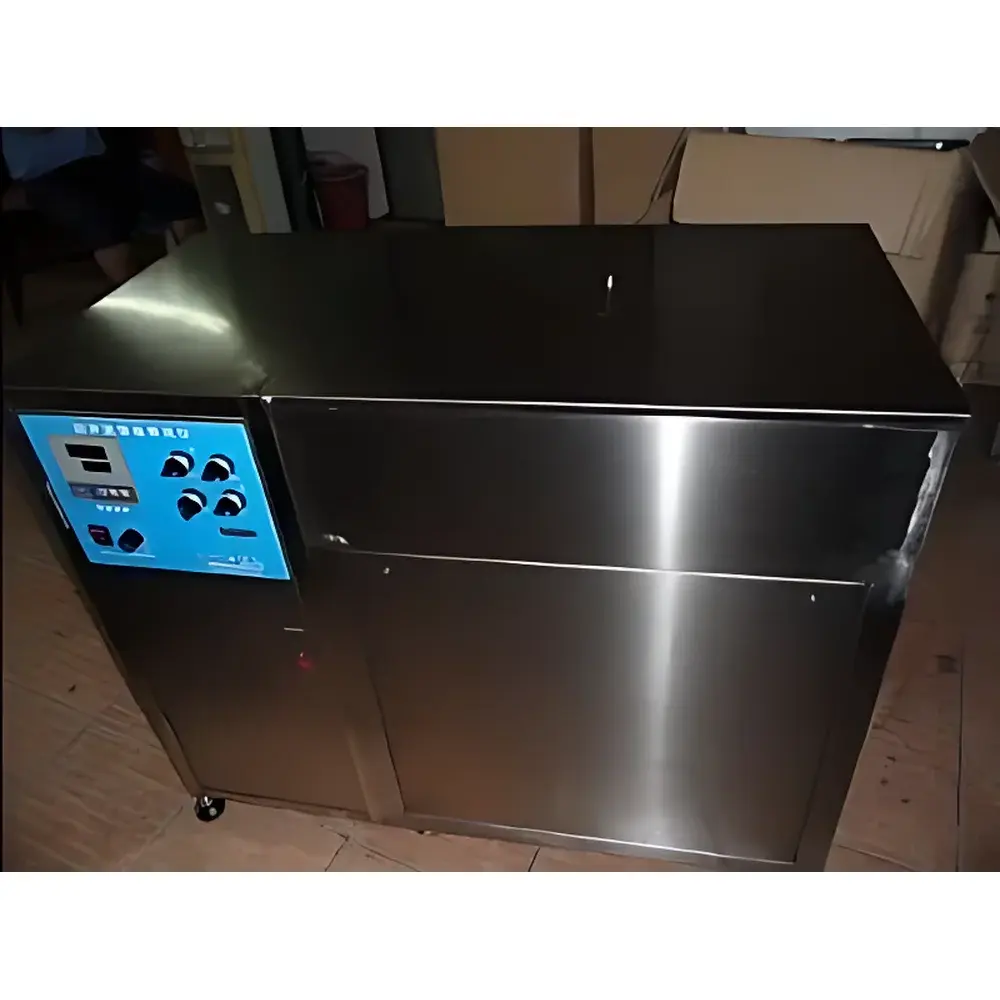
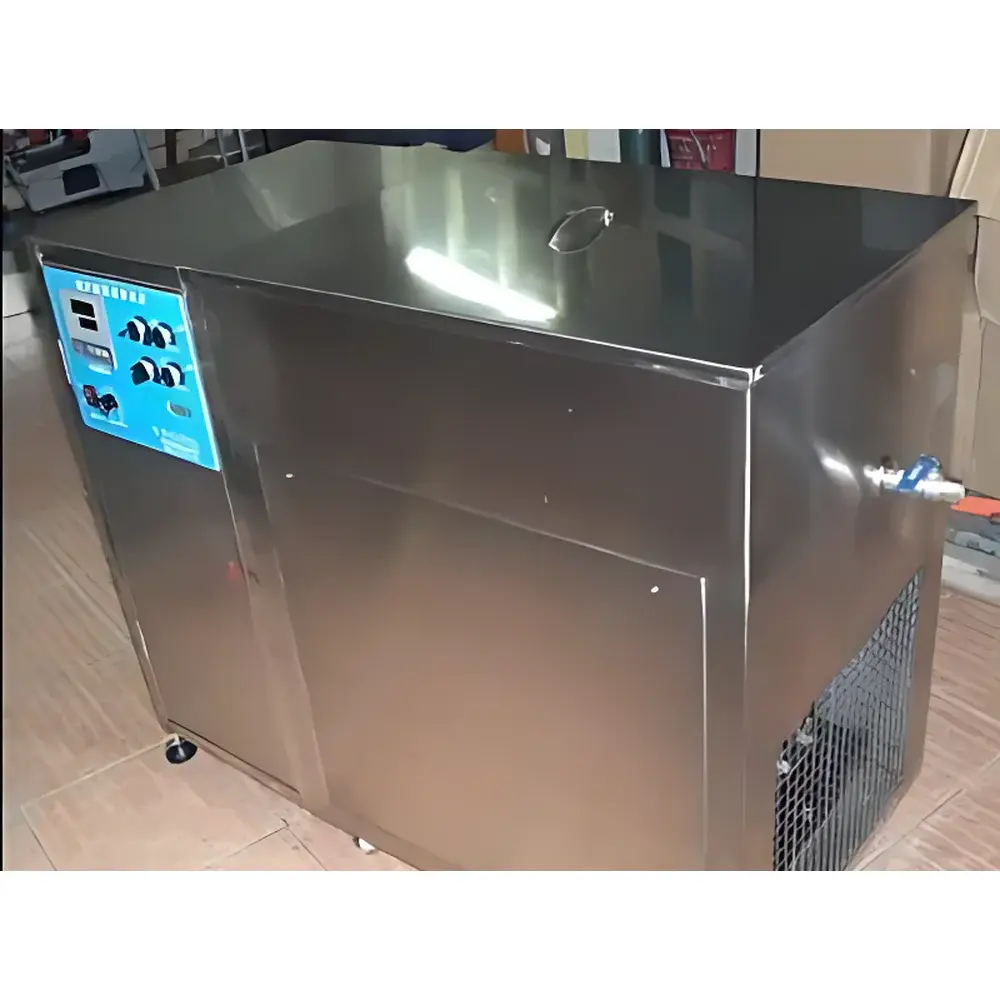
Shengyan SCQ-HC300A Ultrasonic Constant-Temperature Water Bath
| Brand | Shengyan Ultrasonics (SYCS) |
|---|---|
| Origin | Shanghai, China |
| Model | SCQ-HC300A |
| Temperature Range | RT to 100 °C |
| Temperature Stability | ±0.1 °C |
| Tank Capacity | 16 L |
| Internal Dimensions | 420 × 200 × 200 mm |
| Heating Power | 1000 W |
| Ultrasonic Power | 300 W |
| Timer Range | 1–600 min |
| Circulation Type | Internal & External |
| Drain Valve | Yes |
| Lid with Sound-Dampening Cover & Stainless Steel Mesh Basket | Yes |
| Power Supply | 220 V / 50 Hz |
| Construction | 304 Stainless Steel Tank & Heater |
| Control System | Microprocessor-Based with LCD Display |
Overview
The Shengyan SCQ-HC300A Ultrasonic Constant-Temperature Water Bath integrates precise thermal control with high-efficiency ultrasonic energy delivery in a single benchtop platform. Engineered for reproducible laboratory workflows, it operates on the principle of piezoelectric transduction—converting electrical input into mechanical vibrations at frequencies typically in the 40 kHz range—to generate cavitation within aqueous or low-viscosity solvent media. Simultaneously, a PTFE-coated 304 stainless steel heating element and PID-controlled feedback loop maintain temperature stability within ±0.1 °C across the full operating range (ambient to 100 °C). Unlike basic water baths, this system incorporates dual-mode circulation (internal recirculation for uniform bath homogeneity and external port for connection to auxiliary equipment), enabling integration into larger thermal management loops—such as jacketed reactors or inline sample conditioning lines. Its sealed, non-CFC refrigeration-assisted cooling option (available on select variants) further supports rapid cooldown after high-temperature operation, minimizing thermal overshoot and improving protocol repeatability.
Key Features
- Microprocessor-based digital controller with backlit LCD interface for independent setting of temperature, ultrasonic duty cycle, and timer duration (1–600 min)
- 304 stainless steel tank and heating assembly ensure corrosion resistance, long-term dimensional stability, and compatibility with mild organic solvents and aqueous buffers
- Dual-circulation architecture: internal pump maintains axial symmetry of temperature distribution; external outlet/inlet ports support closed-loop integration with chillers or flow-through cells
- Integrated sound-dampening lid and removable stainless steel mesh basket reduce airborne noise emission and enable secure containment of fragile or small-volume samples during sonication
- Drain valve located at the lowest point of the tank allows complete fluid evacuation without disassembly—critical for cross-contamination prevention between biological or pharmaceutical applications
- Over-temperature and dry-run protection circuits comply with IEC 61010-1 safety requirements for laboratory electrical equipment
Sample Compatibility & Compliance
The SCQ-HC300A accommodates standard laboratory vessels including glass beakers (up to 1 L), centrifuge tubes, reaction vials, and custom immersion probes. Its open-bath geometry permits direct placement of temperature sensors (e.g., Pt100 or thermistor probes) for independent validation. The unit meets CE marking requirements under the Low Voltage Directive (2014/35/EU) and Electromagnetic Compatibility Directive (2014/30/EU). While not certified for GMP environments out-of-the-box, its stable thermal performance, audit-ready parameter logging (via optional RS232/USB output), and absence of volatile refrigerants make it suitable for GLP-aligned research labs conducting method development per USP , ISO 13485 pre-clinical support, or ASTM D2622-compliant sample preparation. All wetted surfaces are electropolished 304 SS, facilitating cleaning validation per FDA guidance on equipment hygiene.
Software & Data Management
Standard configuration includes local parameter storage for up to 10 user-defined protocols. Optional communication modules (RS232 or USB-to-serial adapter) enable connection to PC-based acquisition software for time-stamped logging of temperature setpoint, actual bath temperature, ultrasonic ON/OFF status, and elapsed time. Export formats include CSV and Excel-compatible .xls—supporting traceability in regulated environments requiring 21 CFR Part 11–compliant electronic records (when paired with validated third-party software and access controls). No cloud connectivity or proprietary firmware updates are implemented, ensuring deterministic behavior and eliminating cybersecurity exposure vectors common in IoT-enabled lab devices.
Applications
- Accelerated solvent extraction of botanical matrices (e.g., curcuminoids from turmeric, alkaloids from poppy straw) under controlled thermal-sonic conditions
- Controlled depolymerization of chitosan, alginate, or hyaluronic acid for hydrogel precursor synthesis
- In-situ cleaning and descaling of HPLC columns, microfluidic chips, and optical cuvettes without mechanical abrasion
- Temperature-regulated enzymatic digestion (e.g., trypsin, DNase I) where kinetic consistency depends on both thermal precision and acoustic mixing uniformity
- Pre-conditioning of polymer solutions prior to rheological or DSC analysis to eliminate thermal history artifacts
- Cell lysis optimization studies requiring orthogonal control over cavitation intensity and thermal denaturation thresholds
FAQ
What is the maximum recommended operating temperature for continuous use?
The SCQ-HC300A is rated for sustained operation up to 95 °C to ensure long-term seal integrity and transducer longevity; 100 °C is permissible for short-duration (<30 min) protocols only.
Can the ultrasonic function operate independently of heating or cooling?
Yes—ultrasonic activation, timing, and power level are fully decoupled from thermal control settings, allowing cold sonication or ambient-temperature cavitation studies.
Is external temperature probe input supported for cascade control?
No; the system relies solely on its factory-calibrated internal Pt100 sensor. For external feedback, users must implement an external PID controller interfaced via analog voltage output (optional accessory).
How often should the ultrasonic transducers be serviced or replaced?
Under normal usage (≤4 h/day, distilled/deionized water), transducer service life exceeds 5,000 operating hours. Visual inspection for pitting or delamination is recommended every 6 months.
Does the unit meet IP rating requirements for splash resistance?
The front-panel electronics are rated IP20; the bath chamber itself is not sealed against liquid ingress beyond normal condensation—appropriate placement away from sinks or pipetting stations is advised.



