
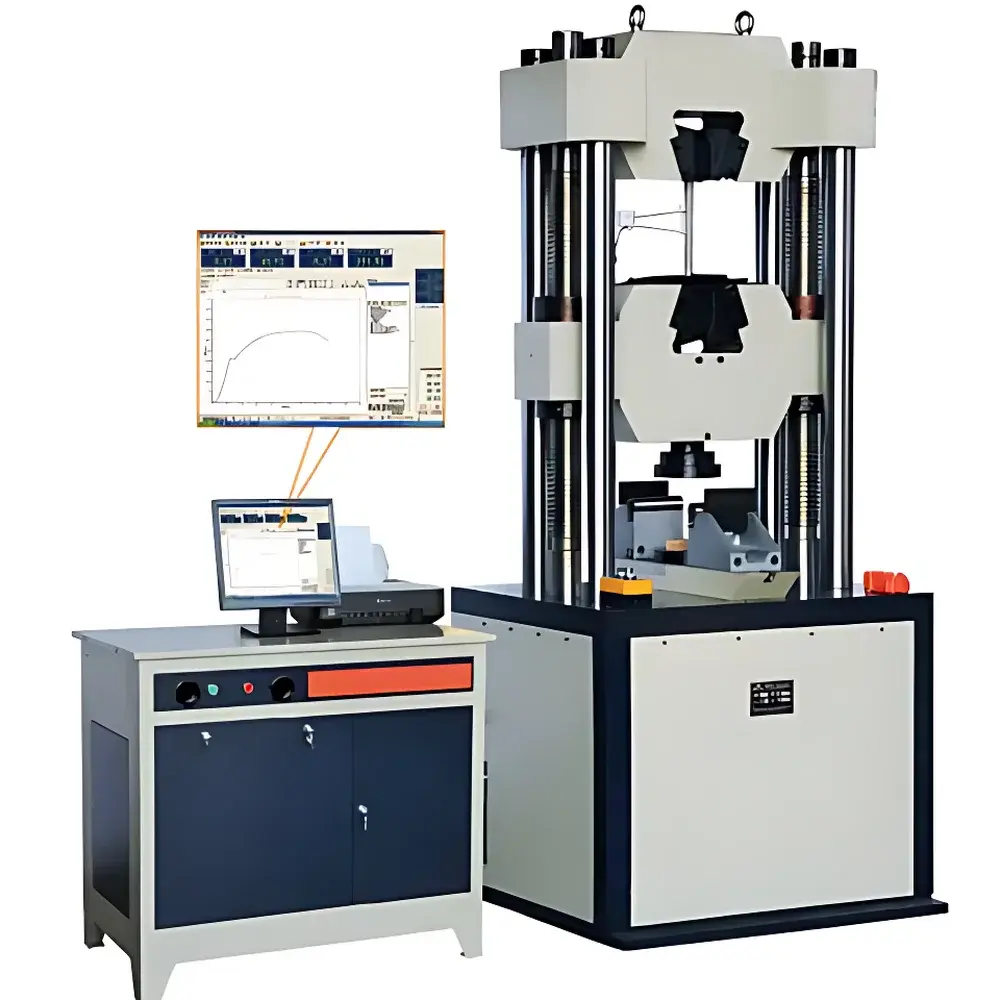
YANRUN WAW600-1000D Electro-Hydraulic Servo Universal Testing Machine
| Brand | YANRUN |
|---|---|
| Origin | Shanghai, China |
| Manufacturer Type | Direct Manufacturer |
| Model | WAW600-1000D |
| Instrument Type | Electro-Hydraulic Servo Testing Machine |
| Max Test Force | 600 kN / 1000 kN |
| Force Measurement Range | 50–600 kN / 50–1000 kN |
| Force Indication Relative Error | ≤ ±1% of reading |
| Force Resolution | 0.01 kN |
| Displacement Resolution | 0.01 mm |
| Deformation Measurement Accuracy | 0.01 mm |
| Max Tensile Test Space | 650 mm / 750 mm |
| Max Compression Space | 380 mm |
| Piston Stroke | 150 mm |
| Round Specimen Clamping Diameter | Φ13–Φ40 mm |
| Flat Specimen Clamping Thickness | 0–15 mm |
| Flat Specimen Max Clamping Width | 75 mm |
| Compression Platen Diameter | φ160 mm |
| Bending Support Span (Max) | 450 mm |
| Bending Support Roller Width | 120 mm / 140 mm |
| Bending Support Roller Diameter | Φ30 mm / Φ40 mm |
| Max Piston Speed | 50 mm/min |
| Clamping Method | Automatic Hydraulic Clamping |
| Host Dimensions (W×D×H) | 830×700×2100 mm / 900×710×2200 mm |
| Load Frame Cabinet Dimensions (W×D×H) | 1000×700×1400 mm |
| Weight | 3300 kg / 4000 kg |
Overview
The YANRUN WAW600-1000D Electro-Hydraulic Servo Universal Testing Machine is an industrial-grade static mechanical testing system engineered for high-force tensile, compression, and flexural evaluation of metallic and high-strength composite materials. It operates on a closed-loop electro-hydraulic servo control architecture, utilizing a wide-band digital proportional valve to precisely regulate hydraulic flow to the lower-mounted actuator cylinder. This design ensures stable load application, minimal hysteresis, and high reproducibility across force-controlled, displacement-controlled, and strain-controlled test modes. The machine complies with ISO 6892-1:2019, ASTM E4, ASTM E8/E8M, and GB/T 228.1–2010 for metallic material tensile testing, and supports full traceability in GLP and GMP-aligned environments through audit-ready data logging.
Key Features
- Lower-actuator frame configuration with integrated powertrain housed beneath the base—enhancing structural rigidity and minimizing column deflection during high-load testing.
- Full-opening jaw design with automatic hydraulic clamping system, enabling rapid specimen loading/unloading and consistent gripping pressure across round (Φ13–Φ40 mm) and flat (0–15 mm thick × up to 75 mm wide) geometries.
- Dual-capacity force sensor configuration (600 kN and 1000 kN), each calibrated per ISO 376 Class 0.5, with force resolution of 0.01 kN and indication error ≤ ±1% of reading over the valid measurement range (50–1000 kN).
- High-resolution displacement measurement via non-contact linear variable differential transformer (LVDT) and encoder-based crosshead tracking (0.01 mm resolution); deformation acquisition via extensometer interface supporting both clip-on and video-based systems.
- Industrial-grade Lenovo control workstation pre-installed with proprietary testing software supporting real-time parameter setting, multi-step test sequencing, and synchronized acquisition of force, displacement, and strain channels at ≥1 kHz sampling rate.
Sample Compatibility & Compliance
The WAW600-1000D accommodates standardized tensile specimens (e.g., ISO 6892-1 Type 2, ASTM E8 dog-bone), compression cylinders (up to φ160 mm), and three-point bending fixtures (support span up to 450 mm, roller diameters Φ30/Φ40 mm). Its mechanical architecture meets CE Machinery Directive 2006/42/EC requirements, and its measurement subsystems are traceable to national metrological standards (CNAS-accredited calibration). The system supports compliance workflows for ISO/IEC 17025 accredited laboratories, including configurable pass/fail criteria, electronic signatures, and 21 CFR Part 11–compliant audit trails when paired with validated software modules.
Software & Data Management
The embedded Windows-based control platform provides ISO-standardized test method templates (tensile, compression, bending), automated calculation of mechanical properties—including ultimate tensile strength (Rm), yield strength (ReL, Rp0.2), Young’s modulus (E), elongation at break (A50, A80), and reduction of area (Z)—in accordance with GB/T 228.1 and ASTM E8. Raw data is stored in binary .tdms format with embedded metadata (operator ID, timestamp, environmental conditions, calibration IDs). Export options include CSV, PDF reports with embedded stress–strain curves, and XML for LIMS integration. All data modifications are logged with user attribution and timestamping.
Applications
This system is routinely deployed in metallurgical QA/QC labs, aerospace component certification facilities, and construction material R&D centers for mechanical validation of structural steels, aluminum alloys, titanium grades, and high-performance weldments. Typical use cases include: qualification testing of forged crankshafts per SAE J429; compressive strength verification of concrete-filled steel tubes (CFT); flexural property assessment of rail fastening components; and high-cycle fatigue pre-screening via monotonic ramp-and-hold protocols. Its dual-range capacity allows cost-effective testing across both medium- and heavy-section specimens without hardware reconfiguration.
FAQ
What standards does the WAW600-1000D support out-of-the-box?
Pre-configured test methods cover GB/T 228.1–2010, ISO 6892-1:2019, ASTM E8/E8M, ASTM E9, and ASTM D7264 for flexure.
Is the system compatible with third-party extensometers?
Yes—it features analog and digital (RS-422) inputs compliant with ASTM E83 Class B-1 and ISO 9513:2012 for strain measurement devices.
Can test data be integrated into enterprise LIMS or MES platforms?
Raw data exports support CSV, XML, and SQL database push via ODBC; API documentation is provided for custom middleware development.
What maintenance intervals are recommended for hydraulic system integrity?
Hydraulic oil analysis and filter replacement every 2,000 operating hours; annual recalibration of load cell and displacement transducers is advised per ISO 376 and ISO 7500-1.
Does the system support cyclic or low-cycle fatigue testing?
While primarily designed for static and quasi-static tests, it supports basic load-controlled cycling (≤5 Hz) with optional waveform generator module and closed-loop strain feedback.



