Swiss Dantec Extol Online Coordinate Measuring Machine (CMM) – ABERLINK Extol 370/520
| Brand | ABERLINK |
|---|---|
| Origin | United Kingdom |
| Manufacturer Type | Authorized Distributor |
| Origin Category | Imported |
| Model | Extol 370/520 |
| Pricing | Available Upon Request |
| Configuration | Hybrid (Contact + Optional Non-Contact Probes) |
| Operation Mode | Fully Automated |
| Machine Architecture | Vertical Cantilever |
| Measurement Principle | Contact-Based Tactile Metrology (ISO 10360-2 Compliant) |
Overview
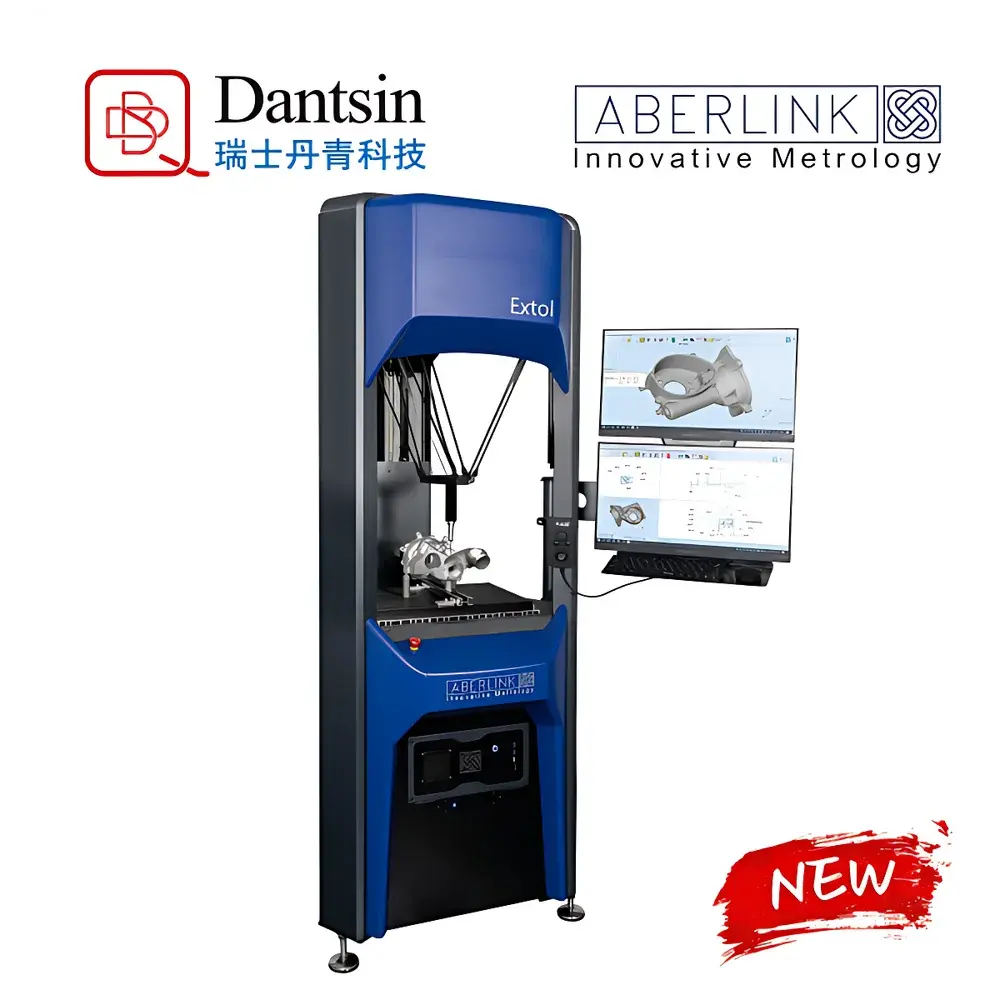
The Swiss Dantec Extol Online CMM series—engineered and distributed by ABERLINK (UK)—represents a purpose-built solution for in-process and near-line geometric metrology within demanding production environments. Unlike conventional Cartesian-frame coordinate measuring machines, the Extol platform employs a proprietary triangular mechanical architecture that decouples structural rigidity from traditional X-Y-Z orthogonality constraints. This non-Cartesian kinematic design delivers enhanced dynamic stiffness, reduced thermal drift sensitivity, and improved vibration damping—critical attributes for stable operation directly adjacent to CNC machine tools or inside temperature-fluctuating manufacturing cells. Certified to ISO 10360-2 for length measurement error (E₀,MPE), the Extol 370/520 is classified as a vertical cantilever CMM with hybrid capability: tactile probing forms the metrological foundation, while optional vision or laser line scanners may be integrated for feature-based alignment or surface characterization without compromising traceable dimensional accuracy.
Key Features
- Robust vertical cantilever structure with granite base and thermally stabilized aluminum bridge—designed for continuous 24/7 operation in shop-floor conditions (IP54-rated enclosure optional)
- Triangular kinematic frame minimizing Abbe error and elastic deformation under probe loading, supporting repeatability ≤ 1.2 µm (2σ) across full working volume
- High-speed servo-driven axes with direct-drive linear motors and optical encoder feedback (resolution: 0.1 µm)
- Integrated temperature compensation via dual-point thermal sensors (ambient + bridge), compliant with ISO 10360-3 thermal uncertainty modeling
- Automated probe changers (up to 12 positions) supporting modular tactile styli, scanning heads (e.g., SP25M), and optional non-contact modules
- Real-time collision avoidance logic with adaptive path planning—enabling unattended operation during first-article inspection or SPC-driven sampling cycles
Sample Compatibility & Compliance
The Extol 370/520 accommodates workpieces ranging from small precision components (e.g., medical implants, aerospace fittings) up to medium-sized castings and machined assemblies (max. weight: 50 kg; max. height: 520 mm). Fixturing flexibility includes magnetic chucks, custom soft-jaw clamps, and palletized automated loading interfaces compatible with standard MES/SCADA handshaking protocols (OPC UA, Modbus TCP). All measurement routines adhere to ISO/IEC 17025 requirements for accredited calibration laboratories, and system validation documentation supports GLP/GMP audit trails per FDA 21 CFR Part 11 when paired with ABERLINK’s certified software suite. Traceability is maintained through NIST-traceable artifact verification (e.g., step gauges, sphere plates) performed at installation and annually thereafter.
Software & Data Management
ABERLINK’s proprietary Metrology Suite v8.2 serves as the embedded control and analysis environment. It provides ISO-compliant GD&T evaluation (ASME Y14.5–2018, ISO 1101), statistical process control dashboards (X̄–R, Cp/Cpk), and automated report generation in PDF/XML formats with digital signature support. Audit logging records all operator actions, parameter changes, and calibration events with timestamped, immutable entries—fully satisfying FDA 21 CFR Part 11 electronic record requirements. Data export supports STEP AP242, DMIS 4.3, and CSV for integration into enterprise quality management systems (QMS) such as ETQ Reliance or Siemens Opcenter Quality.
Applications
- In-process verification of critical dimensions on turned/milled parts prior to final finishing or heat treatment
- First-article inspection with full GD&T reporting for AS9102 or PPAP submissions
- Tool wear monitoring via repeated measurement of master gages or reference fixtures
- Production-line SPC implementation using real-time deviation trending against engineering tolerances
- Reverse engineering support for legacy part requalification (with optional scanning add-ons)
- Calibration verification of shop-floor handheld instruments (e.g., micrometers, bore gages) using calibrated CMM artifacts
FAQ
Is the Extol CMM suitable for unattended operation in a high-vibration machining cell?
Yes—the triangular frame architecture and active damping elements ensure stable metrological performance even when installed within 2 meters of multi-axis CNC equipment. Vibration isolation mounts and optional active anti-vibration platforms are available for extreme environments.
Can the system validate ISO 2768 general tolerances automatically?
Yes—Metrology Suite includes preconfigured templates for ISO 2768-mK, -fH, and -cL classes, enabling rapid pass/fail assessment of linear, angular, and form tolerances without manual GD&T definition.
Does ABERLINK provide factory acceptance testing (FAT) and on-site IQ/OQ documentation?
Yes—comprehensive FAT protocols aligned with VDI/VDE 2617 and ISO 10360 standards are delivered with each system. Installation Qualification (IQ) and Operational Qualification (OQ) packages meet pharmaceutical and aerospace quality system requirements.
What is the recommended recalibration interval under continuous production use?
ABERLINK recommends annual full volumetric calibration using laser interferometry and artifact verification. Intermediate performance checks (e.g., ball bar, sphere plate) should be conducted quarterly per ISO 17025 Clause 7.7.