
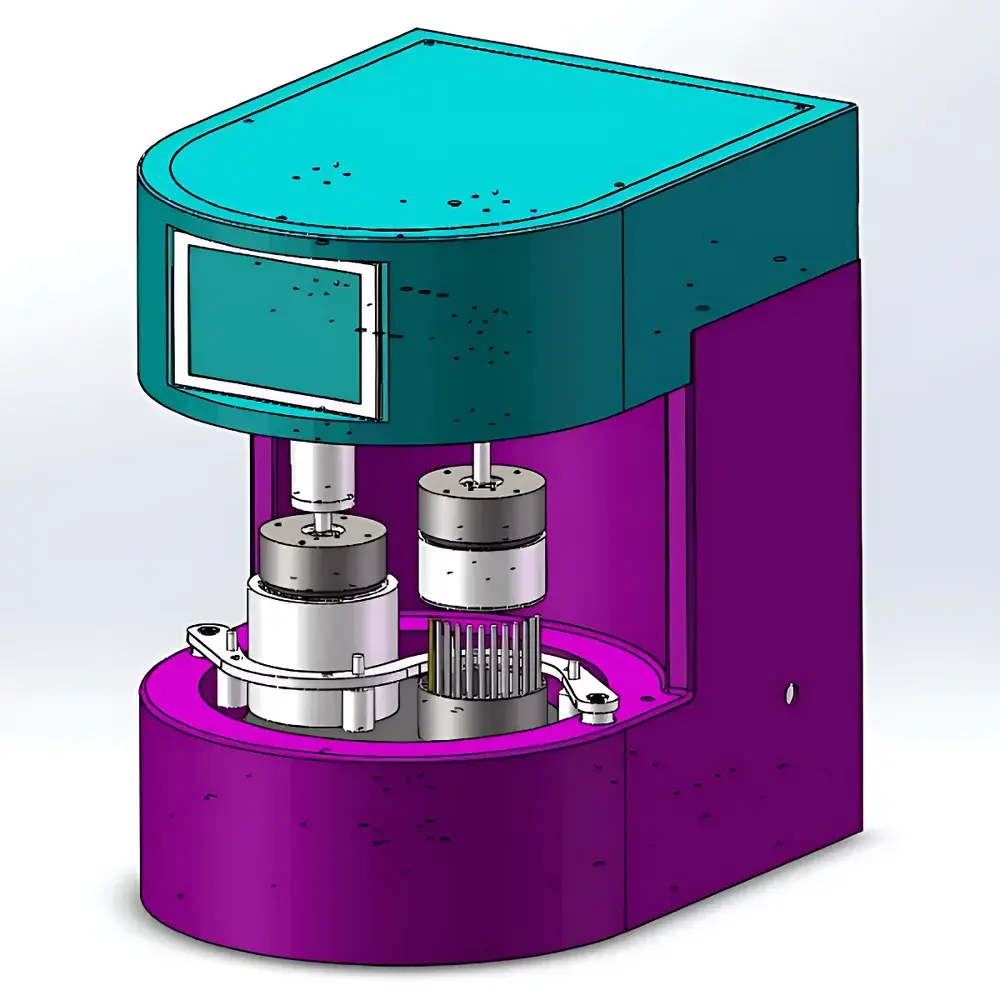
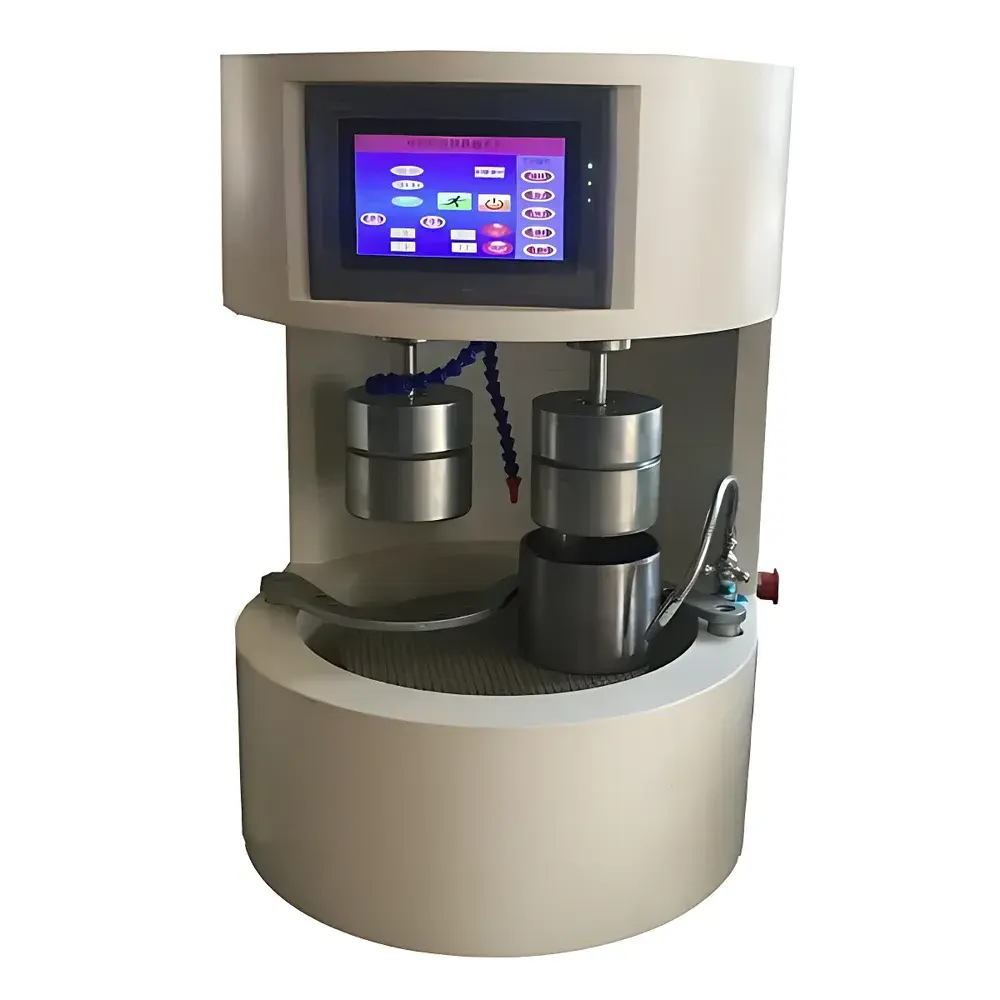
YANRUN ZMP-300S Intelligent Precision Polishing and Grinding System
| Brand | YANRUN |
|---|---|
| Origin | Shanghai, China |
| Manufacturer Type | Direct Manufacturer |
| Region of Origin | Domestic (China) |
| Model | ZMP-300S |
| Price | Upon Request |
| Speed Range | 10–300 rpm (intelligent auto-adjusting) |
| Platen Diameter | φ300 mm |
| Number of Platens | 2 |
| Dimensions (L×W×D) | 650 × 500 × 700 mm |
| Power Rating | 550 W |
| Voltage/Frequency | 220 V / 50 Hz |
| Control System | Color TFT touchscreen + PLC |
| Sample Loading | Counterweight-based pressure application |
| Grinding/Polishing Mode | Fully automated cycle control |
| Abrasive Delivery | Dual-channel programmable spray system |
| Minimum Dispensing Interval | 0.1 s |
| Minimum Spray Duration | 0.1 s |
| Cycle Time Range | 0–9999 s |
| Standard Platen Material | Cast iron with precision-machined surface |
| Included Accessories | One grinding platen, one sample holder plate, one polishing cloth, two sheets of metallurgical abrasive paper, one power cord, one water hose |
Overview
The YANRUN ZMP-300S Intelligent Precision Polishing and Grinding System is an engineered solution for reproducible, high-fidelity specimen preparation in metallographic, ceramic, geological, and advanced materials laboratories. Designed for rigorous compliance with ASTM E3, ISO 14487, and GB/T 13298 standards, the system employs a dual-platen architecture with independent rotational control and synchronized, programmable abrasive delivery to ensure uniform material removal and surface finish across diverse sample geometries. Its core operational principle relies on controlled mechanical abrasion under precisely regulated load, speed, and slurry distribution—enabling consistent planarization from coarse grinding through fine polishing stages. The integrated PLC-driven architecture ensures deterministic timing and repeatability, making it suitable for accredited quality control labs operating under GLP or ISO/IEC 17025 frameworks.
Key Features
- Intelligent dual-channel abrasive dispensing system with programmable interval (0.1 s resolution) and duration (0.1 s resolution), minimizing operator intervention and inter-batch variability.
- Color TFT touchscreen interface with intuitive graphical workflow navigation, real-time parameter monitoring, and password-protected user profiles for role-based access control.
- Dual 300 mm diameter platens mounted on rigid cast-iron base structure, each independently driven by low-vibration AC motors with closed-loop speed regulation (10–300 rpm, ±0.5 rpm accuracy).
- Counterweight-based loading mechanism providing stable, non-dynamic pressure application—eliminating hydraulic complexity while maintaining force consistency across extended cycles.
- Full-cycle automation including start/stop sequencing, time-based stage transitions, and automatic rinse/pause functions—all configurable per protocol.
- Integrated water management port and corrosion-resistant fluid pathways compatible with aqueous slurries, diamond suspensions, and colloidal silica dispersions.
Sample Compatibility & Compliance
The ZMP-300S accommodates flat, cylindrical, and irregularly shaped specimens up to 100 mm in diameter or equivalent cross-section, with customizable holder plates supporting standard 25 mm, 30 mm, and 50 mm mount diameters. It supports both conductive and non-conductive materials—including ferrous and non-ferrous alloys, sintered carbides, composites, optical glasses, and semiconductor wafers—without requiring vacuum chucks or adhesive bonding. All operational parameters are logged with timestamped audit trails, satisfying documentation requirements for ISO 9001 internal audits and FDA 21 CFR Part 11–aligned electronic record retention when paired with validated third-party LIMS integration.
Software & Data Management
The embedded control firmware stores up to 99 user-defined protocols, each containing speed profiles, pressure settings, abrasive type identifiers, spray timing sequences, and total cycle duration. Protocol export/import is supported via USB 2.0 interface in CSV format for version control and cross-lab method harmonization. Optional RS-485 or Ethernet modules enable remote monitoring and centralized fleet management in multi-instrument facilities. Data logs include motor current draw, temperature at bearing housings, and dispensing actuation events—facilitating predictive maintenance scheduling and root-cause analysis during process deviation investigations.
Applications
- Routine metallographic specimen preparation for optical and electron microscopy (SEM/TEM cross-section analysis).
- Surface planarization of brittle materials prior to microhardness testing (ASTM E384) or nanoindentation.
- Preparation of fracture surfaces for fatigue or creep studies requiring artifact-free topography.
- Standardized polishing of geological thin sections and mineralogical samples under petrographic QA/QC workflows.
- Processing of additive-manufactured components where layer boundary integrity must be preserved during sectioning.
- Research-grade surface conditioning for tribological testing substrates and coating adhesion evaluation.
FAQ
Is the ZMP-300S compliant with international calibration and traceability requirements?
Yes—the system’s speed control, timer circuitry, and dispensing actuators are factory-calibrated against NIST-traceable references; calibration certificates are provided upon request.
Can the machine be integrated into an automated lab workflow with robotic sample handling?
The ZMP-300S features dry-contact I/O terminals and Modbus RTU support, enabling synchronization with third-party robotic arms and conveyor systems via programmable logic controllers.
What maintenance intervals are recommended for long-term operational stability?
Platen surface flatness verification every 6 months; bearing lubrication annually; abrasive delivery nozzles cleaned after each 200 hours of cumulative operation.
Does the system support custom platen materials such as copper, tin, or synthetic polymers?
Yes—custom platens with alternative surface hardnesses, thermal conductivity, or chemical resistance can be supplied under OEM engineering collaboration.
Are software updates available remotely, and how are they validated?
Firmware updates are distributed via secure HTTPS portal and require digital signature verification; update history and rollback capability are retained in non-volatile memory.



