
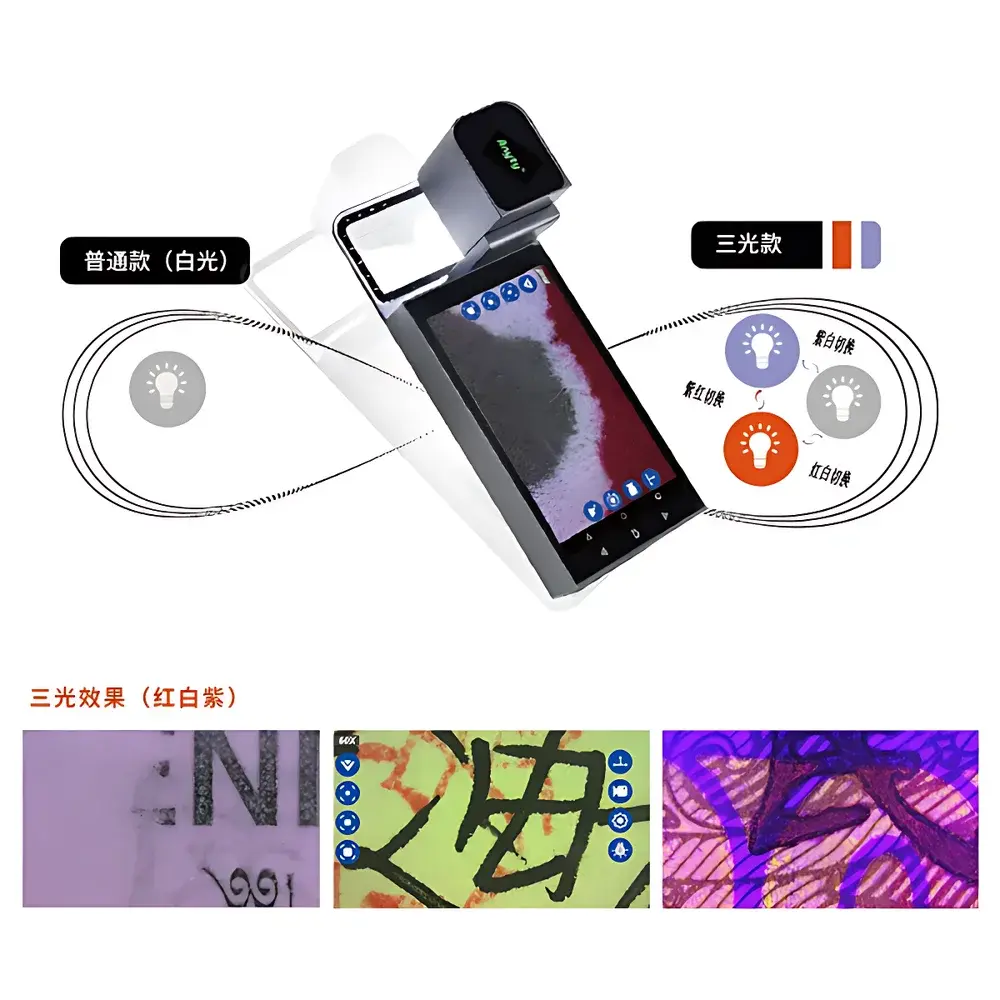
Anyty MSA600SF Portable Forensic Document Examiner
| Brand | Anyty |
|---|---|
| Origin | Beijing, China |
| Manufacturer Type | Direct Manufacturer |
| Country of Origin | China |
| Model | MSA600SF |
| Sensor | 1.3 MP CMOS color |
| Magnification | 5× / 60× / 200× (up to 400× on 17″ display) |
| Display | 5.0″ 720p capacitive touchscreen |
| Battery | 5200 mAh Li-ion (3 h continuous operation) |
| OS | Android-based embedded system |
| Storage | 8 GB internal (expandable to 64 GB / 128 GB via microSD) |
| Image Resolution | 1280 × 720 px |
| Dimensions | 183 × 72 × 52 mm (L × W × H) |
| Weight | ~400 g |
| Interface | USB-C |
| Wireless | Wi-Fi 802.11 b/g/n, Bluetooth 4.2 |
| Operating Temperature | 5–35 °C |
| Storage Temperature | −20 to +50 °C |
| Illumination | White light + UV (365 nm) + Red LED (625 nm) |
| Housing Material | Anodized aluminum alloy |
| Image Format | PNG (default), JPEG support available |
| Lighting Modes | Adjustable intensity per channel |
Overview
The Anyty MSA600SF Portable Forensic Document Examiner is a purpose-built optical instrument engineered for non-destructive, on-site examination of questioned documents in forensic laboratories, law enforcement agencies, and judicial evidence units. Designed around a multi-magnification coaxial optical path architecture, it employs a dual-lens modular configuration—comprising a low-power upward-facing 5× objective for rapid spatial localization and a high-power downward-facing 60×/200× objective for microstructural analysis—to enable precise, stepwise inspection of surface topography, ink layer sequence, and substrate interaction. Its core measurement principle relies on high-fidelity visible and near-UV reflectance imaging under controlled, spectrally selective illumination, facilitating reliable differentiation between original and altered entries—including additions, erasures, overwriting, and stamp impressions—without physical contact or sample preparation.
Key Features
- Tri-modal illumination system with independently controllable white (450–650 nm), ultraviolet (365 nm), and red (625 nm) LEDs—optimized for visualizing fluorescence, ink absorption anomalies, and contrast enhancement in aged or faded documents.
- Three fixed magnification stages (5×, 60×, 200×), calibrated for 17″ reference displays; optional digital zoom extends effective resolution to 400× while preserving geometric fidelity through pixel interpolation algorithms compliant with ISO/IEC 17025 documentation integrity requirements.
- Integrated 5.0-inch 720p capacitive touchscreen with glove-compatible interface, enabling direct annotation, measurement overlay (distance, area, angle), and real-time side-by-side comparison of evidentiary frames.
- Ruggedized anodized aluminum chassis (183 × 72 × 52 mm, ~400 g) meets MIL-STD-810G shock and vibration specifications for field deployment; IP52-rated ingress protection against dust and incidental moisture.
- Embedded Android OS with dedicated forensic imaging firmware—supports timestamped image capture with EXIF metadata embedding (including illumination mode, magnification, device ID, GPS coordinates if enabled), audit-trail logging, and export encryption (AES-256).
Sample Compatibility & Compliance
The MSA600SF accommodates flat, rigid, or slightly curved paper-based substrates up to A4 size (210 × 297 mm) and thicknesses ≤ 5 mm—including banknotes, passports, contracts, notarial deeds, seals, and thermal receipts. Its non-contact optical design eliminates risk of contamination or mechanical damage to fragile or historically sensitive materials. The instrument complies with ASTM E2249-22 (“Standard Guide for Examination of Handwritten Items”) and supports workflows aligned with ISO/IEC 17025:2017 clause 7.2.2 (method validation) and EN 14208:2016 (forensic document examination procedures). All captured imagery adheres to SWGDOC (Scientific Working Group for Document Examiners) best practices for evidentiary admissibility, including unaltered raw data retention and chain-of-custody metadata tagging.
Software & Data Management
The proprietary Anyty Forensic Capture Suite (v3.1+) runs natively on the device and synchronizes seamlessly with Windows/macOS desktop workstations via USB-C or Wi-Fi. It implements role-based access control (RBAC), full audit trails (per FDA 21 CFR Part 11 Annex 11 requirements), and encrypted local storage with automatic backup to network-attached storage (NAS) or cloud repositories (AWS S3, Azure Blob) using TLS 1.2+. Image datasets are structured in hierarchical folders by case ID, examiner ID, and acquisition timestamp; batch export supports PDF/A-2b, TIFF, and forensic-ready CSV reports containing calibration logs, illumination parameters, and operator annotations. Software updates are delivered via signed OTA packages verified through ECDSA-256 signature validation.
Applications
- Handwriting Analysis: Differentiation of pen pressure variation, stroke sequence, and tremor patterns at 200× magnification; detection of tracing or simulation artifacts via edge discontinuity mapping.
- Alteration Detection: Identification of chemical erasure (via UV-induced cellulose degradation signatures), mechanical scraping (micro-scratches orthogonal to fiber direction), and ink-layer reflow (interfacial boundary blurring under red-light illumination).
- Stamp & Seal Examination: Discrimination of genuine vs. photocopied impressions using dot-matrix pattern analysis, embossing depth profiling, and朱墨 (zhu-mo) sequence determination via multi-angle oblique lighting.
- Security Feature Verification: Rapid validation of holograms, optically variable devices (OVDs), microprinting, and UV-reactive inks in passports, ID cards, and financial instruments.
- Chain-of-Custody Documentation: On-device generation of tamper-evident PDF reports with embedded digital signatures, compliant with EN 15897:2011 for electronic evidence management.
FAQ
Is the MSA600SF suitable for courtroom-admissible evidence collection?
Yes. All image files retain embedded, non-removable metadata (EXIF + custom forensic tags), and the system enforces write-once storage policies with cryptographic hash verification (SHA-256) for every captured frame.
Can the device be calibrated traceably to national standards?
Yes. Each unit ships with a NIST-traceable calibration certificate for magnification accuracy (±0.8% at 200×) and illumination spectral output (measured per CIE 15:2018), valid for 12 months.
Does the system support integration with existing LIMS or evidence management platforms?
Yes. RESTful API endpoints enable bidirectional synchronization with major forensic LIMS (e.g., LabWare, Thermo Fisher SampleManager) and evidence tracking systems (e.g., Evidence.com, Axon Evidence) via HL7/FHIR-compliant data schemas.
What is the expected service life under daily forensic use?
Rated for ≥30,000 operational hours; key optical components carry a 5-year limited warranty, with extended calibration and firmware update support available under annual maintenance agreements.
Are software upgrades included post-purchase?
Yes. Firmware and application updates—including new illumination profiles, AI-assisted anomaly detection modules (opt-in), and regulatory compliance patches—are provided free of charge for the first three years from date of invoice.





