
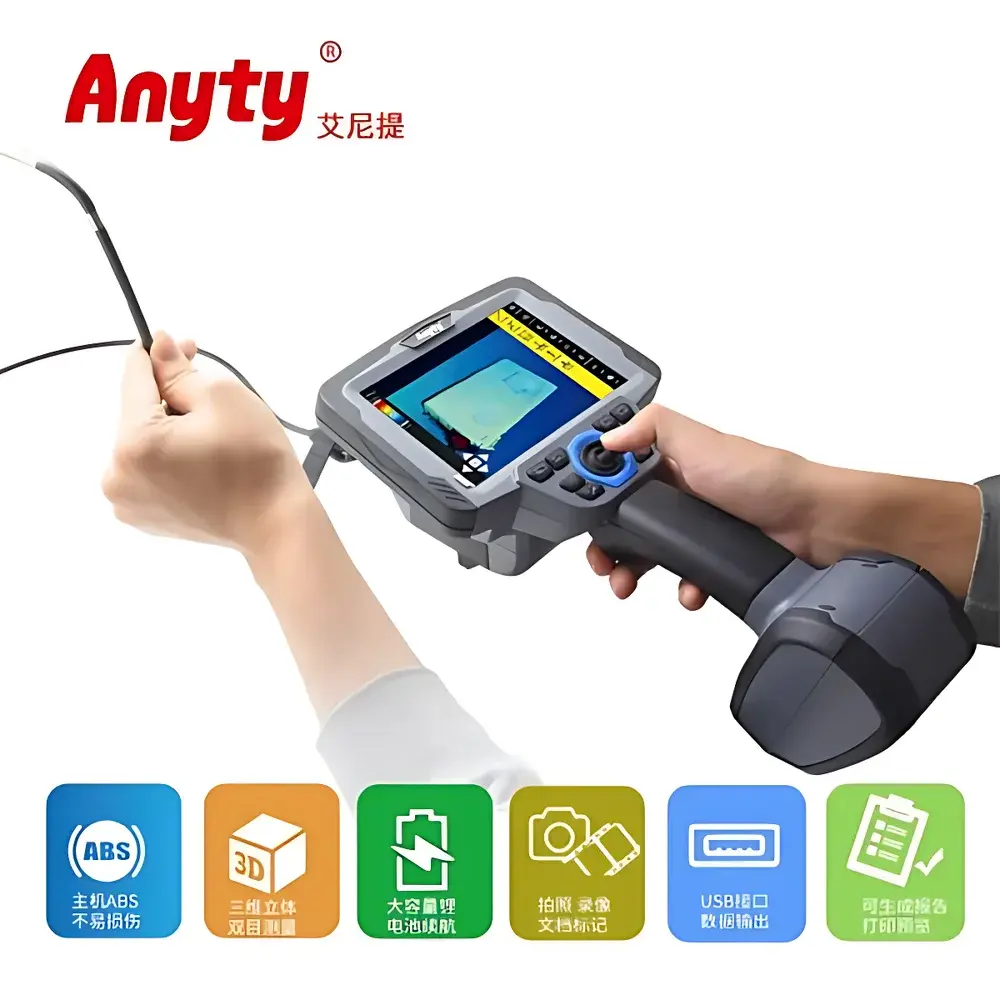
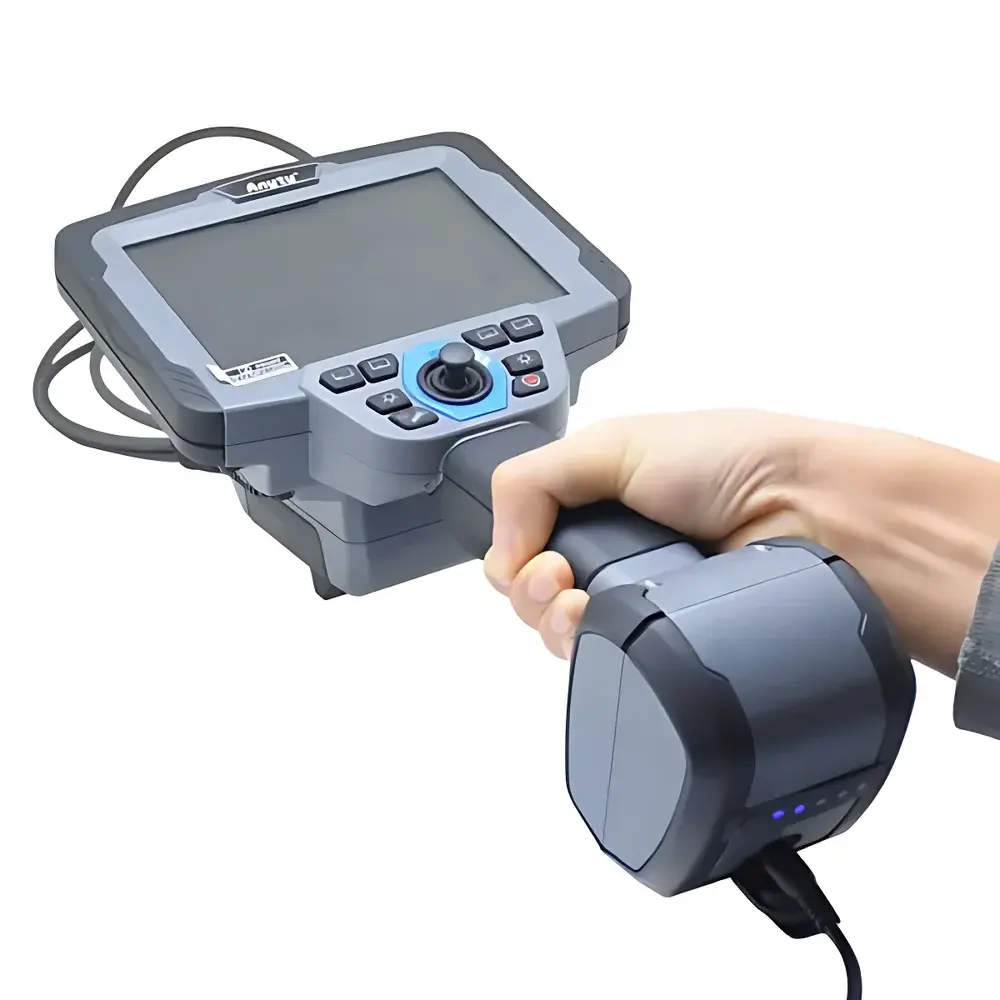
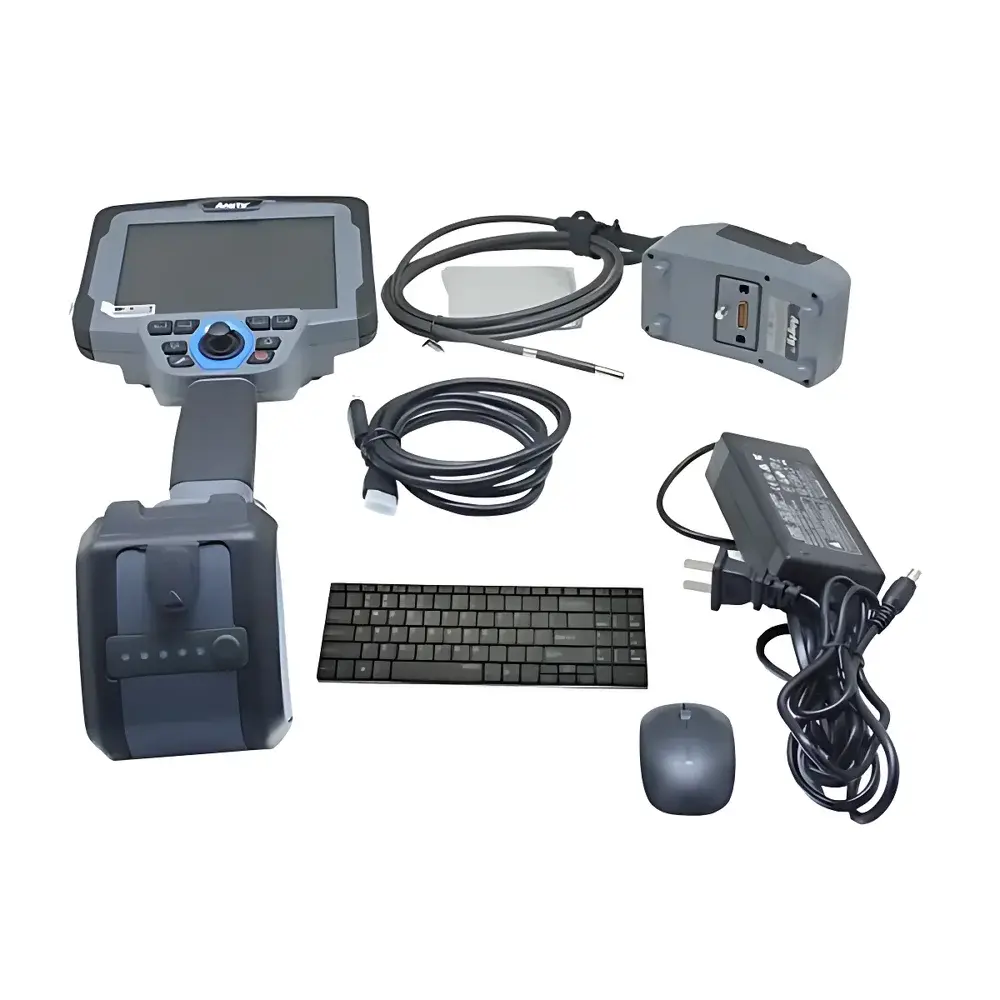
Anyty 3R-TDME-S High-Resolution Stereo 3D Measurement Industrial Endoscope
| Brand | Anyty |
|---|---|
| Origin | Beijing, China |
| Manufacturer Type | Direct Manufacturer |
| Product Origin | Domestic (China) |
| Model | 3R-TDME-S |
| Camera Resolution | 1.0 MP |
| Probe Diameter | 6 mm |
| Display | 6.5-inch Industrial Touchscreen |
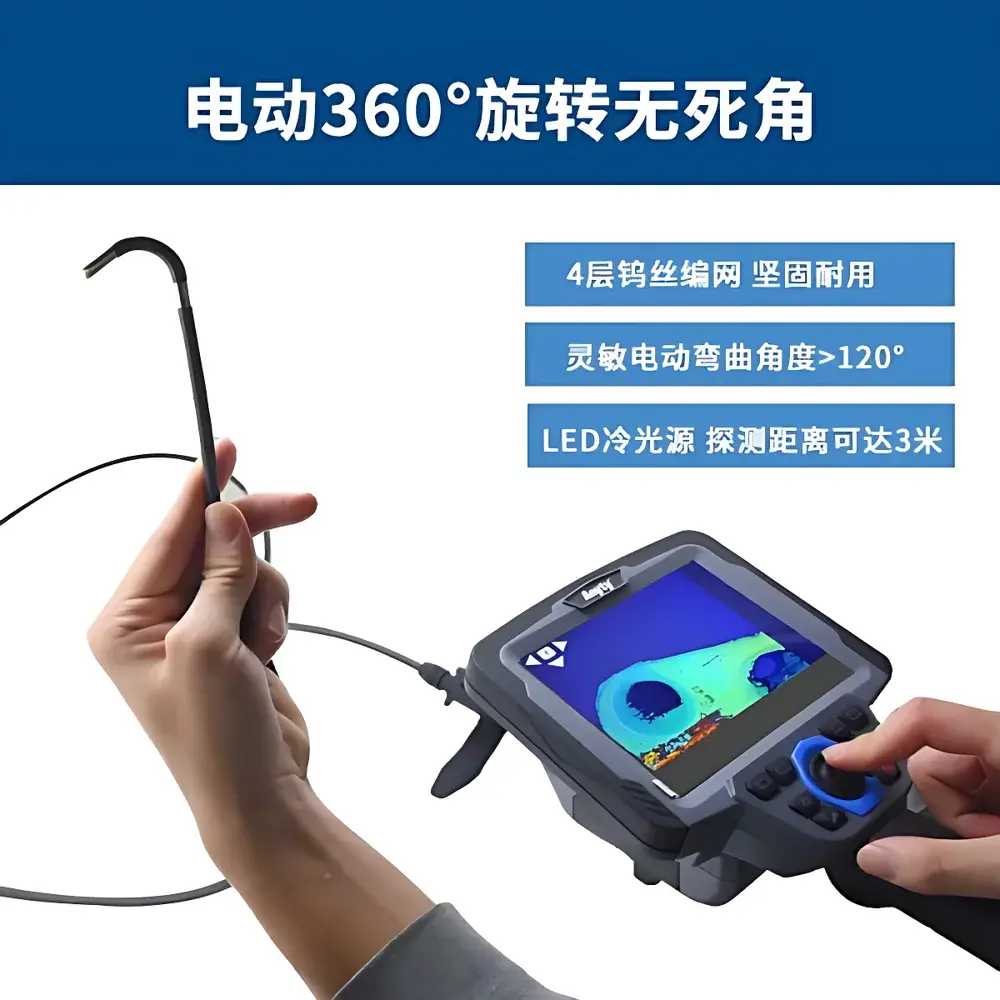
| Illumination | Cold LED Light Source (Effective Inspection Distance up to 3 m) |
| Measurement Accuracy | ±0.001 mm |
| Output Interfaces | USB (for data export), HDMI (for real-time HD video output) |
| Operation Modes | Button + Capacitive Touch Control |
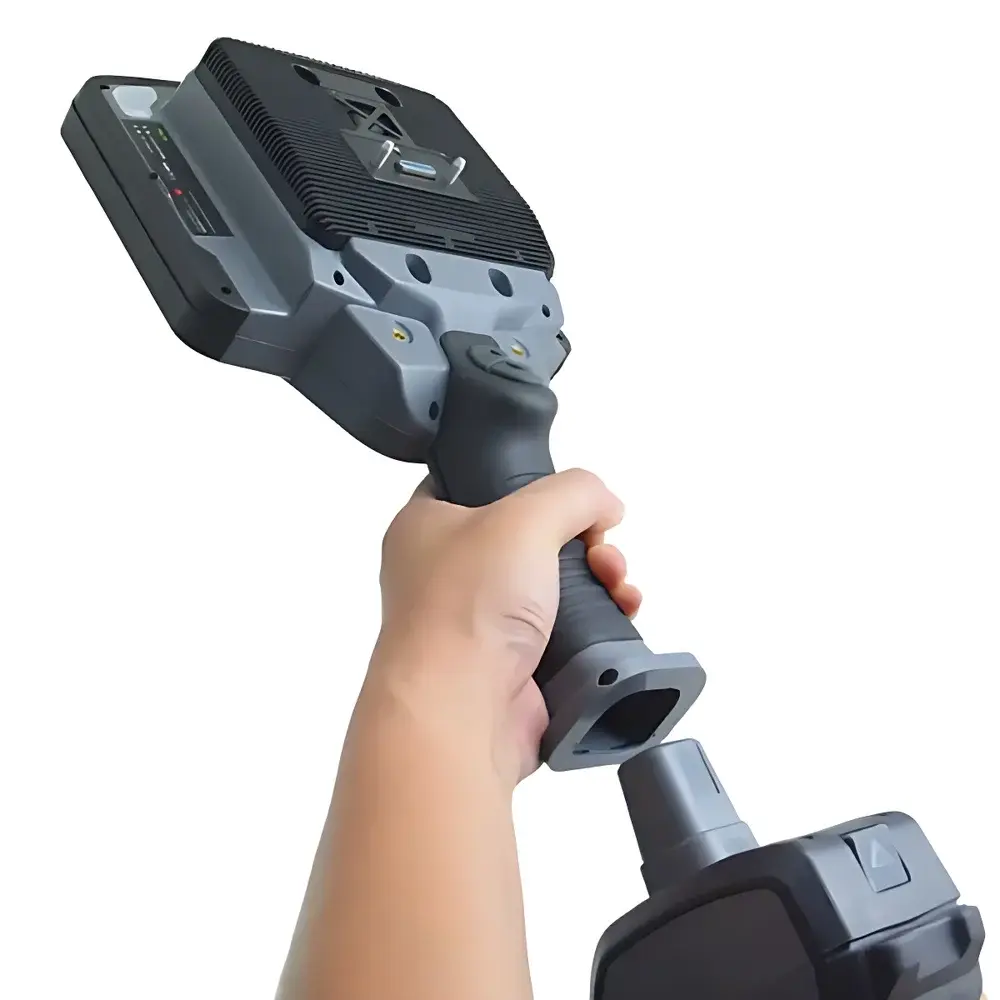
| Articulation | Detachable Handle & Main Unit, 360° Rotatable Probe Head |
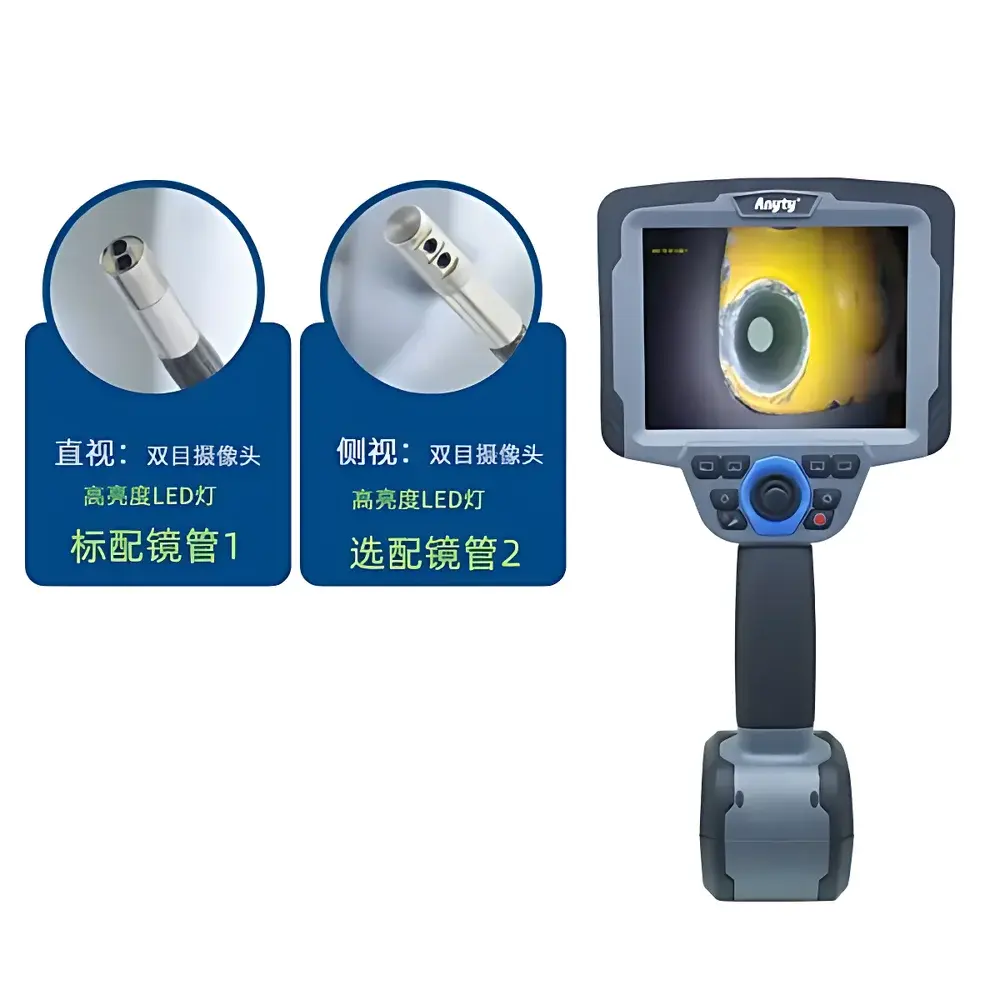
| Lens Configurations | Forward-viewing or Side-viewing Stereo Dual-optic Module |
| Measurement Capabilities | Point-to-point distance, depth, height, angle, area, volume, profile contour, and multi-step comparative analysis |
| Report Generation | Exportable PDF/CSV reports with embedded images, measurement annotations, and metadata |
Overview
The Anyty 3R-TDME-S is a high-precision stereo vision-based industrial endoscope engineered for non-destructive dimensional metrology within confined or inaccessible spaces. Unlike conventional single-sensor borescopes, this system implements calibrated binocular photogrammetry—leveraging two synchronized, geometrically aligned optical channels to reconstruct true-scale 3D surface topography in real time. Its core architecture integrates a rigid 6 mm-diameter probe with dual high-fidelity lenses, a thermally stable LED cold-light illumination system, and an embedded industrial-grade image processing engine. Designed specifically for quality assurance, maintenance inspection, and reverse engineering workflows in aerospace, power generation, automotive manufacturing, and precision machining sectors, the 3R-TDME-S delivers traceable, repeatable measurements without physical contact—enabling compliance with internal QA protocols and external standards such as ISO 17025 (when used within validated procedures) and ASTM E2500-13 (Guide for Specification, Design, and Verification of Pharmaceutical and Biopharmaceutical Manufacturing Systems).
Key Features
- Stereo dual-optic imaging module with forward-viewing or side-viewing configurations, enabling flexible access to complex geometries including turbine blade roots, weld seams, and internal gear cavities.
- Real-time 3D reconstruction engine with sub-micron depth resolution, supporting measurement accuracy of ±0.001 mm under controlled calibration conditions using NIST-traceable reference targets.
- Modular mechanical design: detachable ergonomic handle and main processing unit allow for rapid field reconfiguration and simplified sterilization or cleaning between inspections.
- 6.5-inch capacitive touchscreen interface with glove-compatible operation, providing intuitive access to measurement tools, annotation layers, and live stereo disparity visualization.
- Cold LED illumination system with adjustable intensity and uniformity control, optimized to minimize thermal drift and specular glare on metallic or reflective surfaces.
- On-device data management: direct USB mass storage export of annotated stills, time-stamped video clips (H.264), and structured CSV/PDF reports containing coordinate metadata, operator ID, timestamp, and calibration status flags.
Sample Compatibility & Compliance
The 3R-TDME-S is compatible with opaque, semi-reflective, and textured internal surfaces typical of cast aluminum housings, stainless steel piping, composite airframe components, and ceramic-lined reactors. It does not require surface preparation beyond standard industrial cleaning (e.g., solvent wipe), nor does it emit ionizing radiation or generate electromagnetic interference that would compromise adjacent instrumentation. While the device itself is not CE-marked for medical use, its hardware and firmware architecture align with IEC 61000-6-2 (immunity) and IEC 61000-6-3 (emissions) for industrial environments. When deployed in regulated production settings, users may integrate the system into documented calibration schedules per ISO 9001:2015 Clause 7.1.5 and maintain audit trails consistent with FDA 21 CFR Part 11 requirements via optional encrypted report signing and user-access logging.
Software & Data Management
Firmware v3.2+ includes an embedded measurement suite supporting 12 native geometric primitives—including step height, radius, chamfer angle, parallelism deviation, and cross-sectional area—with customizable tolerance bands and pass/fail color coding. All measurements are stored with full EXIF-like metadata: lens distortion coefficients, probe insertion depth (via encoder feedback), ambient temperature, and calibration expiration date. Data export supports interoperability with common QA platforms: CSV files import directly into Minitab or JMP; PDF reports include QR-coded verification hashes for forensic integrity checks. Optional PC-based desktop software (Windows 10/11, x64) enables batch analysis of multi-frame datasets, alignment to CAD models via ICP registration, and automated report templating compliant with ASME Y14.5 GD&T conventions.
Applications
- Aerospace: Quantitative assessment of foreign object damage (FOD), thermal barrier coating spallation, and compressor blade leading-edge erosion.
- Energy: In-situ measurement of pitting corrosion depth in nuclear steam generator tubes and weld undercut in LNG pipeline girth welds.
- Automotive: Validation of cylinder head port geometry, valve seat concentricity, and turbocharger turbine housing clearance post-reconditioning.
- Medical device manufacturing: Non-contact verification of micro-machined features on implant-grade titanium components prior to passivation.
- Research & development: Dynamic 3D surface tracking during thermal cycling tests or mechanical fatigue studies inside environmental chambers.
FAQ
What calibration standards are supported for traceable measurements?
The system accepts certified calibration artifacts per ISO 8503-2 (surface profile comparators) and custom NIST-traceable 3D step gauges (10 µm–1 mm range). Calibration certificates must be renewed every 12 months or after 200 operational hours, whichever occurs first.
Can measurement data be integrated into an enterprise MES or LIMS platform?
Yes—via RESTful API (available under OEM licensing) or through scheduled CSV exports synchronized to network shares. Authentication supports LDAP and certificate-based TLS 1.2 handshakes.
Is the probe rated for use in explosive atmospheres?
No. The 3R-TDME-S is rated IP65 for dust/water resistance but lacks ATEX or IECEx certification. For hazardous locations, consult Anyty’s intrinsically safe accessory kit (model IS-3R-KIT), pending regional certification.
Does the system support real-time stereo video streaming over Ethernet?
Not natively. Live HDMI output is available for local monitoring; network streaming requires third-party H.265 encoders compliant with ONVIF Profile S, with latency <120 ms at 1080p30.
How is measurement uncertainty quantified and reported?
Uncertainty budgets follow GUM (JCGM 100:2008) methodology and include contributions from lens distortion, pixel pitch error, triangulation geometry, and reference target placement repeatability—automatically appended to each exported report.



