
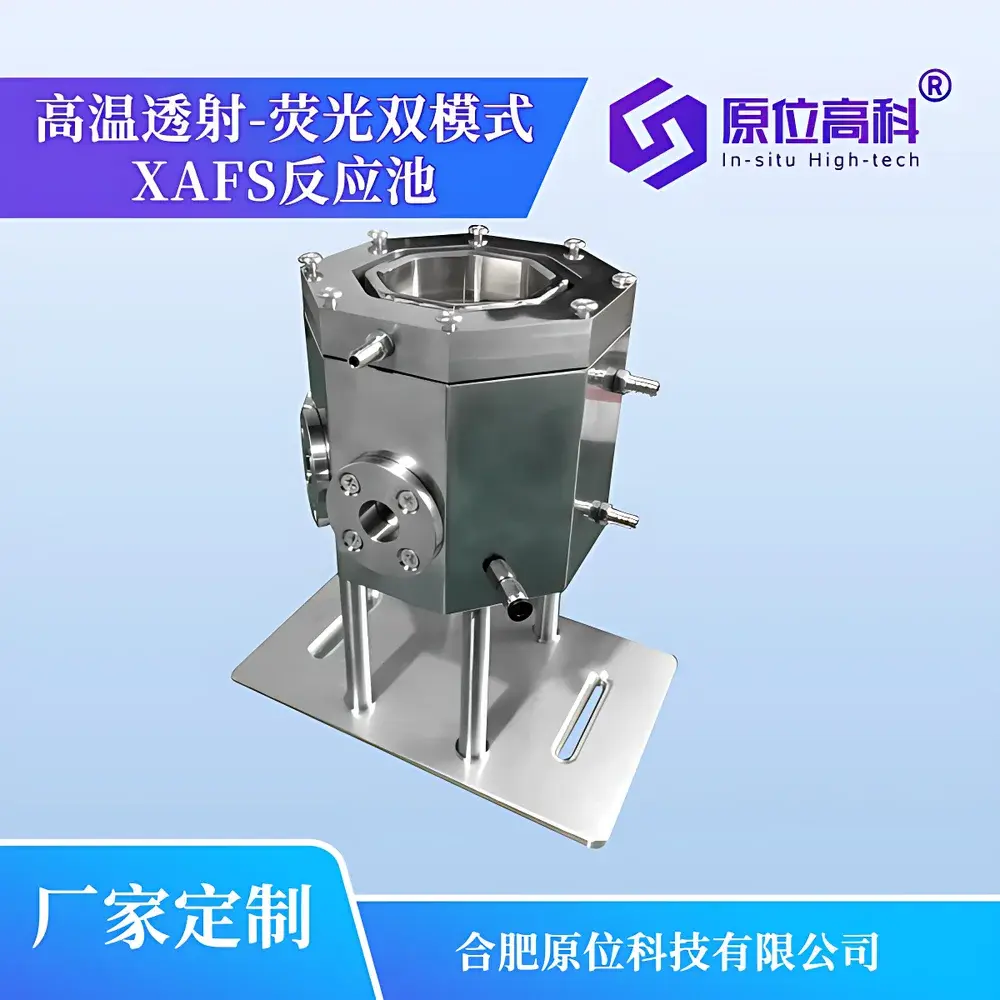
In-situ High-tech CIS-XAFS-TFM-PC-T1000 High-Temperature Transmission-Fluorescence Dual-Mode XAFS Cell
| Brand | In-situ High-tech |
|---|---|
| Origin | Anhui, China |
| Manufacturer Type | OEM Producer |
| Country of Origin | China |
| Model | CIS-XAFS-TFM-PC-T1000 |
| Pricing | Upon Request |
Overview
The In-situ High-tech CIS-XAFS-TFM-PC-T1000 is a purpose-engineered high-temperature, dual-mode X-ray Absorption Fine Structure (XAFS) sample cell designed for synchrotron-based in situ and operando characterization. It enables real-time XAFS measurements under controlled thermal and gaseous environments—specifically supporting both transmission and fluorescence detection geometries. The cell operates on the fundamental principle of X-ray absorption spectroscopy, where incident monochromatic X-rays interact with core electrons of target elements, generating element-specific near-edge (XANES) and extended fine structure (EXAFS) signals. Its robust stainless-steel construction, integrated gas-tight manifold, and precision thermal management allow stable operation up to 1000 °C under ambient pressure—making it compatible with major third-generation light sources including BSRF (Beijing Synchrotron Radiation Facility), SSRF (Shanghai Synchrotron Radiation Facility), and SSLS (Singapore Synchrotron Light Source).
Key Features
- Simultaneous support for transmission and fluorescence XAFS modes—enabling flexible experimental design for dilute or matrix-embedded samples;
- Hermetic gas handling system compatible with inert (Ar, N₂), reducing (H₂, CO), oxidizing (O₂, air), and reactive gas mixtures—validated via helium leak testing (≤1×10⁻⁹ mbar·L/s);
- Integrated resistive heating block with PID-controlled touchscreen temperature controller (±1 °C stability over 1–1000 °C range);
- Dual-stage water-cooling jacket surrounding the furnace zone to maintain external flange temperatures below 60 °C during prolonged high-T operation;
- Quartz observation window (Φ25 mm, UV-VIS-NIR transparent) permitting optical monitoring of sample morphology, color change, or phase transition during measurement;
- Modular flange interface (CF-40 or KF-40 configurable) for direct integration into standard UHV/XAS beamline endstations;
- Machined from high-purity 316L stainless steel and vacuum-brazed ceramic feedthroughs to ensure long-term thermal and chemical stability.
Sample Compatibility & Compliance
The CIS-XAFS-TFM-PC-T1000 accommodates powdered catalysts, supported metal nanoparticles, thin-film electrodes, and bulk ceramic precursors—typically loaded as 5–50 mg specimens in custom graphite or borosilicate holders. It complies with standard synchrotron safety protocols for gas-handling endstations and meets mechanical integrity requirements outlined in ISO 14001 (environmental management) and ISO 9001 (quality systems). All wetted components are certified for compatibility with ASTM E2913-13 (standard practice for evaluating gas purity in analytical instrumentation). While not intrinsically rated for explosive atmospheres, the cell may be operated within certified Class I, Division 2 hazardous location enclosures when used with flammable gases—subject to local facility risk assessment and beamline safety committee approval.
Software & Data Management
The embedded temperature controller features RS-485 Modbus RTU communication for integration with LabVIEW, EPICS, or Tango-based beamline control systems. Real-time temperature logs (timestamped, 0.1 s resolution) are exportable in CSV format and synchronizable with XAFS data acquisition timestamps via TTL trigger input. No proprietary software is required; instrument metadata—including gas composition, flow rate (when paired with mass flow controllers), and thermal ramp profiles—is embeddable in standard HDF5 or NeXus file headers per IUCr/ICDD recommendations. Audit trails for temperature setpoint changes are retained locally for GLP-compliant workflows, though full 21 CFR Part 11 compliance requires integration with facility-level electronic lab notebook (ELN) infrastructure.
Applications
- In situ thermal evolution studies of Ni-, Co-, or Fe-based Fischer–Tropsch catalysts under syngas (H₂/CO) at 200–800 °C;
- Operando tracking of Cu oxidation state dynamics in selective hydrogenation catalysts during transient redox cycling;
- High-temperature structural stability assessment of perovskite oxides (e.g., La₀.₆Sr₀.₄Co₀.₂Fe₀.₈O₃₋δ) for solid oxide fuel cell cathodes;
- Fluorescence-mode XAFS of low-concentration dopants (e.g., Pt L₃-edge in Al₂O₃-supported systems) under reaction conditions;
- Time-resolved EXAFS during rapid thermal annealing of battery electrode materials (e.g., Li-rich layered oxides) to probe cation migration kinetics.
FAQ
What synchrotron beamlines has this cell been validated on?
It has been successfully commissioned at BSRF Beamline 1W1B, SSRF BL14W1, and SSLS XAFS beamline—full commissioning reports available upon technical inquiry.
Can the cell be adapted for in situ XRD–XAFS correlation experiments?
Yes—its symmetric geometry and quartz window permit simultaneous transmission XRD using a Pilatus or Eiger detector mounted at 90° to the X-ray beam; alignment templates and kinematic mounts are optionally available.
Is remote temperature calibration traceable to NIST standards?
The integrated Type-K thermocouple is factory-calibrated against a Fluke 724 calibrator (NIST-traceable certificate included); users may perform field recalibration using a reference thermocouple and dry-block calibrator.
What is the maximum recommended heating ramp rate?
For optimal thermal uniformity and mechanical longevity, a maximum ramp rate of 10 °C/min is advised; faster ramps require prior consultation with application engineering.
Are custom gas inlet configurations or alternative window materials (e.g., sapphire, CaF₂) available?
Yes—custom CF-63 gas manifolds, sapphire windows (transmission to 5 µm), and vacuum-compatible viewports with anti-reflective coatings are offered as optional configurations under OEM agreement.



