
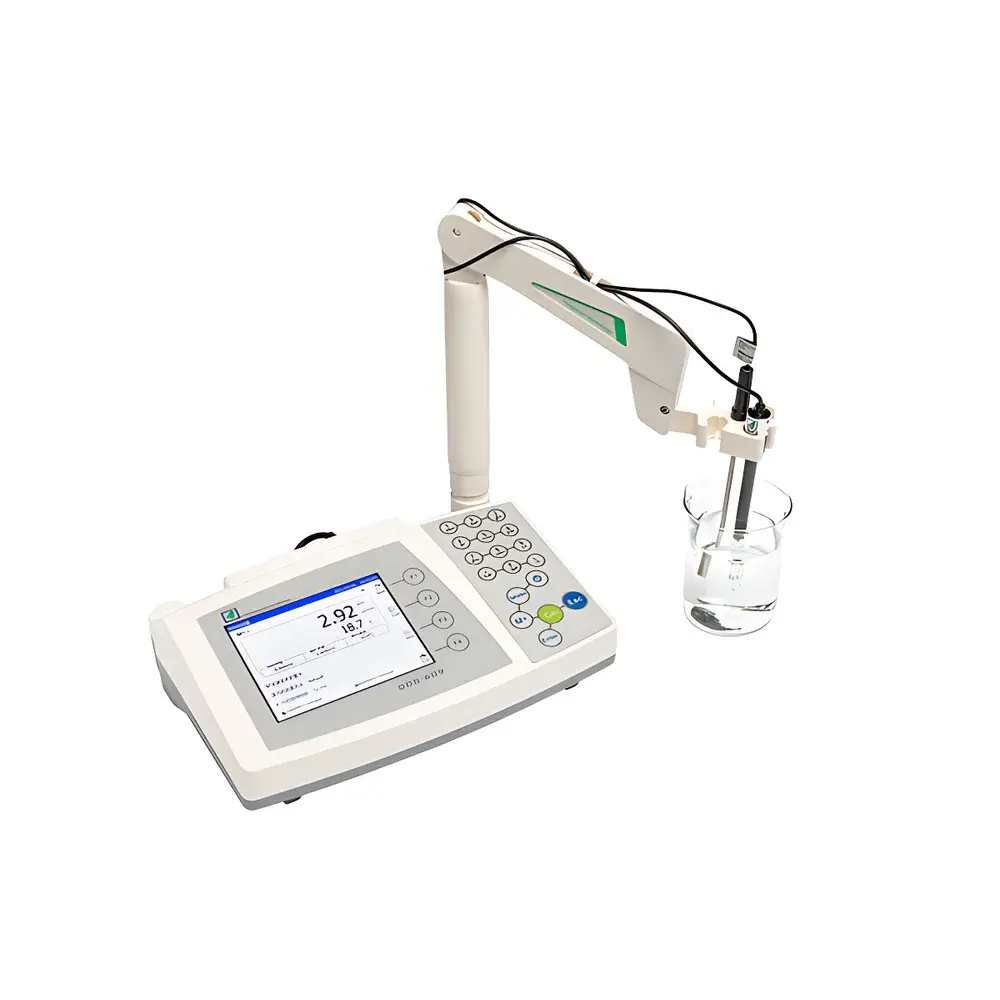
FangZhou DDS-609 Benchtop Boiler Water Conductivity Analyzer
| Brand | FangZhou |
|---|---|
| Origin | Sichuan, China |
| Model | DDS-609 |
| Form Factor | Benchtop |
| Application | Laboratory |
| Conductivity Range | (0–2×10⁵) µS/cm |
| TDS Range | (0.00–300.0) g/L |
| Resistivity Range | (5.00–10⁸) Ω·cm |
| Salinity Range | (0.00–80.00) ppt |
| Temperature Range | (−25.0–135.0) °C |
| Accuracy | ±0.5% FS |
| Minimum Conductivity Resolution | 0.0001 µS/cm |
| Calibration Points | 4 Chinese Standard, 6 US/EU Standard, 1 Custom Solution |
| GLP Compliance | Full Audit Trail, User Management, Method Storage (up to 1000), Data Logging (≥100,000 entries) |
| Interfaces | RS-232, USB, 0–20 mV Analog Output |
| Temperature Compensation | Automatic (ATC) / Manual (MTC), Linear & Nonlinear Modes |
| Water Grade Modes | Lab Grade I/II/III, Pharmaceutical Purified Water, WFI, Electronic Grade EW-I/EW-II/EW-III |
Overview
The FangZhou DDS-609 Benchtop Boiler Water Conductivity Analyzer is a high-precision, multi-parameter electrochemical instrument engineered for continuous quality assurance in steam generation systems, pharmaceutical water purification loops, semiconductor ultrapure water (UPW) distribution networks, and regulated laboratory environments. It operates on the principle of two-electrode or four-electrode conductometric measurement—applying an alternating current (AC) voltage across a conductivity cell to determine solution conductance while minimizing polarization effects and electrode fouling artifacts. The instrument’s core architecture integrates temperature-compensated conductivity calculation per ISO 7888 and ASTM D1125, with configurable reference temperatures (15.0–25.0 °C), adjustable linear/nonlinear compensation algorithms, and programmable TDS conversion factors (0.2–1.00). Designed specifically for boiler feedwater, condensate, and high-purity process streams, it delivers trace-level resolution down to 0.0001 µS/cm in the ultra-low range (0.0000–0.2000 µS/cm, DJS=0.01 cm⁻¹), enabling detection of early-stage ionic contamination that precedes scaling or corrosion events.
Key Features
- 8-range auto-ranging conductivity measurement with seamless switching between µS/cm and mS/cm scales—covering full operational span from ultrapure water (≥5.00 MΩ·cm) to concentrated brines (≤5 Ω·cm)
- Simultaneous real-time display of conductivity, resistivity, TDS, salinity, ash content (%), and temperature—with independent resolution control per parameter
- Comprehensive electrode management system: stores electrode ID, calibration history, DJS constant, last calibration timestamp, and status flag (valid/expired)
- GLP-compliant data governance: user authentication (1000+ accounts with role-based access), method versioning, electronic signatures, and immutable audit trail for all calibrations, measurements, and configuration changes
- Dual temperature compensation modes: automatic (ATC) via integrated Pt1000 sensor or manual (MTC) entry; supports both linear (α = 0.01–3.0 %/°C) and non-linear (e.g., for high-temperature boiler samples) algorithms
- Preloaded calibration libraries: 4 Chinese national standard solutions (GB/T 6682), 6 internationally recognized standards (DIN 19263, ASTM D1125, USP ), plus 1 user-definable solution
- Specialized water-grade operating modes: Lab Grade I/II/III (per GB/T 6682), Pharmaceutical Purified Water & Water for Injection (WFI, per ChP/USP/EP), and Electronic Grade EW-I/EW-II/EW-III (per SEMI F63)
Sample Compatibility & Compliance
The DDS-609 accommodates standard DIN/ISO-compatible conductivity cells with selectable cell constants (0.01, 0.1, 1.0, 10.0 cm⁻¹), ensuring optimal sensitivity across sample matrices—from deionized boiler makeup water (100 mS/cm). Its sealed benchtop enclosure meets IP54 ingress protection requirements for controlled lab use. Regulatory alignment includes full support for FDA 21 CFR Part 11 compliance when paired with validated PC software (audit trail export, electronic signature capture, secure data archiving). Instrument firmware enforces mandatory calibration verification prior to measurement, logs all deviations from SOP-defined tolerance limits (±0.5% FS), and triggers visual/audible alerts during out-of-spec conditions—critical for ASME B31.1 power plant QA protocols and ISO 14644 cleanroom water monitoring.
Software & Data Management
Data integrity is maintained through triple-layered storage: volatile RAM buffer (for active session), non-volatile flash memory (≥100,000 measurement records with timestamps, operator IDs, method names, electrode metadata, and diagnostic flags), and external export via RS-232 or USB to Windows-based systems. Export formats include plain-text CSV, structured Excel (.xlsx), and fully compliant GLP reports containing header metadata (instrument ID, firmware version, calibration certificates), raw readings, calculated values, and digital signatures. All data fields are time-stamped to millisecond precision using an onboard RTC synchronized to NTP upon network connection. The embedded database supports advanced querying by sample ID, date range, operator, method name, or conductivity threshold—enabling rapid root-cause analysis during deviation investigations.
Applications
- Power generation: Continuous monitoring of boiler feedwater, condensate polishers, and turbine bypass streams per ASME PTC 19.11 and EPRI guidelines
- Pharmaceutical manufacturing: Routine testing of Purified Water (PW) and Water for Injection (WFI) per USP , Ph. Eur. 2.2.38, and JP 17
- Semiconductor fabrication: Verification of rinse water resistivity in photolithography and etch tool validation per SEMI F63 and SEMI F57
- Environmental labs: Analysis of surface water, groundwater, and effluent per ISO 17294-2 and EPA Method 120.1
- Academic research: Kinetic studies of ion exchange resins, membrane fouling mechanisms, and thermal stability of electrolyte solutions
FAQ
Does the DDS-609 support four-electrode conductivity measurement?
Yes—when used with optional four-electrode cells (DJS=0.01 or 0.1 cm⁻¹), the instrument eliminates lead resistance errors and enables stable low-conductivity measurements below 1 µS/cm.
Can calibration data be exported for regulatory audits?
Absolutely—all calibration events—including date/time, standard used, measured value, deviation, operator ID, and pass/fail status—are stored in the internal GLP log and exportable in signed PDF or Excel format.
Is non-linear temperature compensation available for high-temperature boiler samples?
Yes—the instrument implements polynomial-based non-linear compensation per IEC 60746-3, allowing accurate correction up to 135 °C without extrapolation error.
How many users and methods can be configured?
Up to 1,000 unique user accounts with password protection and hierarchical permissions; up to 1,000 saved measurement methods, each with dedicated calibration schedules, alarm thresholds, and output templates.
What communication protocols does the RS-232 interface support?
Standard ASCII command set compliant with Modbus RTU and SCPI subsets—enabling integration with LIMS, SCADA, and MES platforms via third-party drivers or custom scripts.
Related Products





