
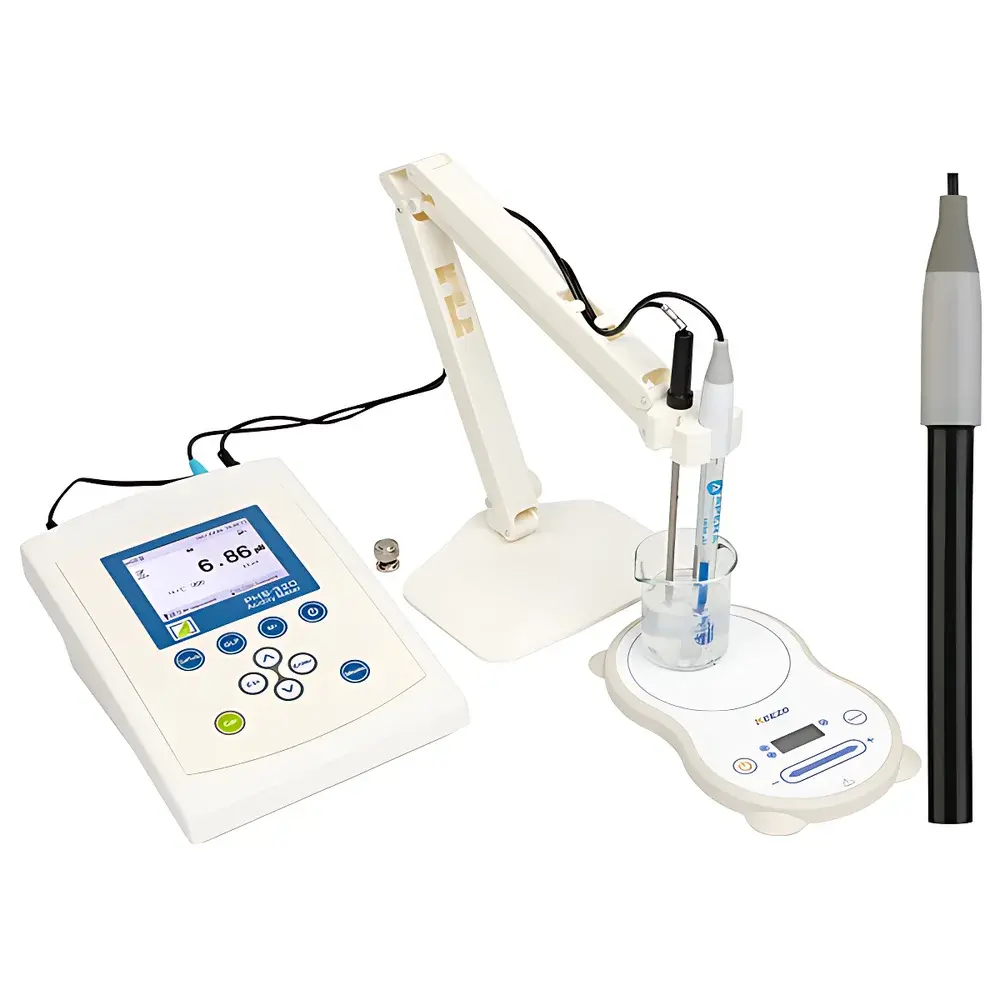
FangZhou PHS-320 Microprocessor-Controlled pH Meter for Culture Media
| Brand | FangZhou |
|---|---|
| Origin | Sichuan, China |
| Manufacturer Type | Authorized Distributor |
| Product Category | Domestic |
| Model | PHS-320 Culture Media pH Meter |
| Instrument Type | Multifunctional |
| Parameter Types | pH, mV, Rel.mV, ORP, ISE, Temperature |
| Measurement Accuracy | ±0.002 pH |
| pH Range | (−5.000 to 20.000) pH |
| Resolution | 0.001 / 0.01 / 0.1 pH (adjustable) |
| Calibration Standards | NIST-traceable buffer solutions |
| Temperature Compensation | Automatic (ATC) and manual (−20.0 to 135.0 °C) |
| Input Impedance | ≥3 × 10¹² Ω |
| Data Storage | ≥100,000 readings with GLP-compliant metadata |
| Interface | RS232 with printer, PC export (Excel/Word/Notepad), and bidirectional control |
Overview
The FangZhou PHS-320 is a high-precision, microprocessor-based pH meter engineered specifically for demanding applications in microbiological culture media preparation, pharmaceutical quality control, bioprocess monitoring, and regulatory-compliant laboratory analysis. It operates on the fundamental principle of potentiometric measurement: detecting the electromotive force (EMF) generated across a glass pH electrode and reference electrode pair immersed in aqueous solution, then converting this voltage into a pH value using the Nernst equation (−59.16 mV/pH unit at 25 °C). Its extended measurement range (−5.000 to 20.000 pH) accommodates highly acidic or alkaline culture formulations—including buffered media, enzymatic hydrolysates, and sterilized nutrient broths—where conventional meters may saturate or drift. The instrument meets ISO/IEC 17025 traceability requirements through NIST-traceable calibration protocols and supports full GLP documentation workflows required by FDA 21 CFR Part 11–aligned environments.
Key Features
- True-color TFT LCD display with graphical data visualization, intuitive menu navigation, and real-time trend plotting
- Adjustable resolution modes: 0.001 pH (high-precision mode), 0.01 pH (standard QC), and 0.1 pH (rapid screening)
- Multi-point calibration support (1–5 points) with automatic recognition of 33 standard buffer solutions across seven internationally recognized sets (NIST, DIN, JIS, USP, Merck, METTLER TOLEDO, JJG119)
- Comprehensive electrochemical measurement suite: pH, mV, relative mV (Rel.mV), oxidation-reduction potential (ORP), ion-selective electrode (ISE) response, and temperature (−20.0 to 135.0 °C)
- Advanced electrode diagnostics including impedance monitoring, asymmetry potential evaluation, and slope calculation (±0.1% typical)
- Configurable measurement modes: Real-time, timed interval (0–6000 s), and adaptive speed (fast/medium/slow) for viscous, low-conductivity, or unstable samples
- Isopotential adjustment (−20.000 to +20.000 pH) to compensate for zero-point offset in specialized electrodes (e.g., double-junction, solid-state, or low-ionic-strength probes)
- Integrated ATC (Automatic Temperature Compensation) with Pt1000 or thermistor input; manual compensation also supported
Sample Compatibility & Compliance
The PHS-320 is validated for use with diverse sample matrices critical to life sciences and industrial QA/QC. Optional electrode configurations include FZ-600T general-purpose combination electrodes, ultra-low-volume microelectrodes (≥15 µL), flat-surface contact probes for agar plates or tissue surfaces, and HF-resistant electrodes for strong acid applications. It complies with ISO 3696 (water for analytical use), USP (pH measurement), and ASTM D1293 (pH of water). All stored data retain GLP-mandated metadata: operator ID (10 slots), sample ID (10 slots), timestamp, calibration history, electrode serial number, and environmental temperature. Audit trails are exportable in CSV or PDF format for internal review or regulatory submission.
Software & Data Management
Data integrity is maintained via built-in non-volatile memory supporting ≥100,000 measurement records with full GLP metadata tagging. The RS232 interface enables three operational modes: (1) direct printing to compatible thermal printers in GLP-compliant report formats (including calibration certificates and measurement logs); (2) bidirectional PC communication using native ASCII protocol for seamless import into Microsoft Excel, Word, or plain-text editors—no proprietary software required; (3) remote instrument control (e.g., start/stop measurement, recall calibration) via terminal emulation. All exported files contain ISO 8601 timestamps and comply with ALCOA+ principles (Attributable, Legible, Contemporaneous, Original, Accurate, Complete, Consistent, Enduring, Available).
Applications
- Pharmaceutical: Sterile culture media pH verification per EP 2.2.3 and USP , WFI (Water for Injection) monitoring, buffer preparation QC
- Biotechnology: Fermentation broth pH tracking, cell culture media optimization, downstream processing validation
- Food & Beverage: pH profiling of dairy products (cheese, yogurt), fermented foods (kimchi, sauerkraut), meat curing brines, and beverage stability testing
- Environmental: Soil leachate analysis, wastewater effluent compliance (EPA Method 9040C), acid mine drainage characterization
- Academic Research: Electrode characterization studies, pKa determination of weak acids, enzyme activity assays under controlled pH
- Industrial: Electroplating bath control, boiler water alkalinity monitoring, polymerization reaction endpoint detection
FAQ
Does the PHS-320 support FDA 21 CFR Part 11 compliance?
Yes—the instrument stores electronic signatures (operator ID), time-stamped audit trails, and immutable calibration records. When paired with validated PC software and access controls, it fulfills Part 11 requirements for electronic records and signatures.
Can it measure pH in low-ionic-strength samples such as pure water?
Yes—when used with optional low-conductivity electrodes (e.g., FZ-PW series) and enabled with guarded input circuitry and high-impedance buffering, it achieves stable readings in Type I/II/III water per ISO 3696.
What buffer standards are pre-programmed for automatic recognition?
It recognizes 33 buffers across seven international groups: NIST SRM (USA), DIN 19266/19267 (Germany), JIS Z8802 (Japan), METTLER TOLEDO, Merck, USP, and Chinese JJG119 standards.
Is temperature compensation mandatory during pH measurement?
No—temperature can be entered manually or measured automatically via integrated Pt1000 sensor; both methods apply the same Nernst correction algorithm.
How is electrode performance verified during routine operation?
The self-diagnostic function evaluates electrode slope (%Nernst), asymmetry potential (mV), and junction resistance—displaying pass/fail indicators aligned with ISO 17025 verification criteria.





