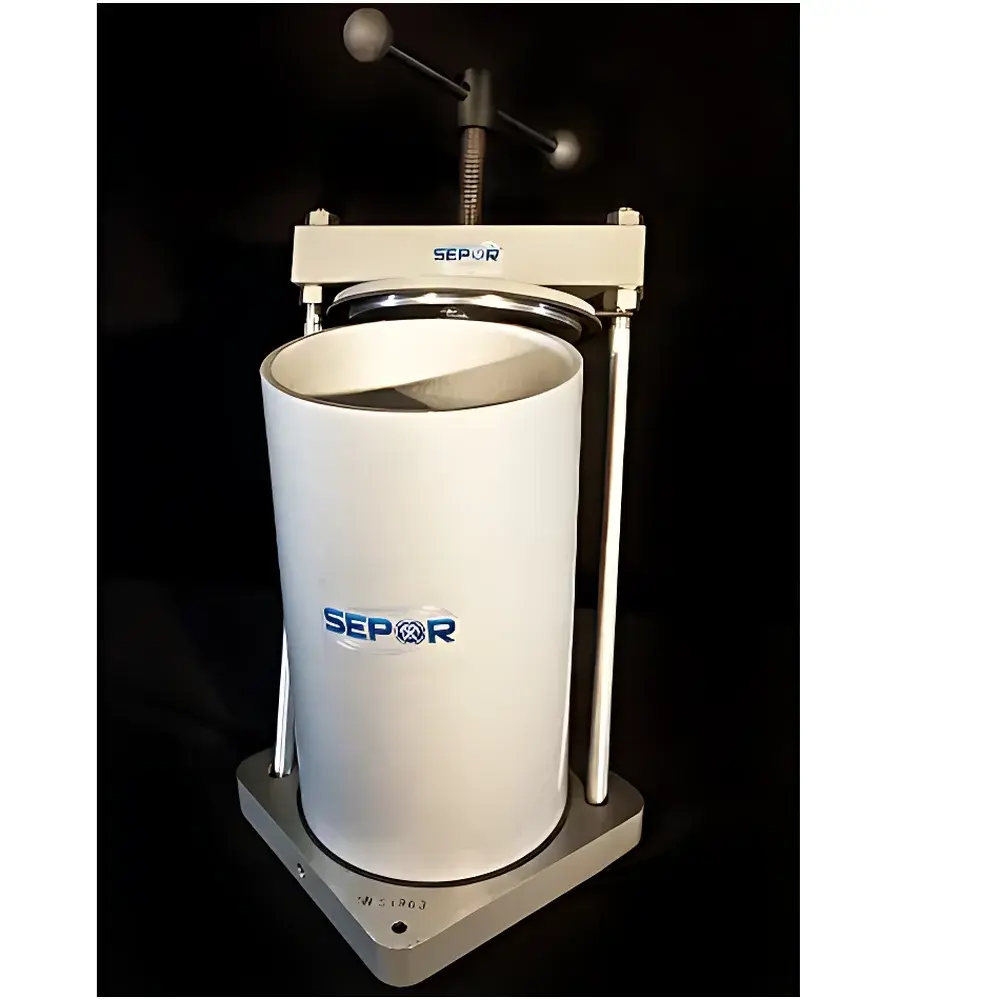
Benchtop 3-Gallon Pressure Filter – Sepor Model Bench 3 Gallon Press
| Origin | USA |
|---|---|
| Manufacturer Type | Authorized Distributor |
| Origin Category | Imported |
| Model | Bench 3 Gallon Press |
| Pricing | Available Upon Request |
Overview
The Sepor Bench 3 Gallon Press is a compact, laboratory-scale pressure filtration system engineered for reproducible solid–liquid separation under controlled pneumatic pressure. Based on the fundamental principle of constant-pressure (dead-end) filtration, it applies regulated compressed air—typically 60–75 psi—to the slurry surface within a sealed cylindrical chamber, forcing liquid through a fixed-area filter medium while retaining solids. Designed for batch processing of up to 11.4 L (3 US gallons), the unit operates safely at nominal pressures up to 75 psi, with a certified hydrostatic test pressure of 80 psi per ASME B31.3 process piping guidelines. Its modular architecture supports rapid setup, cleaning, and media replacement—critical for method development, comparative filtration studies, and dewatering optimization in mineral processing, ceramics, pharmaceutical wet granulation, and wastewater treatment research.
Key Features
- Robust pressure-rated construction available in carbon steel (ASTM A106 Gr. B), 304 stainless steel (ASTM A240), or 316 stainless steel (ASTM A240) for chemical compatibility and corrosion resistance.
- Sealed 8-inch diameter × 14-inch height removable cylinder with full-length O-ring sealing interface and torque-assisted rotating lid for secure closure and safe depressurization.
- 10-inch square baseplate featuring dual NPT-threaded ports: bottom outlet (1/2″ NPT) for filtrate collection and side port (1/4″ NPT) for regulated air supply via quick-connect fitting.
- Integrated safety components: calibrated 0–100 psi Bourdon-tube pressure gauge (ASME B40.100 compliant), adjustable pressure relief valve set at 80 psi, and manual air bleed valve for controlled venting.
- Standard filtration accessories include one 8-inch-diameter polypropylene filter cloth (nominal pore size: 25 µm), one pack of 100 high-wet-strength filter papers (25 µm rating, 8″ diameter), and optional high-seal cloth variants for fine-particle retention.
Sample Compatibility & Compliance
The Bench 3 Gallon Press accommodates slurries with suspended solids ranging from coarse sand (>100 µm) to submicron colloids (e.g., ZnO particles <5 µm, as validated using Sepor-certified filter papers). It complies with standard laboratory safety practices outlined in ANSI Z9.5 and OSHA 1910.1200 (Hazard Communication). All metallic wetted parts meet ASTM material specifications; stainless-steel variants support cleaning validation under cGMP-relevant protocols. While not intrinsically rated for hazardous area use, the system may be integrated into Class I, Division 2 environments when paired with certified air supply and grounding. Documentation includes CE-conformity declaration for mechanical equipment (2006/42/EC) and RoHS-compliant materials statement.
Software & Data Management
This is a manually operated, analog-pressure-controlled instrument with no embedded electronics or digital interface. All operational parameters—including applied pressure, filtration time, slurry volume, cake thickness, and filtrate volume—are recorded manually by the user. For GLP/GMP-aligned workflows, laboratories commonly integrate the unit into electronic lab notebooks (ELNs) such as LabArchives or Benchling, where pressure readings, timing logs, and visual observations are timestamped and archived. Optional third-party pressure data loggers (e.g., Omega OM-CP-PRES2000) can be connected via the 1/4″ NPT air inlet for continuous pressure profiling during dewatering trials—supporting ISO 17025 traceability when calibrated per ISO/IEC 17025:2017 Annex A.3.
Applications
- Mineral processing R&D: Comparative dewatering efficiency testing of tailings, flotation concentrates, and leach residues.
- Pharmaceutical formulation: Wet cake characterization of API crystallization batches and excipient blends prior to drying.
- Ceramics & advanced materials: Filtration kinetics analysis of nanoparticle dispersions (e.g., TiO₂, SiO₂, ZnO) and green body moisture content optimization.
- Environmental engineering: Sludge dewatering benchmarking, coagulant/flocculant screening, and membrane pre-filtration feed conditioning studies.
- Academic research: Teaching core unit operations (filtration theory, Darcy’s law, specific cake resistance calculation) in chemical and environmental engineering labs.
FAQ
What is the maximum recommended operating pressure?
The maximum continuous operating pressure is 75 psi. The vessel is hydrostatically tested to 80 psi and equipped with a factory-set safety relief valve at that threshold.
Can this unit be used with corrosive or high-pH slurries?
Yes—when configured with 316 stainless steel construction and compatible filter media (e.g., PTFE-coated cloths or acid-resistant papers), it supports aggressive chemistries including caustic leach solutions and acidic metal sulfate slurries.
Is the filter cloth reusable?
Polypropylene cloths are generally single-use for particulate-laden slurries to ensure consistent pore structure and avoid cross-contamination; however, they may be cleaned and reused for low-fouling, non-reactive systems following validated SOPs.
How is cake thickness measured post-filtration?
The removable cylinder allows direct caliper measurement of consolidated cake height; optional laser displacement sensors (e.g., Keyence IL-1000) can be mounted externally for non-contact monitoring during pressurized cycles.
Does Sepor provide method validation support?
Sepor supplies application notes, typical filtration curves for reference materials (e.g., ZnO, kaolin), and technical guidance for ASTM D1898 (Standard Test Method for Filtration Characteristics of Slurries) alignment—but does not perform formal IQ/OQ/PQ validation services.