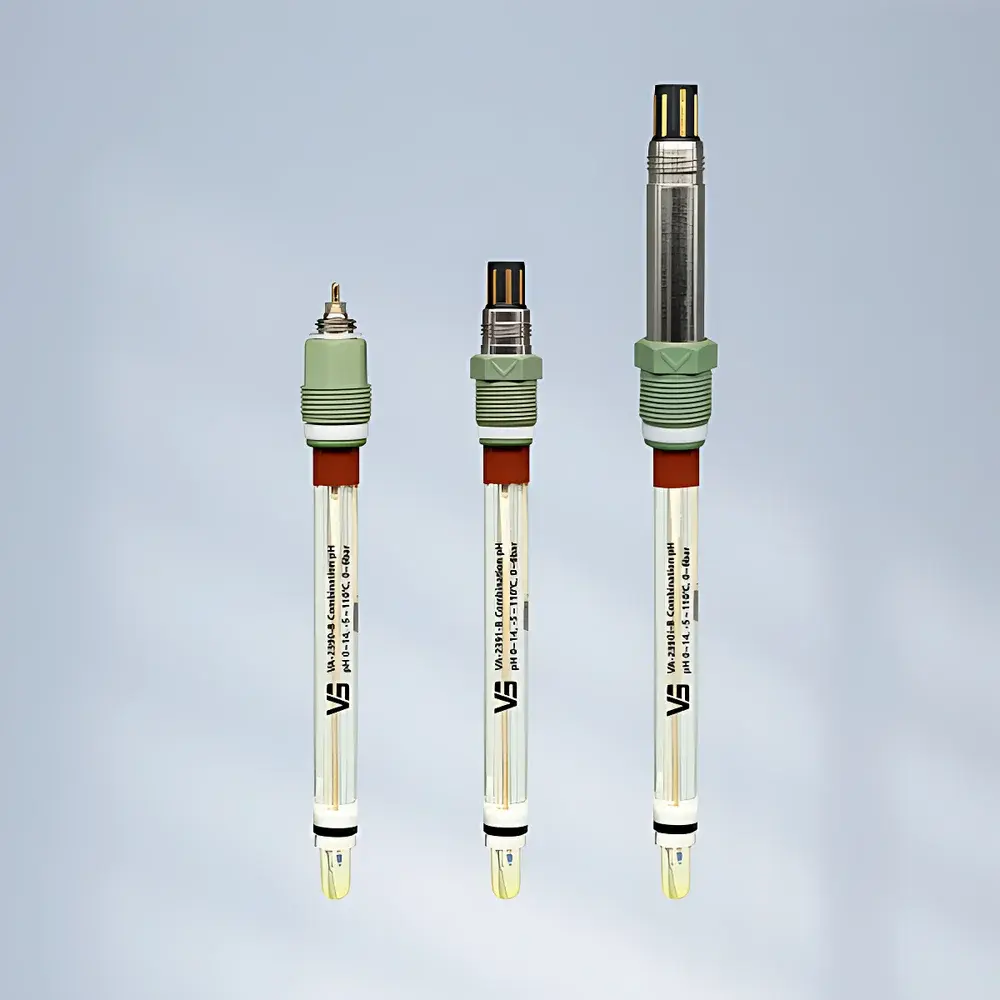
VG Smart Technology CA-2390(i)-B Industrial Online pH Electrode
| Brand | VG Smart Technology |
|---|---|
| Origin | Jiangsu, China |
| Manufacturer Type | Authorized Distributor |
| Product Category | Domestic |
| Model | CA-2390(i)-B |
| pH Measurement Range | 0–14 pH |
| Temperature Compensation Options | None (CA-2390), PT1000 (CA-2391), PT100 (CA-2392) |
| Probe Lengths | 120 / 225 / 325 / 425 mm |
| Diameter | Φ12 mm |
| Explosion Protection Rating | Ex ia IIC T6/T5/T4 Ga |
| Sensing Membrane | Thickened acid/alkali-resistant glass bulb |
| Reference System | Dual-membrane + helical capillary design with PTFE outer membrane and porous ceramic inner junction |
| Reference Electrolyte | High-temperature-stable polymer gel (Swiss-formulated) |
| Typical Weight | 0.38–0.52 kg (varies by length) |
Overview
The VG Smart Technology CA-2390(i)-B is an industrial-grade online pH electrode engineered for continuous, high-reliability measurement in aggressive process environments—including strong acids, concentrated alkalis, high-solids slurries, and elevated-temperature aqueous streams. It operates on the potentiometric principle: a hydrogen-ion-selective glass membrane generates a Nernstian potential difference relative to a stable internal reference, while a robust dual-junction reference system maintains electrochemical stability under challenging chemical and mechanical loads. Designed specifically for integration into PLC- or DCS-controlled process loops, this electrode meets the operational demands of continuous monitoring in chemical manufacturing, power plant water chemistry, food & beverage sanitation validation, and battery electrolyte production—where long-term drift resistance, fouling resilience, and intrinsic safety compliance are non-negotiable.
Key Features
- Acid/alkali-resistant thickened glass membrane: Optimized composition and wall thickness provide enhanced mechanical integrity against particle impact in high-velocity flows and superior chemical durability in pH extremes (0–14), particularly improving accuracy and response time in caustic solutions (>12 pH).
- Dual-membrane reference architecture with helical capillary path: The outer PTFE diaphragm resists clogging from suspended solids, biofilm, or precipitates; the inner porous ceramic junction regulates electrolyte diffusion at a controlled rate—extending functional service life by ≥30% versus conventional single- or dual-junction electrodes.
- High-temperature polymer gel electrolyte (Swiss-formulated): Exhibits low leakage rate, thermal stability up to 80 °C, and batch-to-batch consistency in open-circuit potential—ensuring <±0.02 pH long-term baseline stability under static and dynamic conditions.
- Intrinsically safe construction: Certified to Ex ia IIC T6/T5/T4 Ga per IEC 60079-0 and IEC 60079-11, enabling deployment in Zone 0/1 hazardous areas without additional barrier requirements.
- Modular probe lengths (120/225/325/425 mm) and standardized Φ12 mm diameter: Facilitates retrofit compatibility with existing flow cells, immersion housings, and retractable assemblies across OEM and field-installed process analyzers.
Sample Compatibility & Compliance
The CA-2390(i)-B is validated for use in conductive aqueous media with conductivity ≥50 µS/cm. It demonstrates reliable performance in wastewater effluents, boiler feedwater, caustic soda (NaOH) scrubber solutions, citric acid cleaning-in-place (CIP) cycles, and lithium-ion battery electrolyte formulations. Its PTFE outer junction minimizes fouling in high-turbidity or viscous streams, reducing calibration frequency and manual cleaning intervals. The electrode complies with ISO 17025 traceability requirements when paired with certified pH buffers (e.g., NIST-traceable 4.01, 7.00, 10.01), and supports GLP/GMP data integrity protocols via compatible transmitter firmware with audit trail logging (e.g., 21 CFR Part 11-compliant systems).
Software & Data Management
While the CA-2390(i)-B is a passive sensor requiring external signal conditioning, it is fully interoperable with industry-standard pH transmitters supporting mV input, temperature compensation inputs (for models CA-2391/CA-2392), and digital communication protocols including HART 7, Modbus RTU/TCP, and Profibus PA. When integrated with VG’s optional CA-TX series transmitters or third-party platforms (e.g., Endress+Hauser Liquiline, Emerson Rosemount 5081), users gain access to real-time diagnostics—including asymmetry potential monitoring, reference impedance trending, and slope degradation alerts—enabling predictive maintenance scheduling and reducing unplanned downtime.
Applications
- Chemical process control: Continuous pH monitoring in nitric acid synthesis, chlorine dioxide generation, and sodium hypochlorite dosing systems.
- Power generation: Feedwater and condensate pH assurance in ultra-supercritical boilers per ASTM D1089 and EPRI guidelines.
- Food & beverage: CIP rinse cycle verification, dairy whey processing, and fermentation broth pH tracking compliant with FDA 21 CFR Part 11 and SQF Code Edition 9.
- Renewable energy: Electrolyte quality control in green hydrogen production stacks and spent lithium battery leaching circuits.
- Environmental engineering: Real-time effluent compliance monitoring per EU WFD and US EPA Method 150.1.
FAQ
What temperature compensation options are available for the CA-2390(i)-B series?
The base model CA-2390 has no built-in temperature sensor. CA-2391 integrates a PT1000 element; CA-2392 uses a PT100 sensor—both support automatic temperature compensation (ATC) when connected to compatible transmitters.
Is the electrode suitable for high-pressure applications?
It is rated for continuous operation up to 6 bar (87 psi) at 25 °C; pressure rating decreases linearly with temperature—consult the mechanical installation manual for derating curves.
How often should calibration be performed in continuous operation?
Under stable process conditions, weekly two-point calibration (pH 4.01 and 7.00) is recommended; in highly variable or fouling-prone streams, daily verification with a single buffer may be necessary.
Can the electrode be cleaned in situ without removal from the process?
Yes—low-concentration HCl (0.1 M) or enzymatic cleaners can be circulated through the measurement chamber; avoid abrasive brushes or ultrasonic baths on the glass bulb.
Does VG provide documentation for regulatory audits?
Yes—each unit ships with a Factory Calibration Certificate (traceable to NIST standards), RoHS/REACH declarations, Ex certification documents, and material compliance statements suitable for FDA, ISO 9001, and IATF 16949 audits.
Related Products