
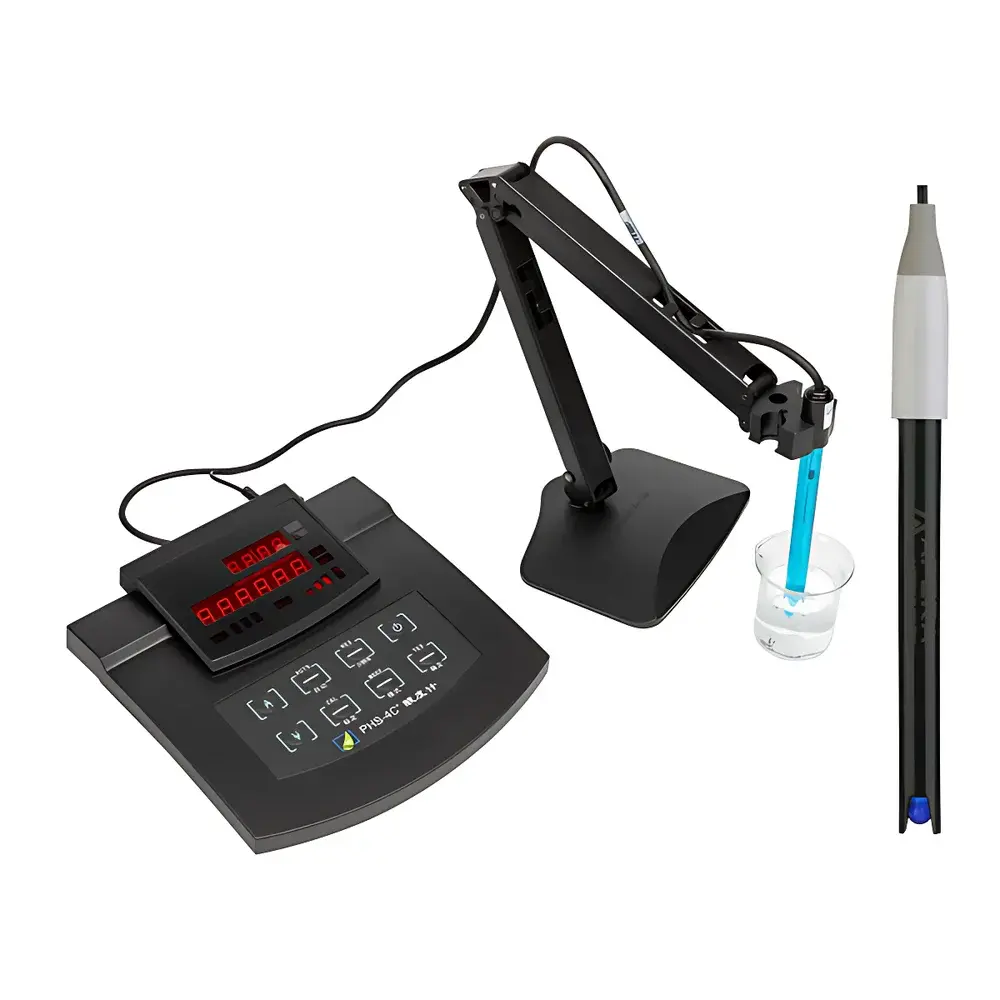
FangZhou PHS-4C+ Titanium Dioxide pH Meter
| Brand | FangZhou |
|---|---|
| Origin | Sichuan, China |
| Model | PHS-4C+ Titanium Dioxide pH Meter |
| Instrument Type | Benchtop |
| Parameter Types | Multi-parameter (pH, mV, ORP, Temperature) |
| Measurement Accuracy | ±0.002 pH |
| pH Range | 0.000–14.000 pH |
| Resolution | 0.001/0.01/0.1 pH (adjustable) |
| mV/ORP Range | −1999.9 to +1999.9 mV |
| mV Resolution | 0.1/1 mV (adjustable) |
| Temp Range | −5.0 to 105.0 °C |
| Temp Resolution | 0.1 °C |
| Temp Accuracy | ±0.3 °C ±1 digit |
| Input Impedance | ≥3 × 10¹² Ω |
| Calibration Standards | NIST-traceable buffers |
| Temperature Compensation | Automatic (ATC) or Manual |
| Calibration Points | 1–3 point |
| Buffer Sets | Chinese standard set (pH 4.00, 6.86, 9.18 at 25 °C) |
| Interface | BNC electrode port, Pt1000/NTC temperature sensor port, RS232 serial output |
| Power Supply | DC 9 V, 300 mA (center-positive) |
Overview
The FangZhou PHS-4C+ Titanium Dioxide pH Meter is a high-precision benchtop electrochemical analyzer engineered for rigorous quality control in pigment manufacturing, particularly for titanium dioxide (TiO₂) slurry and aqueous process streams. It operates on the fundamental principle of potentiometric measurement: detecting the potential difference between a glass pH sensing electrode and a reference electrode immersed in solution, converted to pH via the Nernst equation. Designed specifically for the demanding requirements of TiO₂ production—where trace acidity directly influences particle surface charge, dispersion stability, and coating performance—the instrument delivers laboratory-grade accuracy with robust environmental resilience. Its microprocessor-controlled architecture ensures stable signal acquisition, real-time drift compensation, and consistent response across wide pH and temperature gradients typical in hydrolysis, precipitation, and surface treatment stages.
Key Features
- Triple-resolution pH display (0.001 / 0.01 / 0.1 pH), configurable per application need to balance readability and precision
- Integrated automatic temperature compensation (ATC) using Pt1000 or NTC sensors, with manual override capability across −5.0 to 105.0 °C
- Intelligent multi-point calibration (1–3 points) with auto-buffer recognition and endpoint detection—reducing operator dependency and minimizing human error
- Electrode status monitoring system that evaluates slope, offset, and asymmetry potential to flag aging or fouled electrodes before measurement deviation occurs
- Dual-mode measurement: simultaneous or independent readout of pH, mV (for redox titrations), ORP (oxidation-reduction potential), and temperature
- Ruggedized housing with IP65-rated front panel and chemical-resistant casing, validated for operation in humid, acidic, or particulate-laden environments common in pigment processing facilities
- Non-volatile memory retains up to 200 calibration records and 500 measurement logs with timestamping—even after power loss
- Standard RS232 interface enables direct data export to LIMS or QC databases; compatible with GLP-compliant audit trail software via external logging modules
Sample Compatibility & Compliance
The PHS-4C+ is optimized for heterogeneous, high-ionic-strength, and mildly abrasive samples typical of TiO₂ slurries, sulfate-process intermediates, and post-wash effluents. Its high-input-impedance circuitry (>3 × 10¹² Ω) prevents loading errors when measuring low-conductivity rinse waters or diluted pigment dispersions. The instrument supports NIST-traceable calibration standards and conforms to ISO 3696 (Grade 3 water specifications), ASTM E70 (standard test method for pH of aqueous solutions), and IEC 62304 (medical device software lifecycle—applicable to embedded firmware). While not FDA 21 CFR Part 11–certified out-of-the-box, its RS232 output and deterministic calibration logging support integration into Part 11–compliant workflows when paired with validated third-party data acquisition systems. All electrical design complies with IEC 61010-1 safety standards for laboratory equipment.
Software & Data Management
Data transfer is handled via ASCII-based RS232 protocol, supporting both polling and auto-transmit modes. Firmware includes built-in CSV-formatted export templates compatible with Excel, LabVIEW, and SQL-based QC dashboards. Calibration history includes date/time stamps, buffer IDs, measured slopes (%), zero offsets (mV), and user-assigned batch identifiers—enabling full traceability required under ISO/IEC 17025 accreditation. Optional PC software (sold separately) adds trend analysis, SPC charting (X-bar/R), and automated report generation aligned with internal SOPs or customer-facing quality documentation (e.g., CoA, CoC). Audit trails are immutable once recorded; firmware prohibits editing or deletion of stored calibration events.
Applications
- pH monitoring during TiO₂ hydrolysis and crystal growth in sulfate or chloride processes
- Quality verification of surface-treated pigments (e.g., silica/alumina coatings) where pH governs hydrolysis kinetics
- Neutralization endpoint detection in acid-wash or alkali-leach steps
- Stability testing of aqueous pigment dispersions under accelerated aging conditions
- In-process control of wastewater neutralization prior to discharge (per local environmental regulations)
- Calibration validation of inline pH sensors used in continuous TiO₂ slurry lines
FAQ
What calibration standards are supported?
The PHS-4C+ recognizes Chinese national buffer standards (pH 4.00, 6.86, 9.18 at 25 °C) and accepts any NIST-traceable standard with user-defined nominal values.
Can it measure ion concentration directly?
No—it is not an ion meter by default, but supports optional ion-selective electrodes (ISEs) via the same BNC interface when configured with appropriate calibration protocols.
Is temperature compensation mandatory?
No—both automatic (ATC) and manual temperature entry modes are available, allowing flexibility for non-temperature-probed measurements or legacy probe compatibility.
What is the warranty coverage?
The instrument carries a 36-month limited warranty on the main unit; electrode assemblies and consumables are excluded per standard industry practice.
Does it meet GLP requirements?
Yes—when used with documented procedures and external audit-log software, its calibration integrity, timestamped records, and uneditable memory satisfy core GLP data integrity principles per OECD GLP Principles Section 5.2.2.



