
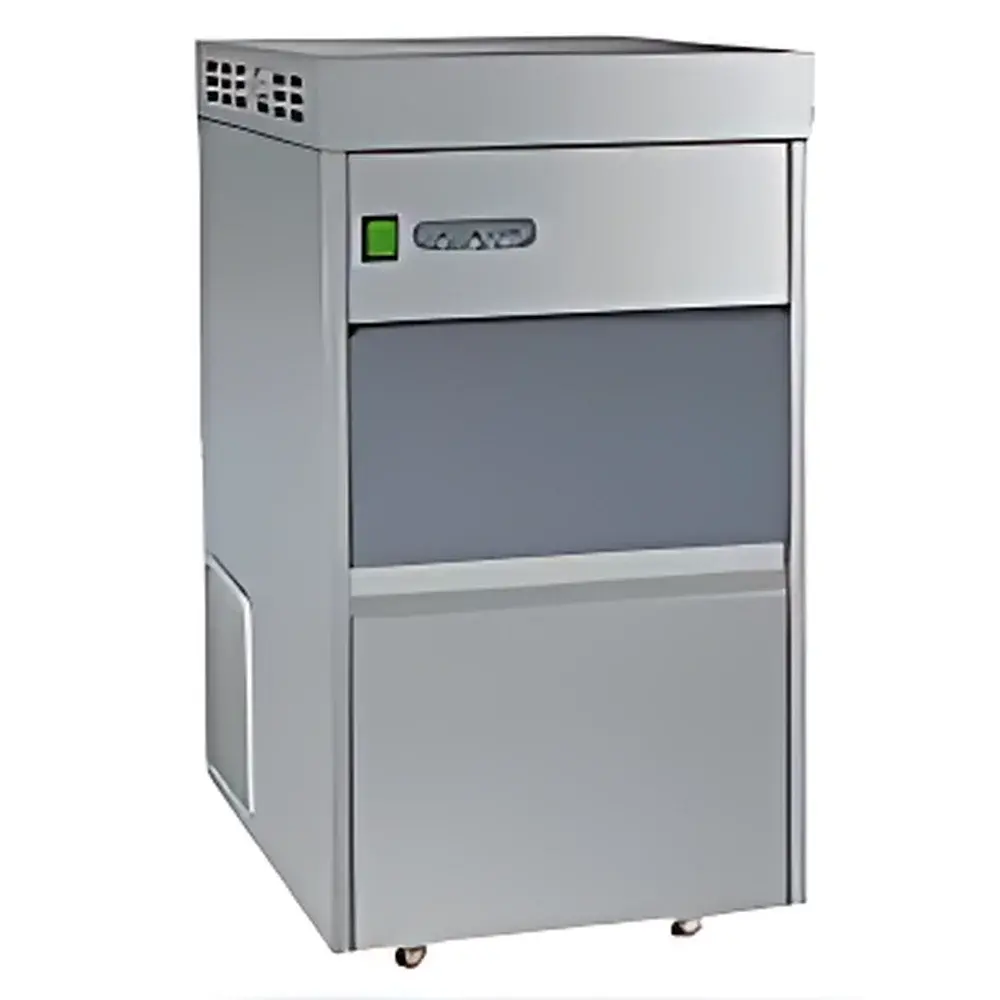
ZiQi IMS-30 Laboratory Flake Ice Machine
| Brand | ZiQi |
|---|---|
| Origin | Shanghai, China |
| Manufacturer Type | OEM Manufacturer |
| Country of Origin | China |
| Model | IMS-30 |
| Daily Ice Production | 30 kg/24 h |
| Ice Storage Capacity | 10 kg |
| Water Consumption | ≤1.2 L/h |
| Cooling Method | Air-Cooled |
| Ice Making Principle | Dual-Spiral Extrusion |
| Ice Type | Irregular Flake Ice (Fine, Low-Density Particles) |
| Construction | Full Stainless Steel (304) Enclosure |
| Insulation | CFC-Free Polyurethane Foam |
| Evaporator Type | Chamber-Partitioned Ice Evaporator |
| Control System | Microprocessor-Based Digital Controller with Fault Code Display |
| Safety Compliance | CE-marked electrical architecture, IPX4-rated water protection, Overheat & Dry-Run Protection |
Overview
The ZiQi IMS-30 Laboratory Flake Ice Machine is an air-cooled, microprocessor-controlled ice generation system engineered specifically for demanding laboratory environments where rapid thermal equilibration, precise temperature control, and contamination-free cooling are critical. Unlike cubed or cylindrical ice machines, the IMS-30 employs a dual-spiral extrusion mechanism to produce irregular, low-density flake ice—typically 1–3 mm in nominal dimension—with high surface-area-to-volume ratio and negligible internal crystalline stress. This morphology enables rapid heat transfer, deep penetration into narrow sample vessel gaps (e.g., centrifuge buckets, electrophoresis tanks, or reaction flask jackets), and uniform ice bath formation without mechanical compaction or thermal stratification. The unit integrates a hermetically sealed, high-efficiency rotary compressor, a chamber-partitioned evaporator optimized for continuous nucleation and shear-assisted flake release, and a fully enclosed stainless steel (AISI 304) chassis designed for corrosion resistance, cleanroom compatibility, and long-term stability under repeated sterilization cycles.
Key Features
- Full AISI 304 stainless steel housing and internal components—resistant to acids, solvents, and repeated disinfection protocols (e.g., 70% ethanol, hydrogen peroxide vapor)
- CFC-free polyurethane foam insulation (≥35 mm thickness) with antimicrobial inner liner—meets ISO 14001 environmental compliance for refrigerant and insulant selection
- Dual-spiral extrusion ice maker with hardened alloy ice-cutting blades—engineered for consistent flake geometry, minimal ice bridging, and automatic ice–water separation without manual defrost cycles
- Intelligent water management via float-activated, self-draining inlet system—eliminates residual standing water, prevents biofilm accumulation, and reduces microbial load per ISO 22000 food safety benchmarks
- Digital microcontroller (industrial-grade ARM Cortex-M4 core) with real-time diagnostics—supports fault code display (e.g., E01 = low water, E03 = evaporator overtemp), auto-restart after power recovery, and memory retention of operational state
- Air-cooled condenser with thermostatically regulated axial fan and top-mounted ventilation grilles—ensures stable operation at ambient temperatures up to 35 °C and relative humidity ≤80% RH
- Integrated safety architecture: dry-run protection, compressor thermal cutoff, door-open interlock, and grounded chassis meeting IEC 61010-1 Edition 3 for laboratory electrical equipment
Sample Compatibility & Compliance
The IMS-30 generates non-compacted, low-melting-point flake ice ideal for biological sample chilling (e.g., tissue homogenization, PCR setup, cell culture passaging), chromatography column pre-cooling, and calorimetric reference baths. Its ice output meets ASTM D4178-22 requirements for “flake-type ice used in analytical sample conditioning.” All wetted surfaces comply with USP for pharmaceutical-grade material contact, and the unit’s electrical design conforms to EN 61326-1 (EMC) and EN 61010-1 (safety). Optional documentation packages include Factory Acceptance Test (FAT) reports, material traceability certificates for stainless steel components, and calibration records for onboard temperature sensors (±0.5 °C accuracy).
Software & Data Management
While the IMS-30 operates as a standalone instrument, its digital controller logs operational events—including runtime hours, ice production cycles, fault triggers, and ambient temperature trends—for GLP-compliant audit trails. Event timestamps are stored in non-volatile memory and exportable via RS-232 interface (optional USB-to-serial adapter) for integration into LIMS or electronic lab notebooks (ELN). Firmware supports remote firmware updates via secure authenticated protocol, and all diagnostic codes align with ISO/IEC 17025 clause 7.7.2 for instrument condition monitoring. No proprietary software installation is required; raw ASCII log files are compatible with common data analysis platforms (e.g., Python Pandas, MATLAB, LabVIEW).
Applications
- Pre-chilling reagents and buffers prior to enzymatic reactions or immunoassays
- Maintaining sub-0 °C thermal mass during DNA extraction and RNA isolation workflows
- Stabilizing electrophoresis buffer tanks during high-voltage runs
- Providing rapid, localized cooling for NMR probe pre-conditioning and FTIR sample holders
- Supporting QC/QA cold chain validation studies requiring traceable, reproducible ice morphology
- Supplementing ultra-low temperature freezers in cryopreservation labs where intermittent rapid cooldown is needed
FAQ
What is the typical flake size and density of ice produced by the IMS-30?
The IMS-30 generates irregular flakes averaging 1.2–2.5 mm in longest dimension and 0.3–0.6 mm in thickness, with bulk density ~380–420 kg/m³—optimized for maximal surface contact and minimal thermal lag.
Does the IMS-30 require a dedicated drain line or plumbing connection?
No. It uses a closed-loop water reservoir with automatic refill via gravity-fed or pressurized supply (0.1–0.6 MPa); excess meltwater is recirculated, eliminating need for floor drains.
Can the unit operate continuously in a temperature-controlled lab at 28 °C?
Yes—its air-cooled condenser and thermally shielded compressor are rated for uninterrupted operation at ambient temperatures ≤35 °C and humidity ≤80% RH, per IEC 60068-2-14.
Is the ice suitable for direct contact with food-grade or clinical samples?
The ice meets NSF/ANSI 12 standards for food equipment when operated with potable water and maintained per manufacturer cleaning schedule; however, direct contact with sterile biologicals requires additional validation per ISO 13485.
How often does the unit require maintenance or descaling?
With deionized or softened water feed, scheduled maintenance (evaporator inspection, condenser coil cleaning, sensor verification) is recommended every 6 months; no descaling is needed if water hardness remains <50 ppm CaCO₃.



