
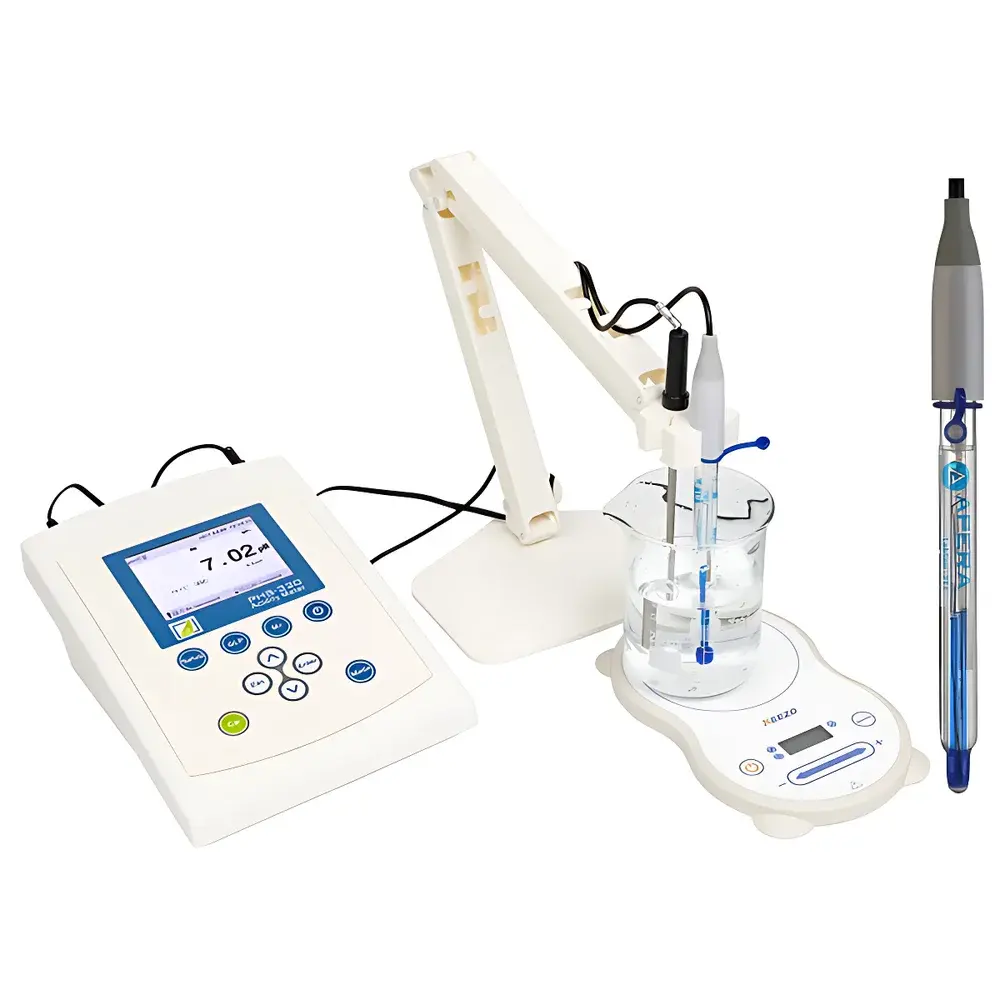
FangZhou PHS-320 Electroplating Bath pH Meter
| Brand | FangZhou |
|---|---|
| Origin | Sichuan, China |
| Manufacturer Type | Authorized Distributor |
| Regional Category | Domestic (China) |
| Model | PHS-320 Electroplating Bath pH Meter |
| Instrument Type | Multifunctional Benchtop pH/MV/ISE/Temp Analyzer |
| Parameter Types | pH, mV, Rel.mV, ORP, ISE, Temperature |
| pH Accuracy | ±0.002 pH |
| pH Range | −5.000 to 20.000 pH |
| Resolution | 0.001 / 0.01 / 0.1 pH (user-selectable) |
| mV Range | −2000.00 to +2000.00 mV |
| mV Resolution | 0.01 / 0.1 / 1 mV (user-selectable) |
| Temp Range | −20.0 to 135.0 °C |
| Temp Accuracy | ±0.2 °C |
| Input Impedance | ≥3 × 10¹² Ω |
| Calibration | Up to 5-point auto-recognized pH calibration using NIST-traceable buffers (7 groups, 33 total standards) |
| Temperature Compensation | ATC or manual (−20.0 to 135.0 °C) |
| Isopotential Adjustment Range | −20.000 to +20.000 pH |
| Data Storage | ≥100,000 records with GLP-compliant metadata (sample ID, operator ID, timestamp, calibration history) |
| Interface | RS232 with three operational modes (printer output, PC data export to Excel/Word/Notepad, bidirectional instrument control) |
| Power | DC 9 V, 500 mA (center-positive) |
Overview
The FangZhou PHS-320 Electroplating Bath pH Meter is a high-precision, microprocessor-controlled benchtop analyzer engineered for rigorous electrochemical measurement in industrial and laboratory environments where pH stability directly impacts process integrity—particularly in electroplating bath monitoring, pharmaceutical water systems, bioprocessing media, and regulated quality control workflows. It operates on the fundamental principle of potentiometric pH measurement: detecting the electromotive force (EMF) generated across a glass pH electrode and reference junction when immersed in an aqueous solution, then converting that voltage signal into a pH value via the Nernst equation (−59.16 mV/pH at 25 °C). Its extended pH range (−5.000 to 20.000) accommodates highly acidic or alkaline plating solutions—including chromic acid baths, nickel sulfamate formulations, and cyanide-based electrolytes—where conventional meters fail due to junction clogging or electrode drift. The instrument’s input impedance exceeds 3 × 10¹² Ω, minimizing loading error during low-conductivity measurements (e.g., deionized rinse waters or ultrapure process streams), while its isopotential adjustment function enables precise zero-potential alignment for non-standard or aged electrodes—critical for maintaining traceability in long-term bath monitoring programs.
Key Features
- True-color 4.3-inch TFT LCD with graphical real-time curve display and intuitive menu navigation—supports multilingual UI (English default)
- GLP-compliant data management: 10 user-defined sample IDs, 10 operator IDs, full audit trail including calibration timestamps, buffer IDs used, and electrode status logs
- Five selectable measurement modes: Real-time, Timed (0–6000 s interval), Auto-Fast, Auto-Medium, and Auto-Slow—optimized for viscous, low-ionic-strength, or unstable samples
- Seven preloaded buffer groups (33 total standards) covering JJG 119, NIST SRM, DIN 19266/19267, JIS Z8802, and METTLER TOLEDO specifications—enabling one-button, auto-recognized multi-point calibration
- ATC (Automatic Temperature Compensation) with dual-sensor support: integrated Pt1000 RTD or external thermistor probe; manual override available
- Comprehensive electrode diagnostics: detects open circuit, short circuit, asymmetry potential, and reference junction resistance—flagging degradation before measurement error occurs
- RS232 interface supporting three interoperable protocols: direct thermal printer output (GLP-formatted reports), raw ASCII data streaming to Excel/Word/Notepad, and bidirectional command control (e.g., remote start/stop, calibration trigger)
Sample Compatibility & Compliance
The PHS-320 is explicitly validated for use with challenging matrices common in electroplating and regulated manufacturing: high-salt electrolytes (e.g., CuSO₄–H₂SO₄ baths), low-ionic-strength rinse waters (≥1 µS/cm), viscous additives (brighteners, levelers), suspended solids (anode sludge), and protein-rich biological buffers (TRIS, PBS). Optional electrode configurations—including double-junction Ag/AgCl reference systems, gel-filled rugged probes, flat-surface sensors, and HF-resistant electrodes—extend applicability to aggressive chemistries (e.g., hydrofluoric acid etchants) and non-liquid surfaces (coated substrates, gels, tissue). The instrument complies with ISO/IEC 17025 requirements for measurement uncertainty estimation and supports FDA 21 CFR Part 11 readiness through secure user authentication, electronic signatures (via optional software), and immutable audit trails. Its design aligns with ASTM D1293 (pH of water), USP (pH Measurement), and ISO 10523 (water quality—pH determination) methodologies.
Software & Data Management
Data integrity is enforced via built-in GLP firmware: every stored record includes date/time stamp (RTC-backed), sample ID, operator ID, electrode serial number (if encoded), calibration verification status, temperature reading, and raw mV output. Internal memory retains ≥100,000 entries with cyclic overwrite protection. Exported datasets include metadata headers compatible with LIMS integration. The RS232 protocol uses ASCII framing with configurable baud rates (9600–115200 bps); no proprietary drivers are required—standard terminal emulators or Excel’s “Get External Data” function suffice. For regulated environments, optional PC software provides 21 CFR Part 11 compliance modules: role-based access control, electronic signature capture, and change history logging—all validated per GAMP 5 guidelines.
Applications
- Electroplating line control: real-time monitoring of acid copper, nickel, chromium, and zinc bath pH to prevent deposit porosity, poor adhesion, or bath decomposition
- Pharmaceutical water systems: USP Purified Water (PW) and Water for Injection (WFI) pH verification per pharmacopeial monographs
- Bioprocess development: cell culture media, fermentation broth, and buffer preparation QC
- Food safety testing: dairy products, fermented foods, and acidified sauces per AOAC and ISO 5725 precision criteria
- Environmental compliance: wastewater effluent pH reporting under EPA Method 150.1 and ISO 10523
- Academic research: kinetic studies requiring high-resolution pH tracking during titration or enzymatic reactions
FAQ
Does the PHS-320 support NIST-traceable calibration verification?
Yes—it recognizes NIST Standard Reference Materials (SRMs) 186, 4698, and 1840a out-of-the-box and stores calibration certificates with buffer lot numbers and expiration dates.
Can it measure pH in non-aqueous or low-conductivity solvents?
It is designed for aqueous systems only. For ethanol/water mixtures or organic solvents, a specialized non-aqueous electrode with solvent-compatible junction and filling solution is required—and must be selected separately.
Is the instrument suitable for continuous unattended operation?
While not rated for 24/7 industrial process control, its robust architecture, wide operating temperature range (5–40 °C), and stable electronics support extended batch monitoring (e.g., 8-hour plating tank audits) with periodic recalibration.
How does the isopotential adjustment improve measurement reliability?
It compensates for inherent asymmetry potentials in aging or damaged electrodes by electronically offsetting the zero-reference point—extending usable electrode life without compromising accuracy against certified buffers.
What documentation accompanies the instrument for regulatory submissions?
Factory calibration certificate (ISO/IEC 17025-accredited lab), CE Declaration of Conformity, RoHS compliance statement, and full GLP implementation guide—including recommended validation protocols for IQ/OQ/PQ execution.
Related Products




