
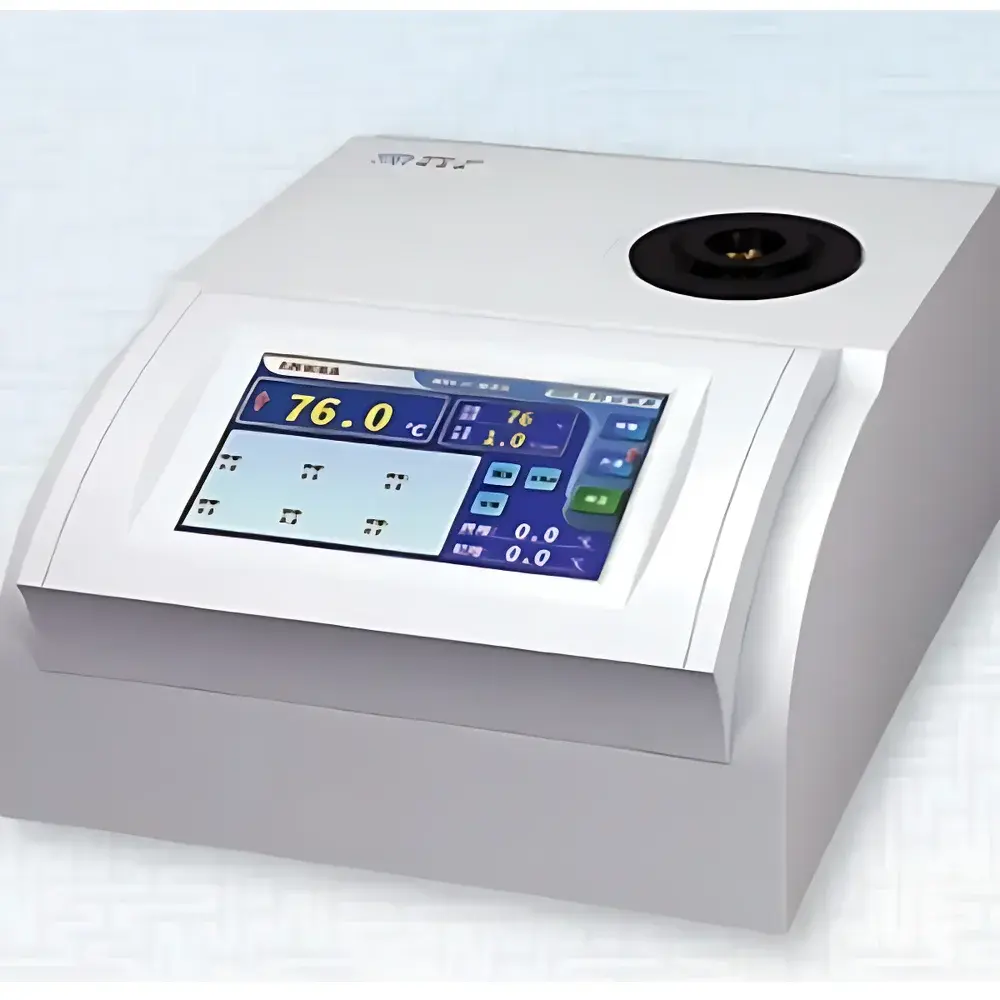
YDWG WRS-2 Digital Automatic Melting Point Apparatus
| Brand | YDWG |
|---|---|
| Origin | Shanghai, China |
| Model | WRS-2 |
| Temperature Range | Ambient to 300 °C |
| Heating Rates | 0.2, 0.5, 1.0, 1.5, 2.0, 3.0, 4.0, 5.0 °C/min (8 selectable steps) |
| Temperature Repeatability | ±0.3 °C |
| Temperature Accuracy | ±0.4 °C ≤200 °C |
| Temperature Resolution | 0.1 °C |
| Capillary Dimensions | OD 1.4 mm, ID 1.0 mm, Length 90 mm |
| Sample Capacity | 1 capillary per run |
| Display | Dot-matrix LCD with numeric keypad input |
| Calibration | Multi-point platinum resistance (Pt100) calibration |
| Control Algorithm | PID temperature regulation |
| Interface | RS232 and USB |
| Power Supply | 220 V ±10 %, 50 Hz ±1 Hz |
| Dimensions | 360 × 290 × 170 mm |
| Net Weight | 9 kg |
Overview
The YDWG WRS-2 Digital Automatic Melting Point Apparatus is a benchtop thermal analysis instrument engineered for precise, reproducible determination of melting point ranges in solid organic compounds, pharmaceutical intermediates, polymers, and reference standards. It operates on the principle of optical detection of phase transition: as a crystalline sample in a standard capillary tube is heated under controlled linear ramp conditions, a photodiode sensor array monitors changes in light transmission through the sample column. The onset of opacity (initial melting) and complete translucency (final melting) are detected automatically, eliminating subjective visual interpretation. Integrated Pt100 platinum resistance thermometry—calibrated against NIST-traceable references—ensures traceable temperature measurement across its full operating range (ambient to 300 °C). The system employs closed-loop PID control to maintain ramp stability within ±10% linearity, critical for compliance with pharmacopeial methods including USP , EP 2.2.17, and JP 2.60.
Key Features
- Automated dual-point detection: Simultaneous identification of onset (initial melt) and offset (complete melt) temperatures via high-sensitivity photometric sensing.
- Eight programmable heating rates (0.2–5.0 °C/min), enabling method optimization for thermally sensitive or high-melting compounds.
- Digital dot-matrix LCD interface with numeric keypad entry—supports direct parameter input, real-time temperature display, and on-screen melt curve visualization.
- Pt100-based temperature sensing with multi-point calibration capability, ensuring long-term accuracy and compliance with ISO/IEC 17025 calibration requirements.
- Integrated statistical processing: Automatic calculation of mean melting point from up to three sequential measurements on a single capillary load.
- Robust mechanical design with thermally shielded optical path and low-drift electronics, minimizing ambient interference and improving inter-day reproducibility (±0.3 °C).
Sample Compatibility & Compliance
The WRS-2 accepts standard 1.4 mm OD × 1.0 mm ID × 90 mm glass capillaries, compatible with ASTM E324 and ISO 6321 methodologies. Sample loading height is optimized at 3–5 mm to ensure uniform heat transfer and consistent optical path length. The instrument meets essential regulatory expectations for QC laboratories: temperature accuracy and repeatability data support GLP documentation; RS232/USB interfaces enable raw data export for audit trails; and firmware supports user-accessible calibration logs required under FDA 21 CFR Part 11 for electronic records (when paired with compliant LIMS or data acquisition software). It is routinely deployed in pharmaceutical QA/QC, fine chemical synthesis verification, and academic materials characterization workflows.
Software & Data Management
While the WRS-2 operates as a standalone unit with embedded firmware, its RS232 and USB interfaces allow seamless integration with laboratory data systems. Exported data includes timestamped temperature readings, detected onset/offset points, ramp rate settings, and calculated mean values—all in ASCII-delimited format. Users may configure automated data logging using third-party serial terminal applications or custom Python/Excel VBA scripts. Audit-ready reporting is supported via optional companion software (sold separately), which provides electronic signature fields, version-controlled method templates, and PDF report generation compliant with ALCOA+ principles. All calibration events—including date, operator ID, reference standard IDs, and deviation values—are stored in non-volatile memory.
Applications
- Pharmaceutical quality control: Identity confirmation and purity assessment of active pharmaceutical ingredients (APIs) per USP monographs.
- Organic synthesis validation: Monitoring reaction completion and intermediate purity during multi-step syntheses.
- Polymorph screening: Differentiation of crystalline forms exhibiting distinct melting behaviors.
- Educational laboratories: Teaching fundamental thermal transitions and instrumental analysis principles in undergraduate chemistry curricula.
- Regulatory submission support: Generating GMP-aligned melting data for dossier submissions to EMA, PMDA, or Health Canada.
FAQ
What capillary specifications are required for optimal performance?
Standard capillaries with outer diameter 1.4 mm, inner diameter 1.0 mm, and length 90 mm are mandatory. Deviations may affect heat transfer uniformity and optical detection sensitivity.
Is the WRS-2 compliant with pharmacopeial standards?
Yes—the instrument’s temperature accuracy (±0.4 °C ≤200 °C), ramp linearity, and automated endpoint detection align with USP , EP 2.2.17, and JP 2.60 requirements for manual and semi-automatic melting point determination.
Can multiple samples be measured consecutively without manual intervention?
No—the WRS-2 processes one capillary per run. However, three replicate measurements can be executed sequentially with automatic averaging, reducing operator dependency.
How is temperature calibration verified?
Multi-point calibration uses certified reference standards (e.g., pure caffeine, indium, tin) traceable to NIST or equivalent national metrology institutes. Calibration coefficients are stored in device memory and accessible via service mode.
Does the instrument support 21 CFR Part 11 compliance out-of-the-box?
The hardware provides necessary audit trail capabilities (timestamped logs, user-accessible calibration history); full Part 11 compliance requires validated third-party software for electronic signatures and role-based access control.



