
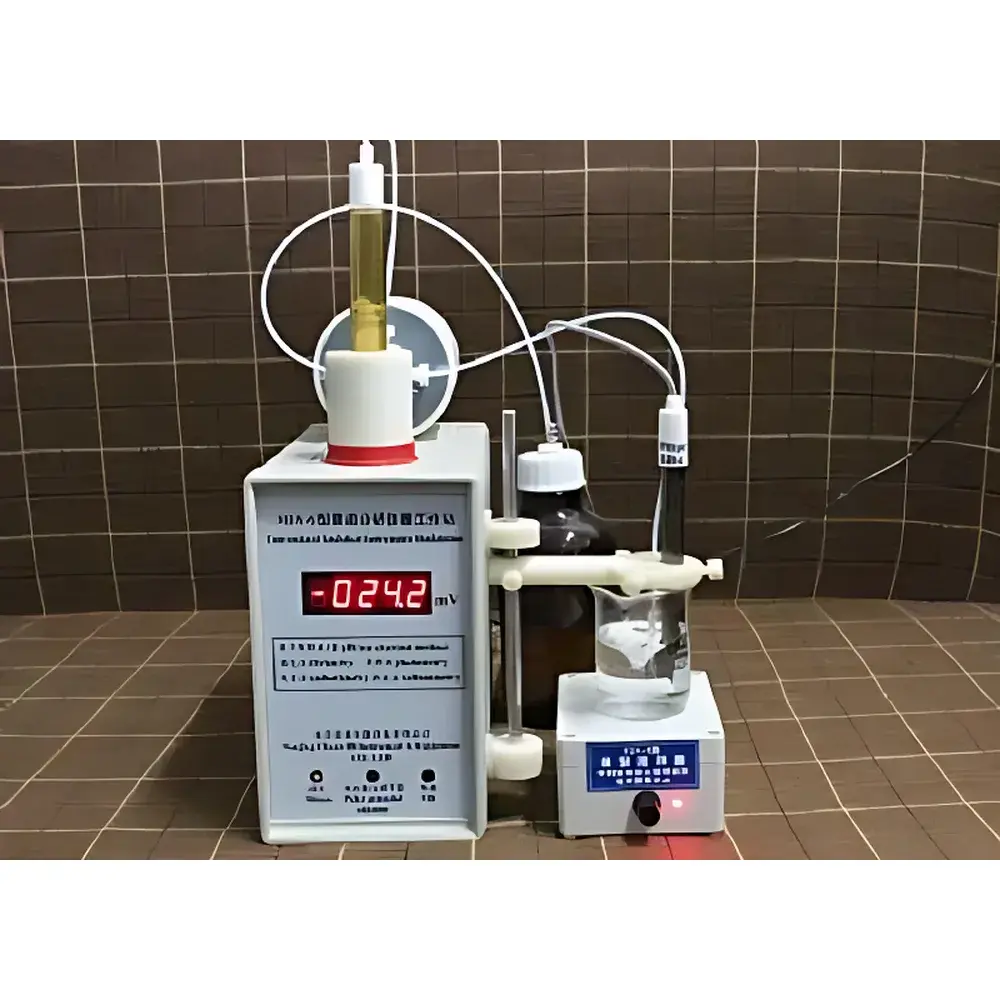
Chuandi MIA-6 (FJA-1) Advanced Multi-Function Automatic Potentiometric Titrator Workstation
| Brand | Chuandi |
|---|---|
| Origin | Jiangsu, China |
| Instrument Type | Universal Potentiometric Titrator |
| Voltage Measurement Range | −1999.9 mV to +1999.9 mV |
| Voltage Resolution | 0.1 mV |
| Voltage Accuracy | ±0.025% of reading ±2 digits |
| Input Impedance | >10¹² Ω |
| Titration Precision | 0.01 mL |
| Minimum Dispensed Volume | 0.001 mL |
| Titration Error | <0.2% (using 0.1 mol/L HCl vs. 0.1 mol/L NaOH) |
| Communication Interface | RS-232 (USB-compatible via adapter) |
| Software Modules | 25 preconfigured titration & analytical methods (potentiometric, photometric, amperometric, coulometric, Karl Fischer water determination, acid-base, redox, complexometric, precipitation, pH-metric, and endpoint detection algorithms) |
Overview
The Chuandi MIA-6 (FJA-1) Advanced Multi-Function Automatic Potentiometric Titrator Workstation is a modular, PC-controlled electrochemical analysis platform engineered for high reproducibility in volumetric and potentiometric determinations. It operates on the principle of potentiometric endpoint detection—measuring the potential difference between a reference electrode and an indicator electrode as titrant is incrementally delivered—enabling precise identification of stoichiometric equivalence points in acid-base, redox, complexometric, precipitation, and non-aqueous titrations. Unlike single-purpose titrators, the MIA-6 integrates hardware control with a Windows-based software suite supporting 25 standardized analytical protocols, including photometric titration (absorbance-based endpoint), amperometric titration (current monitoring), and volumetric Karl Fischer water determination. Its design prioritizes laboratory versatility: it replaces discrete instruments such as standalone pH meters, ion-selective electrode analyzers, conductimeters, dissolved oxygen meters, and conventional autotitrators—reducing capital expenditure and footprint in environmental, agricultural, pharmaceutical, and industrial QC labs.
Key Features
- DC 12 V motor-driven burette system delivering high-speed, low-pulsation reagent dispensing with programmable flow profiles
- User-replaceable 10 mL or 20 mL glass burettes—tool-free installation with integrated sealing and air purge functionality for rapid reagent changeover and cleaning
- High-input-impedance (>10¹² Ω) electrometer circuitry ensuring minimal loading error with high-resistance electrodes (e.g., Ag/AgCl, glass, ion-selective)
- Real-time voltage acquisition at 0.1 mV resolution across ±1999.9 mV range with automatic polarity recognition and auto-zero compensation
- Sub-microliter dispensing capability (minimum 0.001 mL increments) calibrated using included 100 g / 0.01 g precision balance per ASTM E2238 and ISO 8655-5 guidelines
- Compact benchtop form factor (W × D × H: 320 × 280 × 180 mm; mass: <4.5 kg) optimized for shared lab spaces and mobile field deployment
Sample Compatibility & Compliance
The MIA-6 supports aqueous, non-aqueous, and mixed-solvent systems across diverse sample matrices—including soil extracts, wastewater, pharmaceutical formulations, petrochemical distillates, and biological fluids. Its electrode interface accommodates standard BNC and banana-jack connectors compatible with commercial pH, redox, ion-selective, and combination electrodes. The system meets essential requirements for GLP-compliant workflows: all titration sequences, raw voltage/time data, endpoint calculations, and user annotations are timestamped and stored in encrypted binary format. Audit trails record operator ID, method version, calibration history, and manual interventions—supporting alignment with FDA 21 CFR Part 11 principles when deployed with validated Windows OS configurations and networked storage. While not certified to IEC 61000-6-3 EMC standards out-of-box, its RS-232 isolation and shielded analog front-end minimize electromagnetic interference in multi-instrument environments.
Software & Data Management
The workstation runs on Windows 10/11 (64-bit) with a native GUI featuring Chinese/English bilingual menus, context-sensitive help, and template-driven method setup. All 25 application modules—including neutralization (H⁺/OH⁻), argentometric (Cl⁻/Ag⁺), complexometric (Ca²⁺/EDTA), redox (Fe²⁺/Ce⁴⁺), Karl Fischer coulometric and volumetric water assays, and photometric endpoint detection (e.g., Fe³⁺–SCN⁻ absorbance)—are accessible via intuitive workflow wizards. Raw titration curves (E vs. V or dE/dV vs. V) are rendered in real time with adjustable smoothing, derivative overlays, and multiple endpoint algorithms (first/second derivative, inflection point, Gran plot). Data files (.MIA) store full metadata: electrode IDs, temperature logs, calibration coefficients, spike recovery records, and statistical summaries (RSD, confidence intervals). Export options include CSV, PDF reports (with lab header, signature fields, and revision control), and direct printing to networked thermal or laser printers.
Applications
The MIA-6 is routinely deployed in accredited environmental testing labs for EPA Method 300.0 (anions), ASTM D129 (sulfur in petroleum), and ISO 8245 (COD by dichromate titration); in agricultural labs for AOAC 971.22 (soil nitrate), ISO 11260 (exchangeable cations), and USDA-NRCS soil fertility panels (K⁺, Ca²⁺, Mg²⁺, P₂O₅); and in pharma QC for USP (acid value), (water content), and (redox titrations). Specific validated use cases include: sequential bicarbonate/carbonate alkalinity determination in drinking water; iodometric titration of residual chlorine in swimming pools; potentiometric assay of vanadium pentoxide (V₂O₅) in catalysts; amperometric titration of thiols in fuel oils; and photometric titration of calcium in dairy products using o-cresolphthalein complexone. Its modularity enables method transfer between labs without hardware modification—critical for multi-site regulatory compliance.
FAQ
Does the MIA-6 support GLP-compliant data integrity requirements?
Yes—full electronic records include immutable timestamps, operator authentication, audit trails, and exportable raw data archives meeting ALCOA+ principles.
Can endpoint detection be manually adjusted after titration completion?
Yes—the software allows retrospective endpoint re-evaluation using derivative, tangent, or Gran plot methods without re-running samples.
Is the system compatible with third-party electrodes and sensors?
Yes—all standard BNC and 4-mm banana-jack electrodes from Metrohm, Thermo Fisher, Hanna, and Cole-Parmer are supported.
What calibration protocols are recommended for voltage accuracy verification?
Use NIST-traceable Zener reference cells (e.g., Fluke 732B) at ±1000 mV and ±200 mV; verify linearity per IUPAC Technical Report on Potentiometry (Pure Appl. Chem., 2017, 89, 1239).
How is titrant delivery accuracy validated?
Gravimetric verification per ISO 8655-6 using the supplied 0.01 g precision balance and certified density standards for common titrants (e.g., 0.1 mol/L HCl, 0.1 mol/L AgNO₃).





