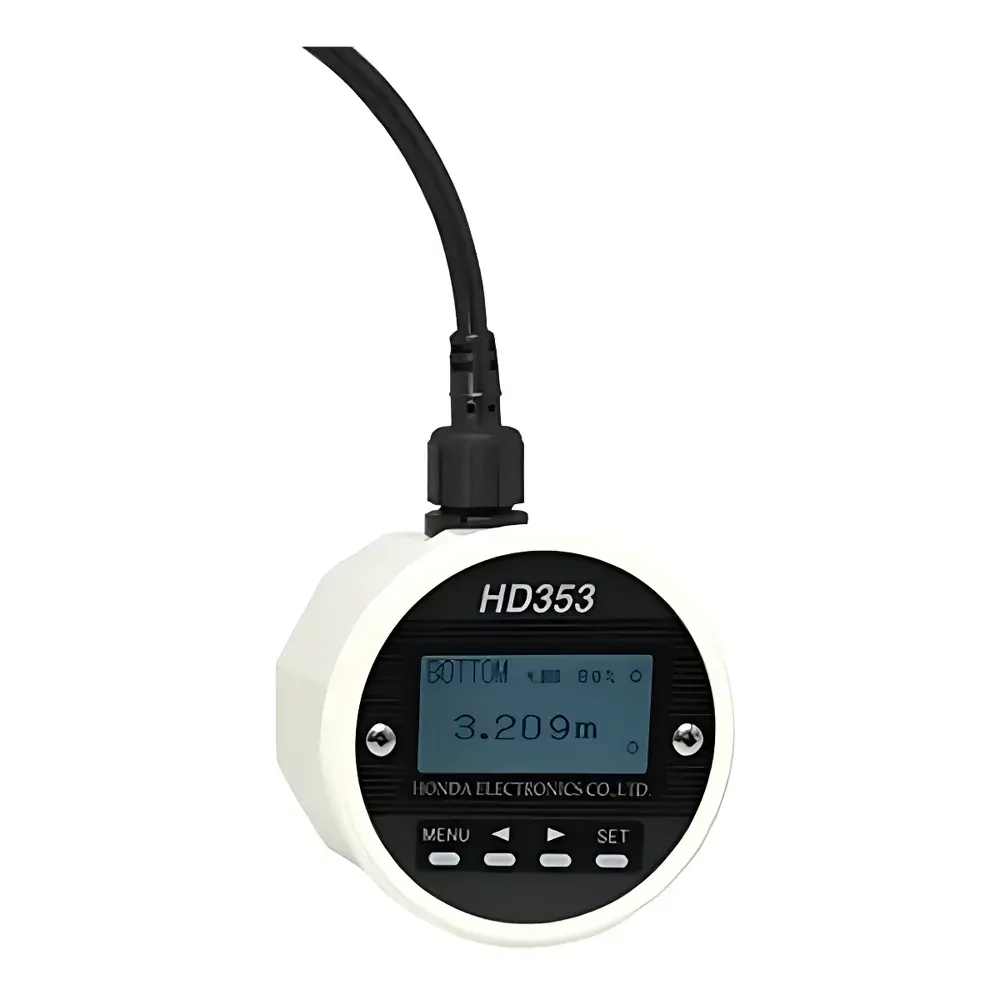
HONDA SANWA HD353-A Ultrasonic Level Transmitter
| Brand | SANWA |
|---|---|
| Origin | Japan |
| Model | HD353-A |
| Measuring Range | 0.3–10 m |
| Output | RS-485, 4–20 mA (12-bit), Dual Relay Alarms |
| Resolution | 1 mm (measurement & display) |
| Accuracy | ±0.25% FS (±2.5 cm) |
| Update Interval | 0.5 s |
| Frequency | 50 kHz |
| Beam Angle | 14° (half-power) |
| Power Supply | DC 12–24 V ±10% |
| Power Consumption | 3 W |
| Display | Graphical LCD |
| Enclosure Material | Polypropylene (PP) |
| IP Rating | IP65 (enclosed), IP20 (with cover open) |
| Operating Temperature | −20 to +70 °C |
| Dimensions | Ø93 × 110 mm |
| Weight | 350 g |
| Cable Length | 10 m |
| Mounting Thread | G2 (PF2) |
Overview
The HONDA SANWA HD353-A is a compact, industrial-grade ultrasonic level transmitter engineered for non-contact distance measurement in liquid and bulk solid applications. Based on time-of-flight (ToF) principle, it emits 50 kHz ultrasonic pulses and calculates distance by measuring the elapsed time between pulse transmission and echo return from the target surface. Designed for high environmental resilience, the device integrates transducer and electronics into a single, chemically resistant polypropylene (PP) housing rated IP65—ensuring reliable operation in humid, dusty, or mildly corrosive environments typical of water management, chemical storage, and process tank monitoring. Its fixed 14° beam angle enables focused sensing with minimal side-lobe interference, while the 0.5-second update interval supports real-time process feedback without latency-induced control instability.
Key Features
- Integrated sensor-and-controller architecture eliminates external cabling complexity and reduces installation footprint.
- Graphical LCD display visualizes A-scan waveforms in real time—enabling onsite diagnostics of signal integrity, echo strength, and false echo sources (e.g., tank obstructions or foam layers).
- Dual independent relay outputs support high/low level alarms with configurable hysteresis—critical for pump interlock, overfill prevention, and safety shutdown protocols.
- Simultaneous analog (4–20 mA, 12-bit resolution, max. 500 Ω load) and digital (RS-485 Modbus RTU) outputs enable seamless integration into PLCs, SCADA systems, and DCS architectures.
- Wide operating voltage range (DC 12–24 V ±10%) accommodates fluctuating field power supplies common in remote or solar-powered installations.
- Lightweight (350 g), compact form factor (Ø93 × 110 mm) and G2 (PF2) threaded mounting simplify retrofitting onto existing tanks, reservoirs, or flanged openings without structural modification.
Sample Compatibility & Compliance
The HD353-A is validated for continuous level monitoring of homogeneous liquids—including water, wastewater, oils, and mild acids—as well as free-flowing powders and granular solids with consistent surface reflectivity. It is unsuitable for highly absorptive media (e.g., thick foam, viscous sludge, or aerated suspensions) where acoustic energy attenuation exceeds detection thresholds. The device complies with IEC 61000-6-2 (immunity) and IEC 61000-6-4 (emission) standards for industrial environments. Its PP housing meets UL 94 HB flammability requirements and resists degradation from prolonged exposure to UV radiation, ozone, and dilute inorganic chemicals. While not certified for hazardous areas (ATEX/IECEx), its low-power design and non-sparking construction make it appropriate for Zone 2/Class I Div 2 installations when installed per local electrical codes.
Software & Data Management
Configuration and calibration are performed locally via the graphical LCD interface using intuitive menu navigation—no PC or proprietary software required. All parameter settings—including zero/span adjustment, damping coefficient, alarm thresholds, and output scaling—are stored in non-volatile memory and retained during power loss. RS-485 communication supports standard Modbus RTU protocol (slave ID, baud rate, parity), enabling integration with third-party supervisory systems that adhere to ISA-88 or ISA-95 data modeling conventions. Audit trails are not natively supported; however, external SCADA historians can log timestamped 4–20 mA values and alarm state transitions for GLP/GMP traceability when paired with compliant data acquisition hardware.
Applications
- Level monitoring in aboveground and underground storage tanks for potable water, fire protection reserves, and chemical feed solutions.
- Open-channel flow estimation in weirs and flumes via stage-to-discharge conversion using calibrated level data.
- Inventory control of dry bulk materials (e.g., cement, plastic pellets, grain) in silos and hoppers where dust accumulation precludes radar or guided-wave radar use.
- Environmental monitoring of natural water bodies—including rivers, lakes, and retention basins—where long-term stability and low maintenance are essential.
- Integration into automated dosing systems requiring precise fill-level feedback for batch-controlled reagent addition.
FAQ
Can the HD353-A measure through foam or vapor layers?
No. Foam, heavy condensation, or dense vapor plumes significantly attenuate ultrasonic energy and may cause measurement dropout or erroneous readings. For such conditions, guided-wave radar or capacitance-based alternatives are recommended.
What is the minimum measurable distance, and how is near-field blanking handled?
The device has a 0.3 m blind zone, below which echoes cannot be reliably distinguished from transducer ring-down. This is factory-set and non-adjustable to ensure measurement repeatability across units.
Is firmware upgrade capability available?
Firmware updates are not supported in the HD353-A. All operational logic is implemented in hardened ASICs to maximize long-term reliability and eliminate field update risks.
Does it support HART communication?
No. The analog output is conventional 4–20 mA only, without digital superimposed HART protocol. RS-485 is the sole digital interface.
How does temperature variation affect accuracy?
Internal temperature compensation corrects for speed-of-sound drift in air across the full −20 to +70 °C operating range. No external temperature sensor input is required or supported.