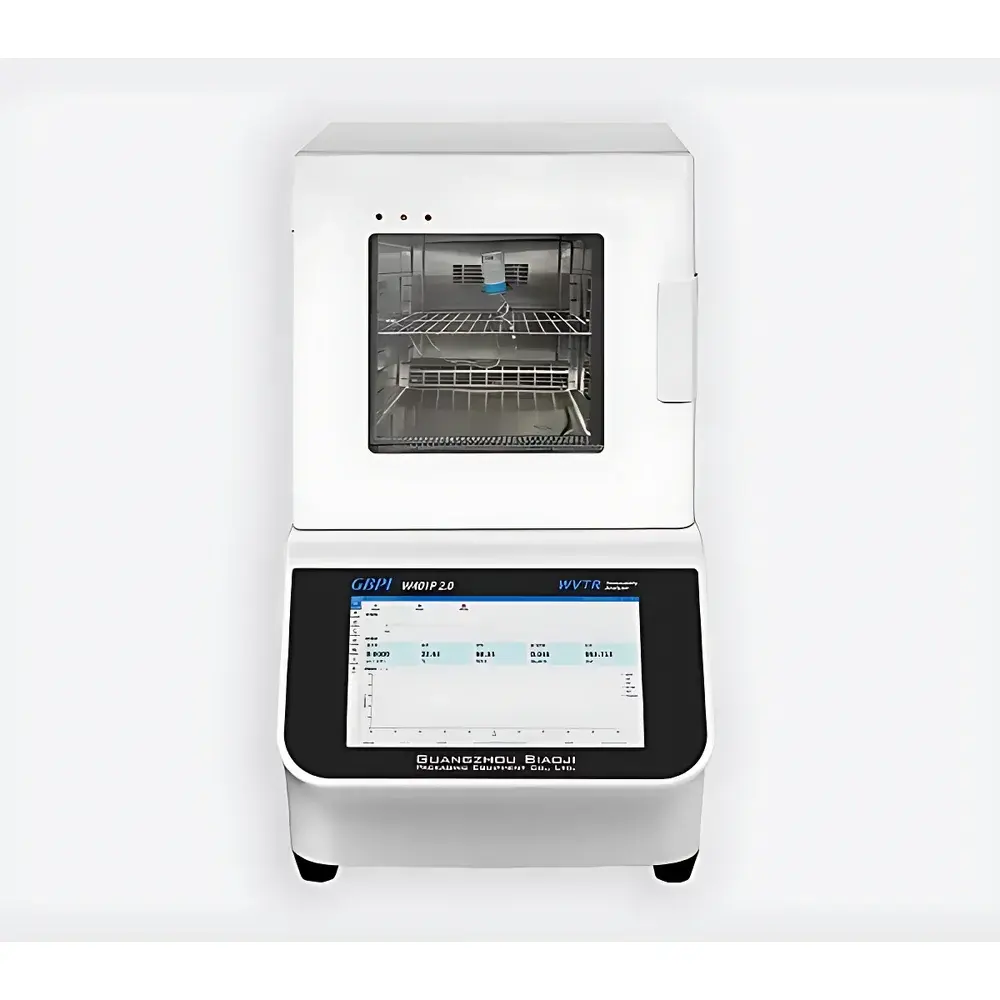
GBPI W401P 2.0 Infrared-Based Water Vapor Transmission Rate (WVTR) Tester for Packaged Goods
| Brand | GBPI |
|---|---|
| Origin | Guangdong, China |
| Manufacturer Type | Direct Manufacturer |
| Region Category | Domestic (China) |
| Model | W401P 2.0 |
| Price Range | USD 39,800 – 52,700 |
| Test Principle | Infrared Detection of Moisture Permeation |
| Standards Compliance | GB/T 31355-2014, GB/T 26253-2010, YBB 00092003, ChP IV <4010>, ASTM F1249, ISO 15106-2, JIS K7129 |
| Test Range (Packaged Goods) | 0.00001–0.5 g/(pkg·day) |
| Test Range (Film) | 0.002–100 g/(m²·24h) |
| Resolution (Packaged Goods) | 0.0001 g/(pkg·day) |
| Resolution (Film) | 0.0001 g/(m²·24h) |
| Temperature Control Range | 15–45 °C |
| Temperature Accuracy | ±0.5 °C |
| Humidity Control Range | 20–95 %RH |
| Humidity Accuracy | ±2 %RH |
| Sample Capacity | 1 packaged unit per test cycle |
| Carrier Gas Pressure | 0.1–0.2 MPa |
| Gas Interface | 1/8″ stainless steel tubing |
Overview
The GBPI W401P 2.0 Infrared-Based Water Vapor Transmission Rate (WVTR) Tester for Packaged Goods is an engineered solution for quantitative measurement of moisture permeation through sealed primary and secondary packaging systems. It operates on the principle of infrared absorption spectroscopy—where water vapor molecules traversing a test specimen are swept by ultra-dry nitrogen carrier gas into a high-sensitivity IR moisture sensor. The resulting analog signal is linearly correlated to mass flow rate, enabling direct calculation of WVTR in gravimetric units. Unlike gravimetric cup methods or electrolytic sensors, this system delivers real-time, non-destructive, and trace-level detection down to 0.00001 g/(pkg·day), making it suitable for evaluating high-barrier pharmaceutical blister packs, sterile medical device pouches, lithium-ion battery enclosures, and photovoltaic module laminates. Its dual-chamber design isolates the internal headspace of the package from ambient humidity gradients while maintaining precise, independent control of temperature and relative humidity across both sides of the diffusion path—ensuring thermodynamic equilibrium and compliance with ISO 15106-2’s defined test conditions.
Key Features
- Modular, field-replaceable packaging fixture architecture with quick-lock mounting—enabling tool-free installation and removal of test specimens including bottles, BFS containers, collapsible tubes, trays, stand-up pouches, and lidding foils.
- Dual-zone environmental control: semiconductor-based Peltier modules provide bidirectional temperature regulation (15–45 °C, ±0.5 °C), while a precision humidification system maintains stable RH (20–95 %RH, ±2 %RH) in the external chamber.
- Integrated 2.5 L reservoir supports unattended operation for up to 120 hours—critical for validating long-term barrier integrity of solar panel encapsulants and implantable drug delivery systems.
- Compliant embedded software platform supporting user role management, electronic signatures, audit trail logging, and automated report generation—fully aligned with FDA 21 CFR Part 11 and EU Annex 11 requirements for computerized systems in regulated environments.
- Real-time data visualization interface with configurable curve overlays, automatic endpoint detection, and intelligent pause/resume functionality during power interruptions or manual interventions.
- USB 3.0 port and optional Ethernet connectivity for secure local backup, remote diagnostics via GBPI LabLink™ IoT gateway, and integration with LIMS or MES platforms using HL7 or ASTM E1384-compliant protocols.
Sample Compatibility & Compliance
The W401P 2.0 accommodates rigid, semi-rigid, and flexible packaged goods without requiring sample cutting or edge sealing—eliminating boundary leakage artifacts common in film-only testers. Customizable fixtures extend compatibility to irregular geometries such as syringe barrels, inhaler canisters, and vacuum-sealed trays. All hardware and firmware comply with ISO/IEC 17025 calibration traceability frameworks. Certified reference materials—including NIST-traceable low- and high-permeability standard films—are supplied directly by GBPI’s National Standard Substance Production Unit (CNAS-certified), enabling on-site verification and interval calibration per ISO 17034 guidelines. Method validation documentation supports GLP/GMP audits under ICH Q5C, USP , and EP 2.6.29.
Software & Data Management
GBPI SmartBarrier OS v3.2 provides full lifecycle data governance: from method creation and instrument qualification (IQ/OQ/PQ templates included) to raw data archiving and e-signature-enabled reporting. Audit trails record every parameter change, user login/logout event, and result modification with immutable timestamps. Export formats include CSV, PDF/A-2b, XML (ASTM E2500-21), and encrypted SQLite databases compatible with statistical process control (SPC) tools. Optional 21 CFR Part 11 Module adds biometric authentication, digital certificate binding, and multi-tiered approval workflows for QA/QC release decisions.
Applications
- Pharmaceutical packaging: Stability assessment of child-resistant blister cards, desiccant-containing HDPE bottles, and cold-chain transport shippers.
- Medical device packaging: Validation of Tyvek®-based sterile barrier systems per ISO 11607-1 and AAMI ST77.
- Food & beverage: Shelf-life modeling of retort pouches, coffee capsules, and modified atmosphere packaging (MAP).
- Electronics: Barrier performance evaluation of conformal coatings and moisture-sensitive component carriers.
- Renewable energy: Long-duration WVTR monitoring of ethylene-vinyl acetate (EVA) encapsulants in PV modules per IEC 61215-2 MQT10.
FAQ
What types of packaged goods can be tested without modification?
Standard fixtures support cylindrical bottles (up to Ø120 mm × H250 mm), flat-bottom trays (max 180 × 180 mm), and pouches with seal widths ≥15 mm. Custom fixtures are available for aerosol cans, ampoules, and tubular sachets.
Is nitrogen purity critical for accurate results?
Yes. Carrier gas must be ≥99.999% pure N₂ with hydrocarbon and oxygen impurities below 1 ppmv. GBPI recommends inline purification filters and pressure-regulated supply at 0.15 MPa ±0.02 MPa.
How often does the IR sensor require recalibration?
Annual factory recalibration is recommended; however, daily zero-point verification using dry nitrogen and quarterly span checks with certified reference films satisfy ISO/IEC 17025 interim verification requirements.
Can the system operate under accelerated aging conditions?
No. The W401P 2.0 is designed strictly for isothermal-isohygrometric testing per ASTM F1249 and ISO 15106-2. Accelerated conditions require separate Arrhenius modeling based on multiple temperature/humidity setpoints.
Does the software support multi-language interfaces and regional regulatory templates?
Yes. UI languages include English, German, French, Japanese, and Simplified Chinese. Preloaded templates cover FDA, PMDA, NMPA, and EMA submission formats for barrier validation dossiers.
Related Products