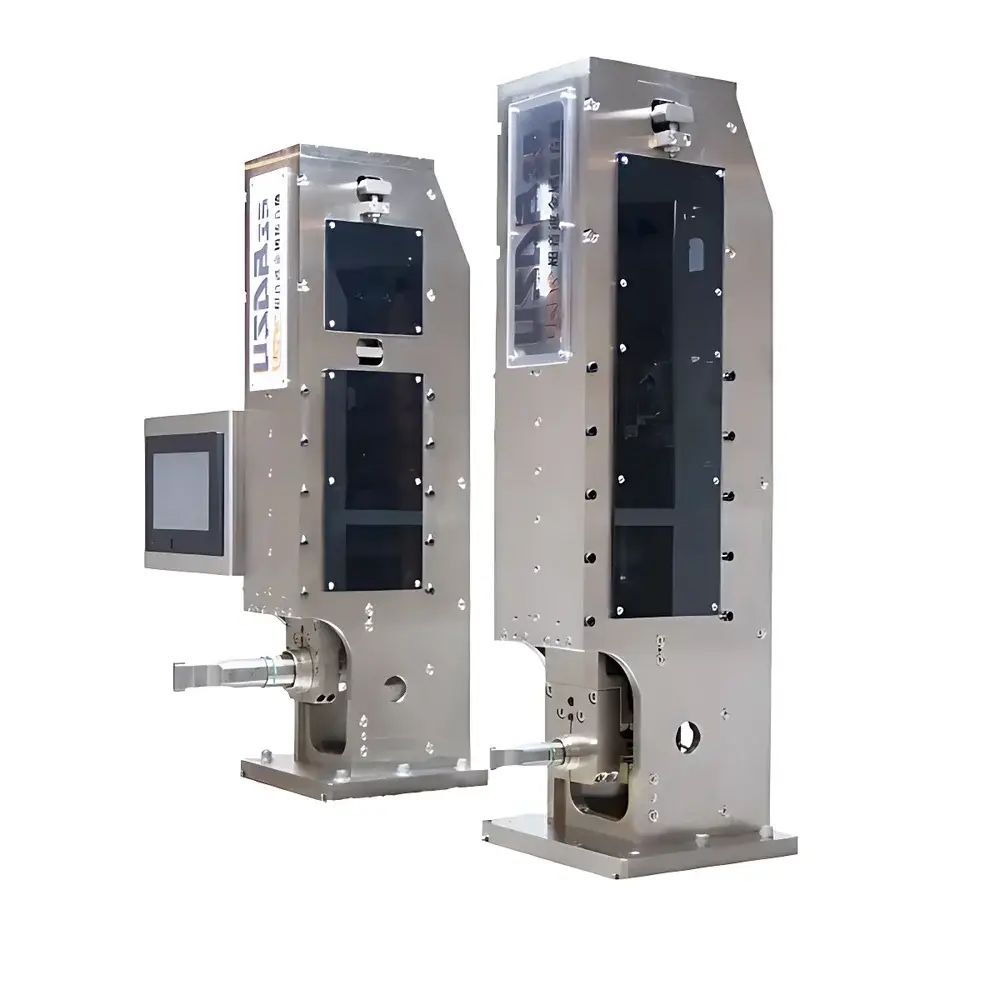
UTHE USDB35kHz/20kHz Ultrasonic Metal Welding System (Imported from Japan, CocoResearch Distribution)
| Brand | CocoResearch |
|---|---|
| Origin | Japan |
| Model | USDB35kHz/20kHz |
| Frequency Options | 20 kHz / 35 kHz |
| Output Power | 3000 W (20 kHz) / 900 W (35 kHz) |
| Welding Force Range | 100–3000 N |
| Positioning Accuracy | ±1 µm |
| Control Interface | Ethernet/IP-enabled HMI with color touchscreen |
| Compliance | Designed for ISO 9001-compliant manufacturing environments |
| Sample Compatibility | Wire-to-wire (0.35–5.5 mm²), wire-to-sheet (0.35–40 mm², thickness 0.2–3.0 mm), sheet-to-sheet (0.2–3.0 mm), foil-to-foil (6–13 µm × N) |
| Primary Materials | Aluminum, copper, nickel, and alloys |
Overview
The UTHE USDB35kHz/20kHz Ultrasonic Metal Welding System is a high-precision, dual-frequency industrial welding platform engineered for reproducible solid-state joining of non-ferrous metals—primarily aluminum, copper, and nickel—without melting or filler material. Based on ultrasonic vibration-assisted plastic deformation at the interface, this system operates via longitudinal mechanical oscillation transmitted through a titanium or aluminum alloy horn (sonotrode) to generate localized frictional heat and atomic-level bonding under controlled static pressure. Developed in collaboration between UC (a Swiss-Japanese ultrasonic transducer pioneer since 1966) and RINCO Ultrasonics AG, the USDB integrates a Swiss-engineered ultrasonic generator with digital adaptive impedance matching, coupled to a Japanese-built servo-electric press mechanism. Its monolithic single-axis rigid frame architecture minimizes mechanical compliance, enabling sub-micron positioning repeatability (±1 µm) and real-time load-following response—critical for consistent weld integrity across variable joint geometries and material thicknesses.
Key Features
- Dual-frequency operation (20 kHz @ 3000 W / 35 kHz @ 900 W) optimized for distinct application profiles: 20 kHz delivers higher energy transfer for thicker sections (e.g., busbar-to-terminal), while 35 kHz enables finer control for thin foils and delicate wire bonds.
- Servo-motor-driven linear actuation with closed-loop force feedback ensures precise, programmable weld force (100–3000 N) and dynamic load compensation during vibration onset and decay phases.
- EtherNet/IP connectivity supports seamless integration into Industry 4.0 production lines, enabling centralized recipe management, remote diagnostics, and time-synchronized weld parameter logging (amplitude, force, duration, energy, displacement).
- Intuitive color touchscreen HMI with graphical waveform display allows real-time monitoring of ultrasonic current, phase angle, and displacement—facilitating immediate process validation and root-cause analysis.
- Integrated protection logic prevents transducer overload, horn fracture, or servo stall via real-time impedance deviation detection and automatic shutdown with event-stamped fault logging.
- Modular tooling interface supports rapid horn and anvil exchange while maintaining mechanical rigidity and positional repeatability—essential for multi-product cell deployment.
Sample Compatibility & Compliance
The USDB accommodates diverse metallic configurations common in battery manufacturing, power electronics, and automotive harness assembly: wire-to-wire (0.35–5.5 mm² cross-section), wire-to-sheet (0.35–40 mm², t = 0.2–3.0 mm), sheet-to-sheet (t = 0.2–3.0 mm), and ultra-thin foil stacks (6–13 µm per layer). Material compatibility extends to oxygen-free copper (OFHC), 1050/1060/3003 aluminum alloys, nickel 200/201, and selected clad materials—subject to amplitude and force optimization per joint design. The system is engineered to support GLP/GMP-aligned documentation workflows; all weld logs include timestamped metadata compliant with FDA 21 CFR Part 11 requirements when deployed with validated software extensions. Mechanical design adheres to ISO 14120 (machine guarding) and IEC 60204-1 (electrical safety), with CE marking applicable for EU market deployment.
Software & Data Management
Firmware-controlled data acquisition records up to 10 kHz sampling of ultrasonic current, voltage, phase, and displacement—enabling full-cycle waveform reconstruction for statistical process control (SPC). Export formats include CSV and HDF5, compatible with MATLAB, Python (NumPy/Pandas), and MES platforms such as Siemens Opcenter or Rockwell FactoryTalk. Optional cloud gateway modules support TLS-encrypted upload to AWS IoT Core or Azure IoT Hub for fleet-wide analytics. Audit trails capture operator ID, program version, calibration status, and environmental timestamps—meeting traceability requirements under ISO/IEC 17025 and IATF 16949. Customizable pass/fail thresholds trigger automated alerts and reject flagging within integrated vision inspection systems.
Applications
Primary use cases include lithium-ion battery tab welding (anode/cathode foil stacking), power module interconnects (IGBT substrates, SiC die attach), EV busbar assembly, medical device sensor lead bonding, and aerospace-grade harness termination. The system’s ability to maintain consistent bond strength across variable surface oxides and minor contamination—without pre-cleaning or flux—makes it suitable for high-mix, low-volume R&D prototyping as well as high-throughput production cells. Its deterministic energy delivery eliminates thermal damage zones observed in resistance welding, preserving metallurgical integrity in heat-sensitive substrates.
FAQ
What frequency should I select for aluminum busbar welding (2 mm thickness)?
For 2 mm aluminum busbars, 20 kHz operation is recommended to ensure sufficient penetration depth and interfacial shear stress; output power is typically set between 2200–2800 W with 1500–2500 N static force.
Can the USDB be integrated with robotic handling systems?
Yes—EtherNet/IP and optional RS-485/Modbus TCP interfaces enable synchronized motion coordination with ABB, KUKA, and Universal Robots controllers via standard PLC communication protocols.
Is weld parameter validation supported per ISO 14273?
While the USDB itself is not certified to ISO 14273 (ultrasonic welding of metallic materials), its data fidelity and traceability infrastructure fully support user-executed validation protocols—including tensile testing correlation, microstructural analysis, and statistical capability studies (Cpk ≥ 1.33).
How often does the ultrasonic transducer require recalibration?
Transducer resonance frequency drift is monitored continuously; annual verification against NIST-traceable reference standards is recommended, with calibration certificates available through authorized service centers in Germany, Japan, and North America.
Related Products