
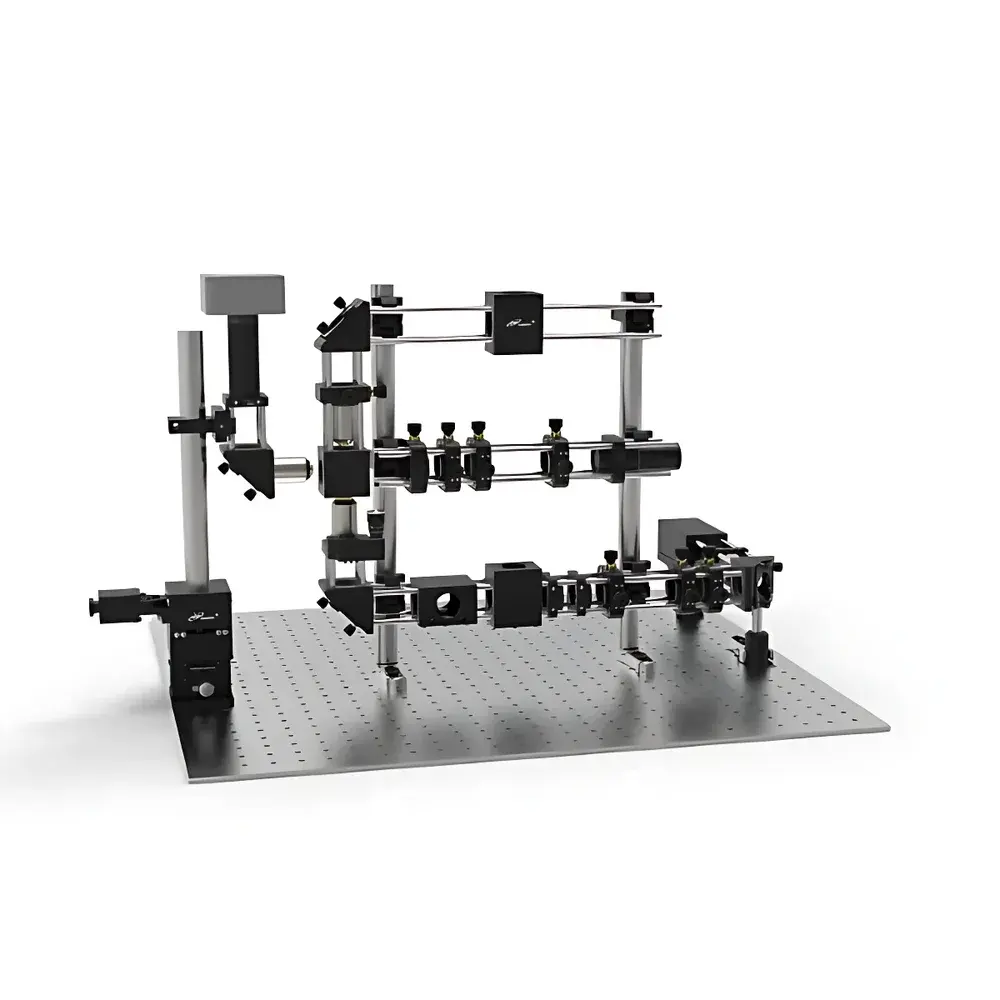
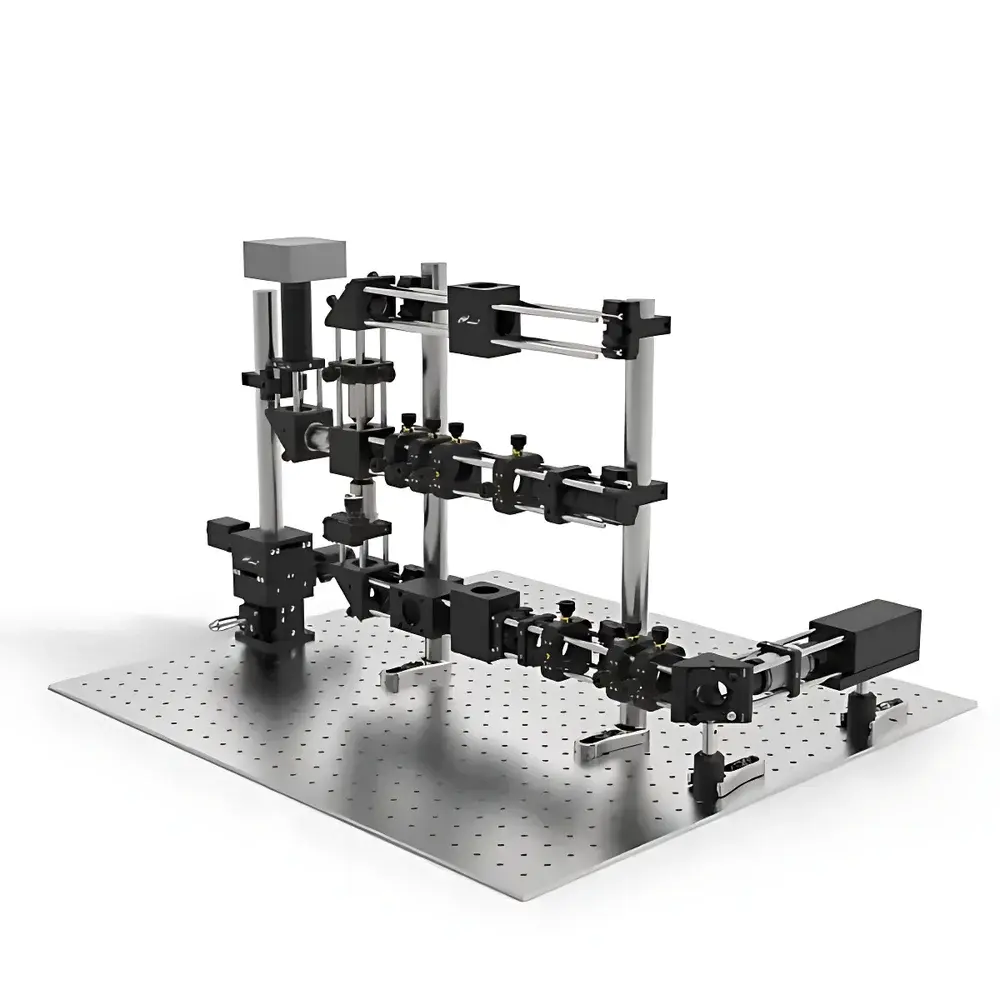
Abner Optical Tweezers System
| Brand | Abner |
|---|---|
| Origin | Jiangsu, China |
| Manufacturer Type | Authorized Distributor |
| Country of Origin | PRC |
| Model | Optical Tweezers System |
| Laser | 1064 nm, 1 W, TEM₀₀ mode |
| XY Stage | Motorized, 10 mm travel, 2.5 µm resolution, manual joystick control |
| Z Axis | Manual adjustment, 10 mm travel, 2.5 µm resolution |
| Illumination | White LED, 5000 K CCT, 1100 mW output, 350–700 nm spectral range, 100 mm working distance, LEC1-B controller |
Overview
The Abner Optical Tweezers System is a research-grade laser-based manipulation platform engineered for quantitative force measurement and sub-micron positional control of dielectric micro- and nano-scale objects in aqueous or viscous media. Based on the principle of radiation pressure gradient forces generated by tightly focused near-infrared (NIR) laser light—specifically at 1064 nm—the system enables non-contact trapping, translation, rotation, and dynamic force spectroscopy of colloids, biological cells, organelles, DNA-protein complexes, and synthetic nanoparticles. Its TEM₀₀ Gaussian beam profile ensures diffraction-limited focusing and high spatial stability, essential for reproducible piconewton-scale force calibration (e.g., via power spectrum analysis or drag calibration). Designed for integration into inverted microscopy workstations, the system supports real-time observation through transmitted white-light illumination and is optimized for low photodamage environments—critical for live-cell biophysics and single-molecule studies.
Key Features
- High-stability 1064 nm NIR laser source (1 W max output, TEM₀₀ mode) with integrated beam conditioning optics for optimal trap stiffness and axial confinement.
- Precision motorized XY translation stage with 10 mm travel range and ≤2.5 µm closed-loop positioning resolution; dual-mode operation via software interface or ergonomic manual joystick.
- Manually adjustable Z-axis fine-focus mechanism (10 mm travel, 2.5 µm mechanical resolution) for rapid objective-sample alignment and trap depth optimization.
- Dedicated broadband white-light illumination module (350–700 nm, 5000 K CCT, 1100 mW total radiant flux) with 100 mm working distance—compatible with standard 40×–100× oil-immersion objectives and enabling simultaneous brightfield/DIC/phase contrast imaging.
- Integrated LEC1-B LED controller with analog/digital input compatibility, enabling synchronized illumination modulation during time-resolved trapping experiments.
- Modular architecture supporting third-party camera integration (USB3/PCIe), piezoelectric positioners, and external force calibration hardware (e.g., quadrant photodiode detection or back-focal-plane interferometry).
Sample Compatibility & Compliance
The Abner Optical Tweezers System accommodates standard 35 mm glass-bottom Petri dishes, No. 1.5 coverslips (0.17 mm thickness), and custom microfluidic chambers (up to 2 mm height). It is routinely deployed in GLP-aligned laboratories conducting ASTM E2919-compliant single-particle tracking, ISO/IEC 17025 traceable force calibration workflows, and USP <1058>–validated instrument qualification protocols. While not pre-certified for FDA 21 CFR Part 11, the system’s data acquisition software supports audit-trail-enabling configurations—including user authentication, electronic signatures, and immutable raw-data export (HDF5/CSV)—to facilitate GMP-relevant documentation requirements.
Software & Data Management
The system ships with AbnerTweezerControl v3.x—a cross-platform (Windows/Linux) application built on Qt and Python-based scientific libraries (NumPy, SciPy, OpenCV). Core capabilities include real-time trap position mapping, multi-particle trajectory reconstruction (≥50 fps), auto-focus-assisted Z-locking, and passive force calibration using equipartition or power spectral density (PSD) methods. All experimental metadata—including laser power logs, stage coordinates, illumination settings, and timestamped video streams—are embedded in HDF5 containers compliant with the NeXus format standard. Raw datasets are exportable without proprietary codec dependencies, ensuring long-term accessibility and interoperability with MATLAB, Python, or ImageJ/Fiji pipelines.
Applications
- Single-molecule biophysics: Unfolding kinetics of proteins and nucleic acids under controlled load; motor protein stepping assays (kinesin, myosin, dynein).
- Cell mechanics: Quantification of cytoskeletal viscoelasticity via particle-tracking microrheology; membrane tether formation and rupture force analysis.
- Nanomaterial characterization: Colloidal stability assessment, interparticle interaction mapping, and directed assembly of plasmonic nanoparticle dimers.
- Microfluidic integration: On-chip particle sorting, concentration gradient generation, and hydrodynamic trap array synchronization.
- Educational use: Undergraduate and graduate-level labs demonstrating optical momentum transfer, Brownian motion statistics, and linear response theory.
FAQ
Is the 1064 nm laser suitable for live-cell experiments?
Yes—1064 nm lies in the optical transparency window of water and cellular components, minimizing absorption-induced heating and phototoxicity compared to visible or UV wavelengths.
Can the system be upgraded to support holographic optical tweezers (HOT)?
The current configuration uses a single-beam Gaussian trap; however, the optical path includes a free-space relay port compatible with optional spatial light modulator (SLM) integration for multi-trap expansion.
What is the typical trap stiffness range achievable with this setup?
Under standard conditions (1.3 NA oil immersion, 1 µm polystyrene sphere, 500 mW incident power), calibrated stiffness ranges from 0.05 to 0.3 pN/nm in water at 25 °C.
Does the system include force calibration tools?
Yes—software-embedded protocols for both passive (thermal fluctuation) and active (drag-based) calibration are provided, with reference datasets and uncertainty propagation models aligned with ISO/IEC Guide 98-3 (GUM).
Is technical support available outside China?
Abner provides remote application engineering support globally via secure screen-sharing and encrypted data exchange; on-site service is coordinated through authorized regional partners in Europe, North America, and APAC.




