
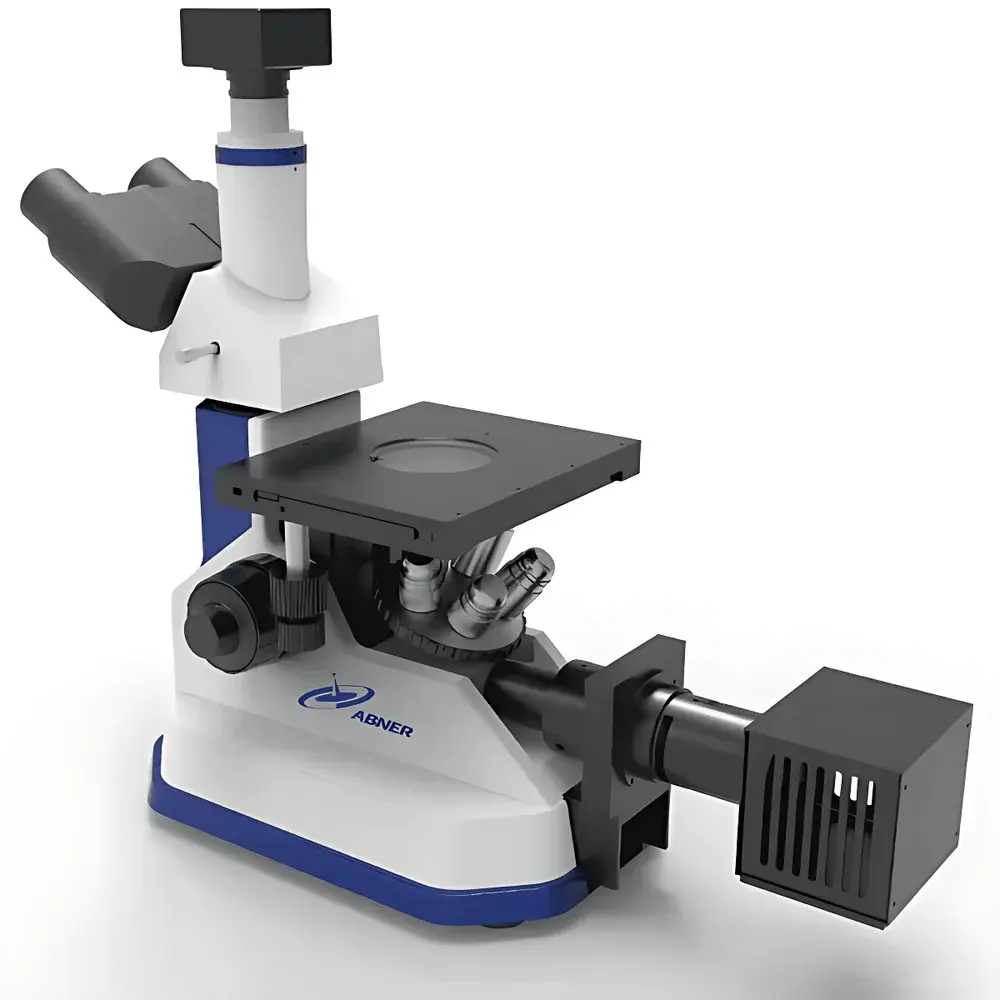
Abner ABN-IMM-001 Inverted Metallurgical Microscope
| Brand | Abner |
|---|---|
| Origin | Jiangsu, China |
| Model | ABN-IMM-001 |
| Configuration | Inverted |
| Eyepiece | Wide-field Achromatic SWF10X (Φ22 mm) |
| Image Analysis System | Integrated |
| Category | Domestic Manufacturer (Distributor-sourced) |
Overview
The Abner ABN-IMM-001 Inverted Metallurgical Microscope is an engineered optical instrument designed for high-fidelity microstructural characterization of opaque, solid-state materials—including metals, alloys, ceramics, semiconductors, and advanced composites. Unlike upright metallurgical microscopes, the inverted configuration positions the objective lenses beneath the specimen stage, with illumination delivered from below via a reflected-light Köhler optical path. This architecture provides enhanced stability for large, heavy, or irregularly shaped samples—particularly those mounted in metallographic hot-pressed mounts or embedded in resin blocks—and eliminates interference from sample holders or stage accessories during high-magnification observation. The system employs an infinity-corrected optical pathway, enabling consistent chromatic and spherical aberration correction across magnifications and supporting modular integration of contrast-enhancing modules such as brightfield, darkfield, polarized light, and differential interference contrast (DIC). Its mechanical rigidity and thermal stability make it suitable for extended-duration imaging sessions under controlled laboratory conditions.
Key Features
- Inverted optical layout optimized for metallurgical specimens up to 50 mm in height and 150 mm in diameter, accommodating standard 30–50 mm metallographic mounts without repositioning.
- Infinity-corrected optical train with parfocal, parcentric objectives (5×, 10×, 20×, 50×, 100× oil immersion optional) ensuring uniform focus and field alignment across magnifications.
- Wide-field achromatic eyepieces (SWF10X, 22 mm field number) delivering ergonomic viewing and compatibility with phototube output for simultaneous visual inspection and digital capture.
- Reflected-light illumination system with adjustable LED cold white light source (6,000 K CCT), intensity control, and integrated heat-absorbing filter to minimize thermal drift during prolonged observation.
- Coaxial coarse/fine focusing mechanism with 0.002 mm fine-focus graduation and torque-limiting clutch to prevent objective-sample contact during operation.
- Pre-aligned mechanical stage with X-Y translation (75 × 50 mm travel), vernier scale, and specimen clamp for repeatable positioning and serial section analysis.
Sample Compatibility & Compliance
The ABN-IMM-001 supports standard metallographic sample preparation protocols per ASTM E3, ISO 643, and GB/T 13298. It accommodates polished, etched, or coated specimens—whether bulk sections, fracture surfaces, cross-sectioned coatings, or thin-film interfaces—without requiring top-side access. The inverted design enables direct integration with hardness testers, thermal stages, or in-situ tensile fixtures (via optional mounting adapters). All optical components comply with ISO 10110 surface quality standards; the LED illumination meets IEC 62471 photobiological safety Class 1 requirements. While not certified for GMP/GLP environments out-of-the-box, the system supports audit-ready documentation when paired with validated image analysis software compliant with FDA 21 CFR Part 11 (e.g., timestamped metadata, user authentication, and electronic signature capability).
Software & Data Management
The microscope ships with Abner ImagePro-Metallurgy Suite—a CE-marked, Windows-based application supporting real-time streaming, multi-layer annotation, grain size quantification (ASTM E112, ISO 643), phase area fraction analysis, inclusion rating (ASTM E45), and automated particle counting. Raw image data is saved in TIFF or proprietary .ABN format with embedded EXIF metadata (magnification, objective ID, exposure time, lamp intensity). The software includes calibration traceability tools, report generation templates aligned with ISO/IEC 17025 reporting guidelines, and export options for CSV, PDF, and XML formats compatible with LIMS integration. Optional DIC module firmware enables quantitative retardation mapping for birefringent phases (e.g., martensite, graphite flakes).
Applications
- Quantitative metallography: grain boundary delineation, ASTM grain size determination, and second-phase particle distribution analysis in steels, aluminum alloys, and titanium grades.
- Failure analysis: identification of fatigue striations, intergranular cracking, void coalescence, and weld zone microstructure evaluation (HAZ, fusion line, base metal).
- Process validation: monitoring microstructural evolution during heat treatment (annealing, quenching, tempering), thermo-mechanical processing, or additive manufacturing post-processing.
- Semiconductor packaging inspection: die attach integrity, wire bond interface morphology, and solder joint microstructure in power modules.
- Academic instruction: standardized curriculum delivery for undergraduate metallurgy labs, including hands-on practice in etchant selection, contrast optimization, and stereological measurement principles.
FAQ
Is the ABN-IMM-001 compatible with third-party digital cameras?
Yes—the trinocular port features a standardized C-mount interface (1× or 0.5× reduction option) and supports USB3.0 and HDMI output for OEM and industrial-grade CMOS sensors.
Can darkfield and polarized contrast be added post-purchase?
Yes—both modules are field-upgradeable via factory-supplied kits with pre-aligned sliders and strain-free analyzers.
What is the maximum usable magnification with standard objectives?
With the 100× oil-immersion objective and 10× eyepieces, total magnification reaches 1000×; resolution is limited by visible-light diffraction (~0.2 µm at 550 nm wavelength).
Does the system support automated stage scanning or motorized focus?
Not by default—but the microscope frame includes M4 threaded mounting points and TTL trigger ports for integration with third-party motorized stages and autofocus controllers.
Is technical support available outside mainland China?
Abner provides remote diagnostics and English-language application engineering support through authorized regional distributors in Southeast Asia, the Middle East, and Latin America; firmware updates and calibration certificates are distributed via secure portal access.




